
DID REMBRANDT HAVE TITIAN IN MIND?
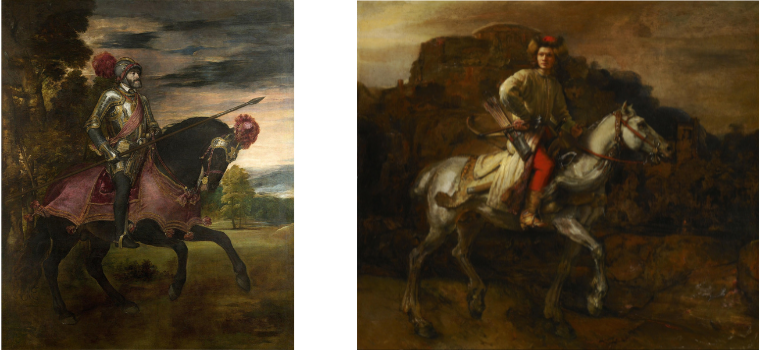
Titian, Equestrian Portrait of Charles V, 1548, Museo del Prado, Madrid (left) Rembrandt, The Polish Rider, 1650s, The Frick Museum, New York (right)
While reading Amy Butler Greenfield’s A Perfect Red, I came across Titian’s portrait of Charles V on horseback.
The moment I saw it, I thought of Rembrandt’s The Polish Rider.
That surprised me. I do not know Rembrandt’s work particularly well, and I had never seen the two paintings discussed together. But the connection was immediate. Not scholarly. Not proven. Just visual.
There they were: two riders, two horses, two paintings separated by roughly a century, and something in the structure of one seemed to call out to the other.
Did Rembrandt know Titian’s painting?
I do not know.
Rembrandt never went to Italy. There is no record, as far as I can tell, that he saw Titian’s Charles V at Mühlberg in person. But Rembrandt knew Italian art. Artists carry pictures in their heads. Sometimes they carry them without knowing exactly where one image ends and another begins.
What struck me was not simply that both paintings show a man on horseback. That is not rare. Equestrian portraits are practically built for power. Put a man on a horse and you have already announced rank, command, wealth, danger, and the ability to remain upright while another living creature moves beneath you.
What struck me first was the red.
In Titian’s portrait, red appears at Charles’s head, across his body, and again in the horse’s trappings. The red makes a triangle. It holds the emperor inside the picture. It moves the eye from the plume to the sash to the horse and back again. The color is not decorative. It is structural.
Then I looked at Rembrandt.
The Polish Rider has his own red triangle: the cap, the trousers, the bridle and tack. It is not the same arrangement, but it performs a similar act. The red binds horse and rider together. It gives the picture its pulse.
Once I saw that, I could not stop seeing the two paintings together.
Titian gives us a mature emperor on a dark horse. Rembrandt gives us a young rider on a pale one.
Charles wears armor. The Polish Rider wears a tunic.
Charles looks in the direction his horse is moving. The Polish Rider turns toward us.
Titian’s horse is controlled. Rembrandt’s horse seems almost inseparable from the body above it.
That may be the biggest difference between the two paintings. In Titian, authority comes from command. Charles sits upright, armored, composed. The horse has energy, but the emperor contains it. Man and animal move as one because the man has mastered the animal.
In Rembrandt, the relationship is stranger. The rider does not feel as if he is commanding the horse so much as emerging with it. Horse and rider make a single presence. The horse moves forward. The rider turns back. The landscape is dark, uncertain, almost dreamlike. Nothing in the painting feels settled.
Charles knows who he is.
The Polish Rider may not.
That is part of the spell.
The known man looks away from us. The unknown man looks back.
I am less interested in proving influence than in noticing the conversation. Art history needs evidence, and rightly so. But looking has its own intelligence. Sometimes one painting calls another to mind because there is a documented line of influence. Sometimes it is coincidence. Sometimes the connection is structural, a visual problem that keeps returning because artists keep needing it.
How do you put a person on a horse and make it mean more than transportation?
How do you make red carry power?
How do you organize movement across a canvas without letting the rider gallop out of the frame?
Titian gives one answer. Rembrandt gives another.
In Titian, the red is imperial. It belongs to armor, victory, command, statecraft, and ceremony.
In Rembrandt, the red is more intimate and more unstable. It belongs to the body. It flares in the cap, trousers, and tack, but it does not explain the painting. If anything, it deepens the mystery.
One painting presents authority through command.
The other presents authority through presence.
Whether Rembrandt had Titian’s rider somewhere in his mind, I cannot say. But once I saw the two paintings together, they seemed to recognize each other across a hundred years of painting.
FOR THOSE WHO LIKE TO WATCH PAINT DRY
The material story makes the red even more interesting.
Titian cared deeply about the red in Charles V at Mühlberg. While working in Augsburg in 1548, he had red lake sent from Venice because he wanted a color brilliant enough to compete with actual silk and velvet. Red lake was a translucent pigment made from dye, and by this period cochineal, the insect dye from the Americas, had become one of the great sources of intense red.
This matters because Titian’s red does not sit on the painting like a flat patch of color. It glows. Red lake was often used in glazes, thin layers of transparent color built over other paint. That is how red becomes deep rather than merely bright. It is not just red. It is red, with light trapped inside.
By Rembrandt’s time, cochineal red lake was part of the painter’s world. Rembrandt used red not only where we see red, but also often inside darkness itself. That is one reason his shadows feel alive. They are not simply black or brown. They contain warmth.
That is a useful thing to remember when looking at The Polish Rider. The mystery of the painting is not only iconographic. It is material. The atmosphere has been made of layers, glazes, darks warmed from beneath, and colors that have shifted over time.
Even the painting itself has not remained stable. A strip was added along the bottom after damage, and parts of the horse’s legs and hooves were later restored. So when we look at The Polish Rider, we are looking at Rembrandt, time, damage, repair, argument, and chemistry.
Which seems right.
A painting this mysterious should have a seam in it.