
LE JAPON ARTISTIQUE: THE MAGAZINE THAT CARRIED JAPAN INTO THE HEART OF EUROPE
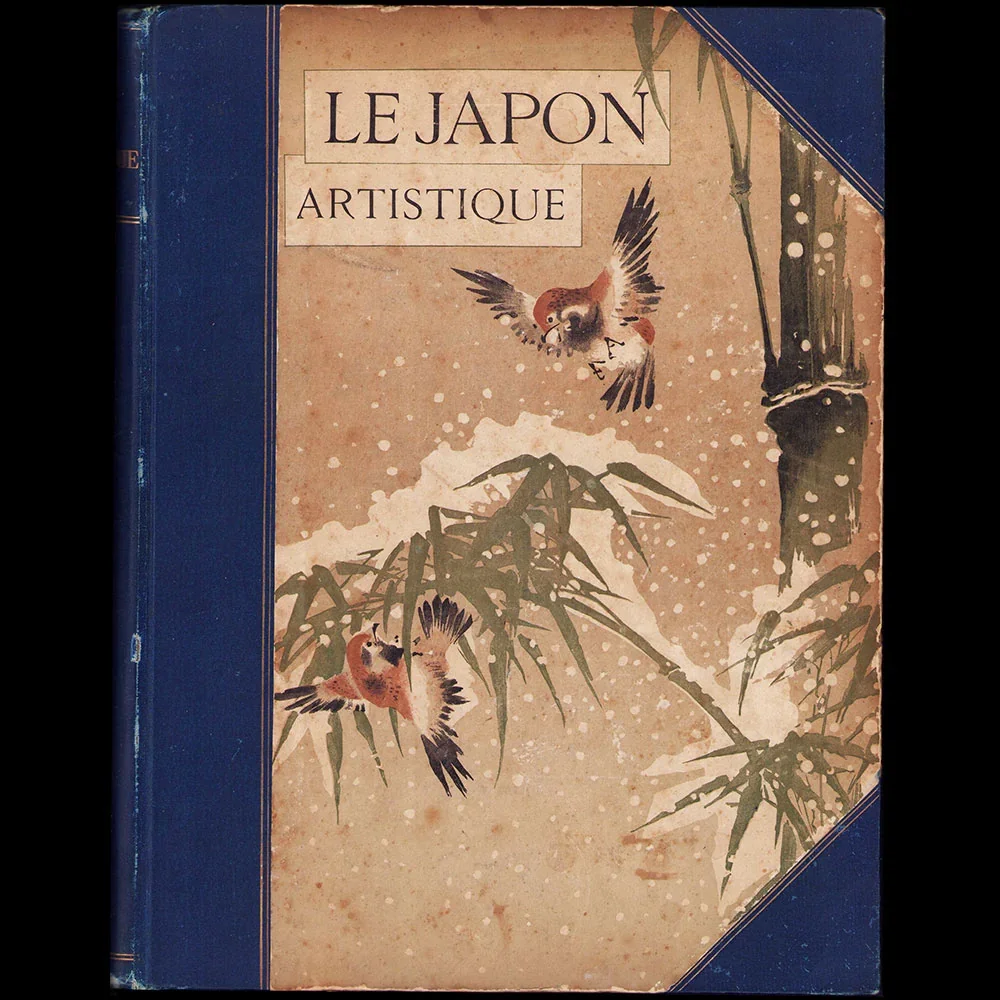
When Siegfried Bing launched Le Japon Artistique in 1888, he wasn’t merely publishing a magazine — he was setting fire to the imaginations of Europe's artists, designers, and dreamers. Over its three transformative years in print, this elegant publication didn’t just spread images of Japanese art across Europe; it rewired the very way artists thought about space, form, and nature. Through its pages, Japonism didn’t remain a trend — it became a revolution.
Painters like Claude Monet, Edgar Degas, Vincent van Gogh, and Henri de Toulouse-Lautrec pored over its issues, absorbing lessons from the floating world of ukiyo-e prints. Designers such as Hector Guimard and Émile Gallé found in it the sinuous lines and motifs that would birth Art Nouveau. And across the Atlantic, an American architect named Frank Lloyd Wright took from its aesthetic philosophy ideas that would shape his most famous works, including the house that would come to symbolize his genius: Fallingwater.
Monet’s Garden and the Japanese Way of Seeing
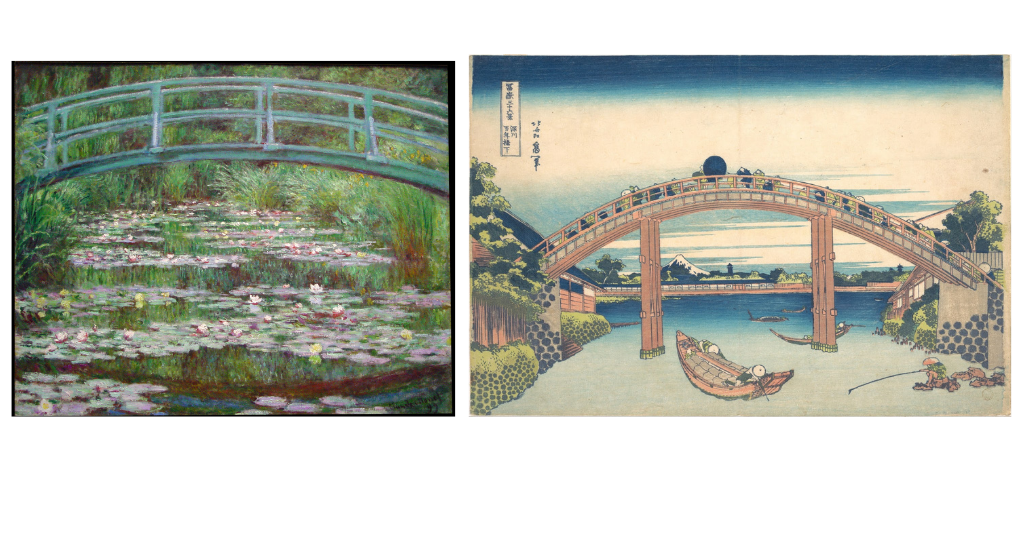
Among the most passionate readers of Le Japon Artistique was Claude Monet. Already a collector of Japanese prints, Monet found in Bing’s magazine not only reproductions of Hiroshige’s landscapes but detailed articles on Japanese garden design. These writings, celebrating asymmetry, natural flow, and the use of water as a reflective surface, struck a chord with Monet.
Inspired, he began reshaping his garden at Giverny with a distinctly Japanese sensibility. He installed a wooden bridge arched like those in Hiroshige’s prints and populated his pond with water lilies, an exotic plant introduced from Egypt and South America but popular in Japanese aquatic gardens. The resulting scenes became the subject of his late, great series — the water lilies, the Japanese bridge — where the composition floats between surface and depth, sky and water, just as ukiyo-e prints collapse traditional Western perspective.
Degas and the Dance of Asymmetry
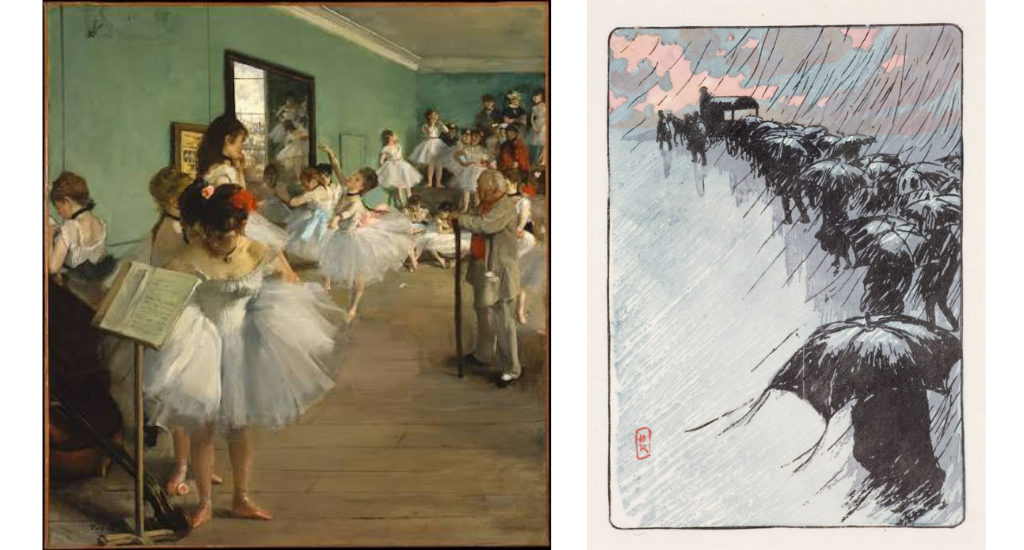
For Edgar Degas, the influence ran through his figure compositions. Degas, a man deeply invested in the mechanics of movement, found in Le Japon Artistique's presentations of ukiyo-e prints a new visual grammar. Japanese artists like Utamaro captured human figures in dynamic, off-centered arrangements, cutting off forms at the edges and leaving empty spaces that suggested rather than dictated meaning.
Degas took this to heart in his depictions of ballerinas and bathers. His famous ballet scenes abandon the symmetrical, staged composition of academic painting. Instead, dancers are often cropped, the action seeming to spill beyond the canvas. The floor tilts upward in a shallow plane, just as it does in Japanese prints, where depth is suggested by overlapping forms rather than linear vanishing points.
Van Gogh: The Most Devout Student of Japonism
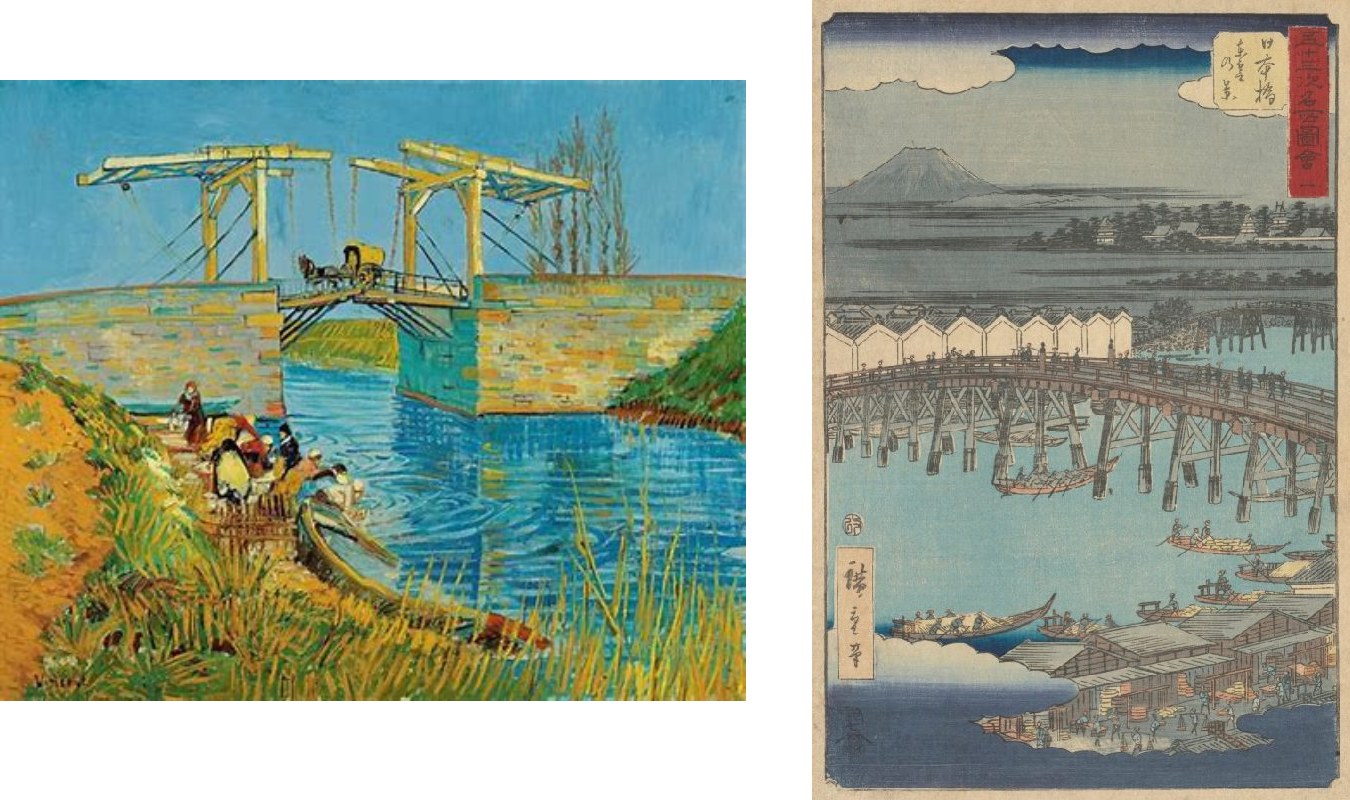
No artist was more feverishly devoted to Japonism than Vincent van Gogh. He didn’t just admire Japanese prints; he copied them directly. His 1887 painting Flowering Plum Orchard (after Hiroshige) is an almost faithful translation, but with Van Gogh’s signature saturated palette.
From Le Japon Artistique, Van Gogh took not just motifs — plum blossoms, rain showers, bridges — but a spiritual lesson. He wrote to his brother Theo of his admiration for Japanese artists’ ability to live simply and be in harmony with nature, a state he longed for. In Arles, he hoped to establish a "Studio of the South" that would mirror the artistic communities of Japan. His thick outlines, bold color contrasts, and flattened forms in works like The Courtesan (1887) owe a direct debt to the reproductions and essays he encountered through Bing’s magazine.
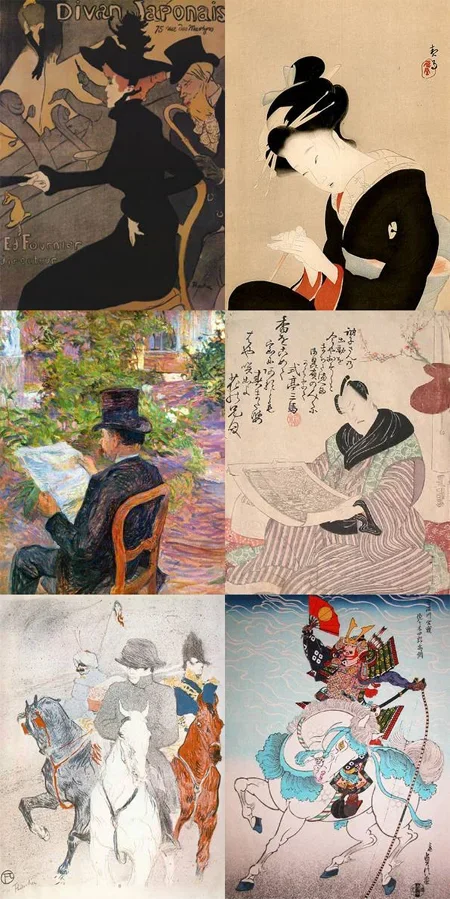
Toulouse-Lautrec and the Graphic Revolution
Henri de Toulouse-Lautrec found in Japonism the key to unlocking the modern poster. His breakthrough works, like the 1891 Moulin Rouge: La Goulue, echo the bold silhouettes and flat colors of Japanese woodcuts. Le Japon Artistique had not only introduced him to the visual style but also the idea that art could permeate the streets — ukiyo-e prints were mass-produced yet deeply artistic.
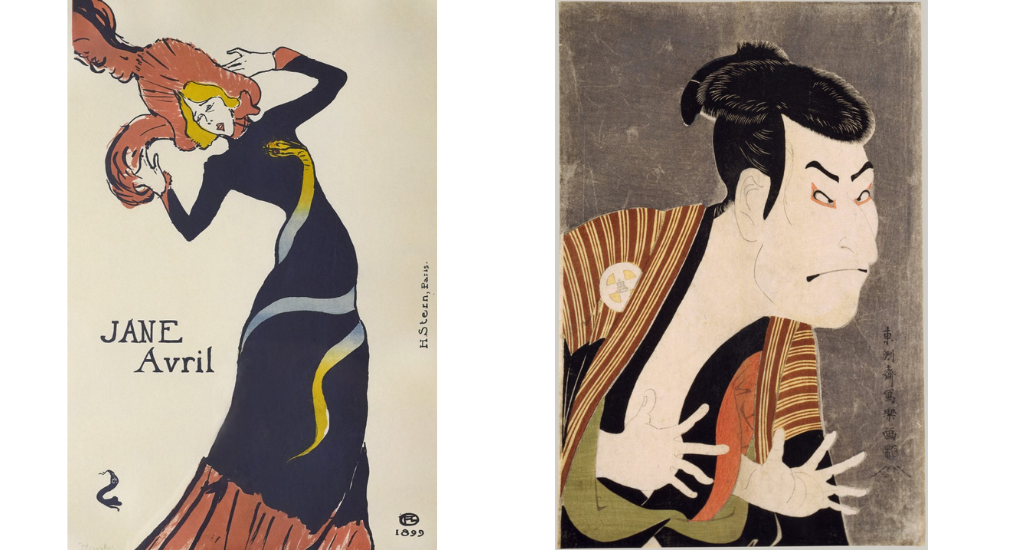
In Lautrec's posters, figures are cropped at the edge, colors are reduced to strong contrasts, and lines sweep fluidly across the surface — all hallmarks of Japanese design that the magazine championed.
Guimard, Gallé, and the Birth of Art Nouveau
Beyond the painters, Le Japon Artistique exerted an even broader influence on decorative arts and architecture. Hector Guimard, the architect famed for his Paris Metro entrances, drew from the magazine’s illustrations of Japanese flora and sinuous natural forms. The whiplash curves of his ironwork gates mimic the organic lines found in Japanese waves and vines, which the magazine reproduced in loving detail.
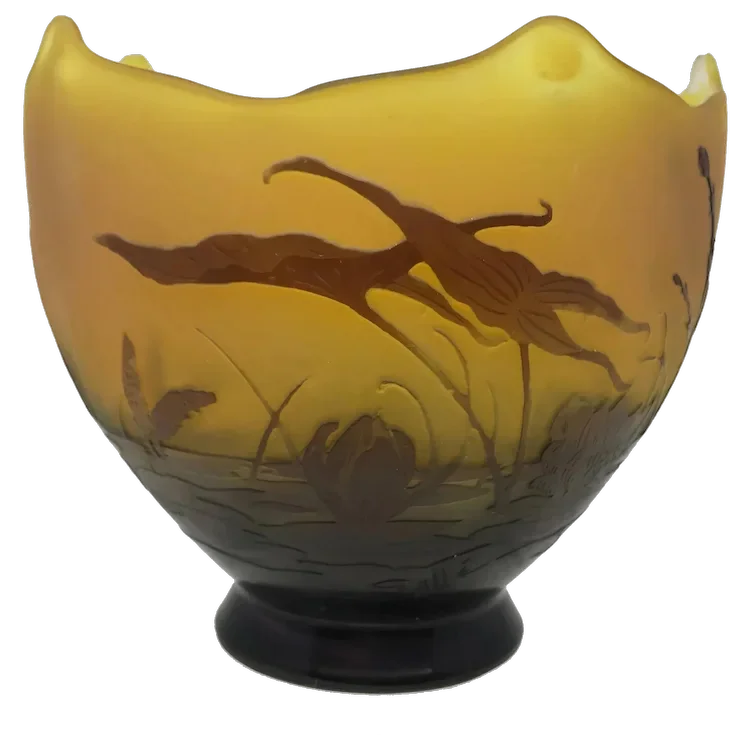
Similarly, Émile Gallé, a leading glassmaker, absorbed Japanese motifs into his Art Nouveau masterpieces. His vases and furniture often feature dragonflies, ginkgo leaves, and water plants — elements celebrated in Japanese lacquerware and textiles and carefully cataloged in Bing’s pages. Gallé’s treatment of transparency and layering in glass also mirrors the flattened, overlapping planes seen in Japanese prints.
Frank Lloyd Wright and the Japanese House Reimagined
Across the ocean, Frank Lloyd Wright encountered Le Japon Artistique and became one of its most fervent Western disciples. Wright not only collected Japanese prints — he would later deal them himself — but he internalized their compositional and philosophical principles.
His most famous house, Fallingwater (1935), though designed decades after the magazine ceased publication, reveals these lessons. The building’s cantilevered terraces hover over the stream like the horizontal planes in Hiroshige’s bridges. Its integration into the landscape reflects the Japanese ideal of harmony between built form and nature, a theme Bing’s magazine had illustrated repeatedly in articles on Japanese architecture and garden design.
In Wright’s earlier Robie House (1909), the influence is even clearer — the low, elongated horizontal lines and open interior spaces recall the flexible, sliding partitions of a Japanese home.
A Revolution Bound in Pages
Le Japon Artistique was more than a publication — it was a cultural detonator. By carefully curating not just images but scholarly commentary, Bing gave Europe a vocabulary to understand and emulate Japanese aesthetics. Artists took from it not only surface motifs but deeper structural and philosophical lessons: the embrace of asymmetry, the use of empty space, the harmony with nature, and the flattening of perspective.
Over its three years and thirty-six issues, the magazine didn’t just teach Europe about Japanese art—it changed European art itself. From Monet's lily ponds to Wright’s architectural masterpieces, the spirit of Le Japon Artistique flows on, quiet but unstoppable, like a Japanese stream winding through a Parisian garden.