
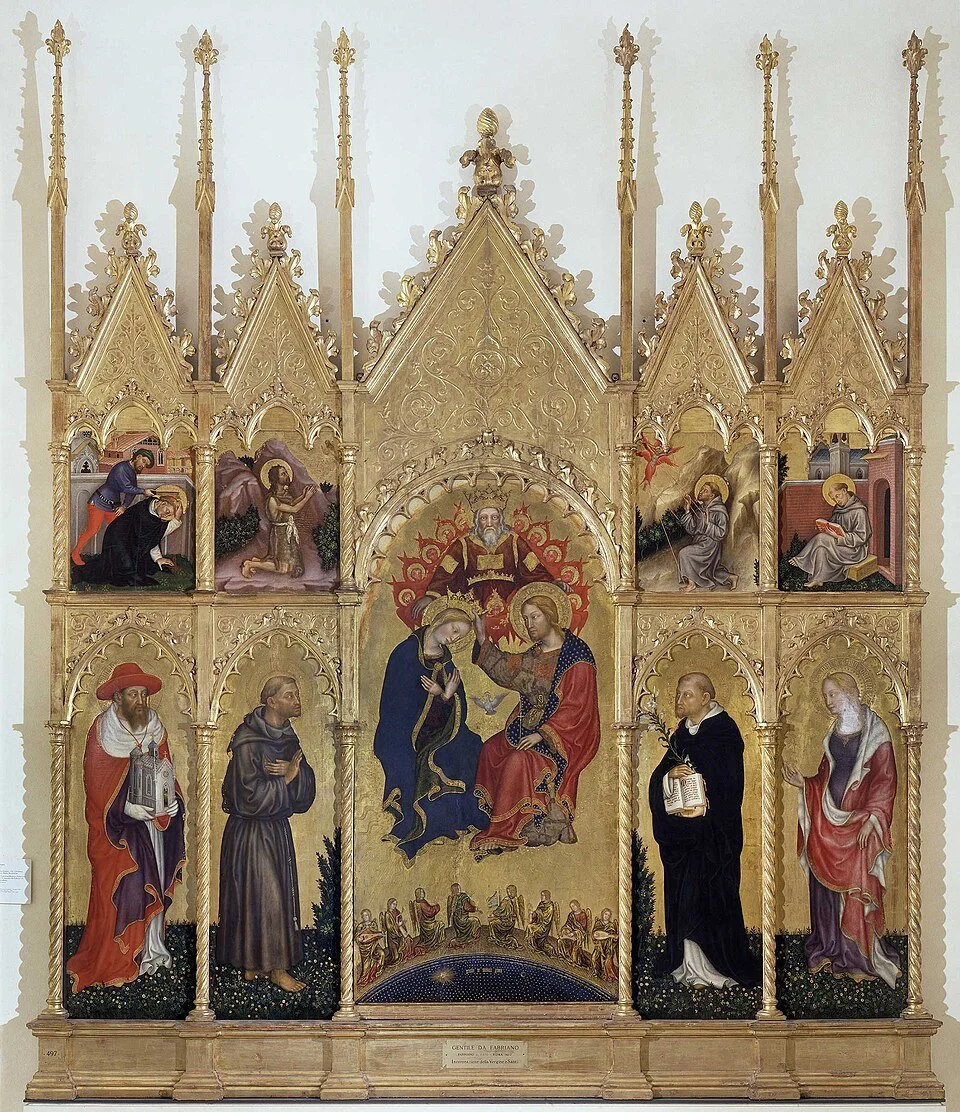
Gentile da Fabriano, Valle Romita Polyptych (about 1410 to 1412), Pinacoteca di Brera, Milan.
A gap at the beginning of Jacopo Bellini's story has always bothered me. His father, Nicoletto, was a tinsmith near the Rialto, and Jacopo would ordinarily have been expected to follow him into the trade. Then, somehow, Jacopo turns up as the assistant of Gentile da Fabriano, possibly the most famous painter in Italy. How did that happen?
The romantic explanation practically writes itself. Young Jacopo produces a drawing so brilliant that the great Gentile takes one look and recognizes genius. Unfortunately, there is no evidence that anything of the kind happened. What we do have is a fair amount about who Nicoletto was, where the Bellinis lived, and what Gentile was doing in Venice. Put those side by side, and the meeting starts to look much less mysterious.
I keep thinking about the New York art world in the 1970s. From the outside it looked enormous. Once you were inside it, it wasn't. You didn't need to know an artist personally to be one step away from them. You ran into them at Pearl Paint, David Davis, or New York Central. Your framer knew their assistant. Or you saw them at the Spring Street Bar. Venice in 1408 was not New York in 1975, but it was even more compressed, and its trades were often grouped by street. The famous painter and the tinsmith's son may not have been living in separate worlds at all.
Nicoletto Bellini was a batistagno, a tin beater. He hammered, soldered, and burnished thin sheets of tin into bowls, mugs, pans, and basins, and he mended the ones people dented. He may also have beaten the tin foil that painters bought, and painters used a lot of it. Cennino Cennini, a painter writing his handbook around 1400, tells his readers to cover every nail head in a panel with little coins of tin foil so the rust won't bleed through the gesso. He explains how to hammer tin foil into a carved stone mold to make relief ornaments that could be gilded, and how to make "golden tin" for halos and stars when fine gold was too expensive. Most painters took the cheap route, he grumbles. Nicoletto lived in the parish of San Salvador, near the Rialto, probably close to the Calle dei Stagneri, the street of the tinsmiths.
This was skilled work, and Jacopo grew up inside it. He would have known the tools, the suppliers, and the customers, and he would have learned early that one bad blow could ruin a piece. If he had already started at his father's bench, which seems likely, Gentile was not getting a boy who knew nothing about making things. We like to imagine artistic gift as something that floats free of manual skill, as though drawing beautifully were what mattered and the rest could be picked up later. Gentile ran a business. A boy who understood tools, surfaces, and workshop discipline was useful long before anyone knew whether he could paint a convincing face.
Gentile, meanwhile, was in another league. By 1408, when we can first securely place him in Venice, he was already commanding high prices. According to the sixteenth-century writer Francesco Sansovino, Venice paid him so well that he went around in open sleeves, the big rolled-back sleeves fashionable among young noblemen. Sansovino was writing a century and a half later, so take the sleeves with a grain of salt. Gentile did not come for one job and leave. He set up a bottega, lived in the parish of Santa Sofia, and joined the Scuola di San Cristoforo dei Mercanti, a confraternity whose members included artisans, painters, and woodcarvers. Venice then handed him one of the great commissions in the city: a fresco in the Hall of the Great Council in the Doge's Palace, showing a naval battle between the Venetians and the emperor's son Otto. Gentile was painting one of the Republic's founding legends on the walls of the room where the Republic governed itself. The fresco is gone, lost when fire swept the palace in the sixteenth century.
Here is the part of Gentile's biography that makes the Bellini connection interesting. He came from an artisan family himself. His mother died when he was young, and when his father entered a monastery, Gentile and his sister were left with their grandfather, Giovanni di Massio, a smith and an officer of the smiths' guild in Fabriano. The most famous painter in Italy grew up in a metalworker's house. When he met a tinsmith and his son, he was not looking across a social divide. He knew that world from the inside.
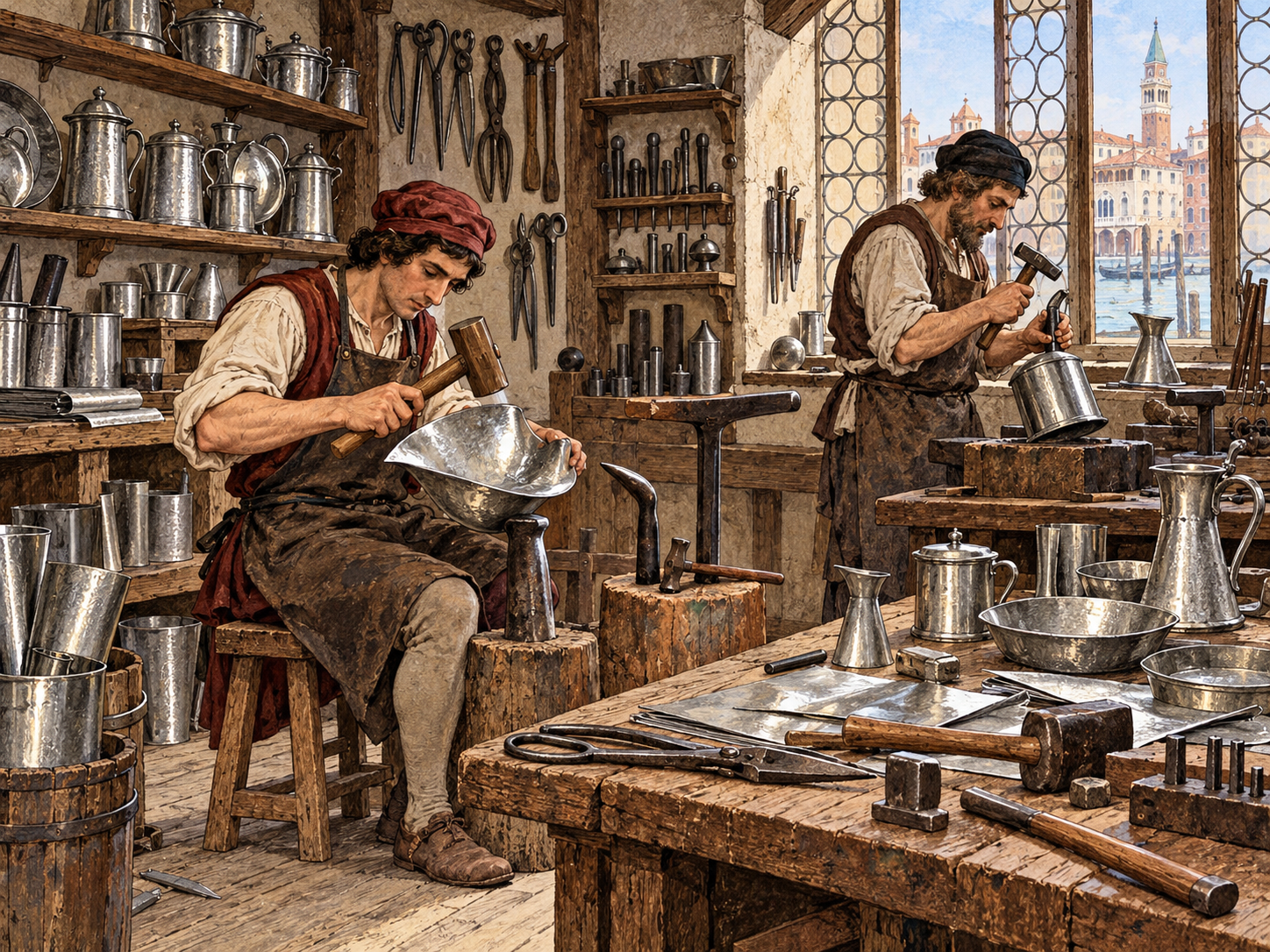
An AI rendering of a tinsmith's bottega
A bottega was not what we think of as an artist's studio. It was workshop, business, school, and production floor at once, with apprentices, paid assistants, family members, and outside specialists moving through it. Panels had to be built and gessoed, drawings transferred, pigments ground, and gold laid. The account books from Gentile's years in Brescia, where he worked for Pandolfo Malatesta, list what went into his pictures: gold, tin, ultramarine, wax, white lead, turpentine, cinnabar, lacquers, and colored glass. There's the tin again.
Now look at the map. Nicoletto worked near San Salvador and the Rialto. Gentile lived in Santa Sofia, on the other side of the Grand Canal and not far upstream. His big commission was at the Doge's Palace. Venice was a walking city, and a painter running a large workshop needed carpenters, gilders, pigment sellers, and metalworkers within reach.
We have no evidence that Gentile bought his tin from Nicoletto. Their paths could have crossed in any number of ways in a city that small. But my guess is that the work brought them together. Gentile needed tin, and the tin beaters were a short walk away. Perhaps he or one of his assistants came into Nicoletto's shop and noticed the boy at the bench. Perhaps Jacopo was the one sent across the Rialto to deliver an order to Gentile's bottega. After that, convenience could have done the rest, along with a boy who turned out to be handy to have around.
Talent mattered eventually. Jacopo became an important painter, and at some point Gentile must have seen what he could do. But there is a lot to be said for the apprentice who doesn't have to be told which end of the hammer to hold. Gentile may have found him useful first and discovered later how well the boy could draw.
Nicoletto had his own calculation to make. A son meant labor and, eventually, someone to take over the shop, so letting him go cost something. But look at what Nicoletto saw in Gentile: a man from a family of smiths whose work was now wanted by merchants, governments, and princes, who had turned craft into money and mobility. I doubt Nicoletto thought, my son is going to be an artist. I suspect he thought, this man can teach my son a better trade than I can.
However it began, it lasted. Jacopo followed Gentile out of Venice and stayed with him for years.
One last twist I can't resist. In 1474, Jacopo's son Gentile Bellini, named after his father's old master, was hired to restore and repaint the great narrative cycle in the Hall of the Great Council, the same room where Gentile da Fabriano had painted his naval battle. Giovanni Bellini later took on more and more of that work. Giovanni was related to the tinsmith too, though not in the way you've probably been told. More on that later in the series.
Venice really was a small world.
YOU MAY ALSO LIKE


DEEP DIVE
Daniel Wallace Maze, Young Bellini (Yale University Press, 2021). If you read one book on the early Bellinis, make it this one. Maze went into the archives and found what we actually know about Nicoletto's trade, the family's house near San Salvador, and Jacopo's early years with Gentile. He is also the one who will upend the family tree a few posts from now.
Cennino Cennini, Il libro dell'arte, translated by Daniel V. Thompson Jr. as The Craftsman's Handbook (Yale University Press, 1933; still in print from Dover). A working painter's how-to manual from Gentile's own generation, and much more fun than it has any right to be. Cennini will tell you how to cover nail heads with tin, how to fake gold, and why you shouldn't, and he is sure God will reward you for using good ultramarine on the Virgin.
Keith Christiansen, Gentile da Fabriano (Cornell University Press, 1982). Forty-odd years old and still the place to start in English. This is where you'll meet the smith grandfather in Fabriano, Sansovino's story about the open sleeves, and a good sense of how big a name Gentile was in Venice.
Laura Laureati and Lorenza Mochi Onori, eds., Gentile da Fabriano and the Other Renaissance (Electa, 2006). The catalogue of the big Fabriano exhibition, and the best place to find Gentile's Venetian workshop, his house in Santa Sofia, and the materials listed in his accounts.
THE FAMILY BUSINESS is my developing treatment for a television drama about the Bellini family, their workshop, and the world of Renaissance Venice.