

Gentile da Fabriano, Coronation of the Virgin (about 1420), J. Paul Getty Museum, Los Angeles.
When Jacopo Bellini joined Gentile da Fabriano’s workshop, he wasn’t just learning to grind pigment and paint a hand. Gentile was one of the most successful artists in Italy, and for the next decade or more Jacopo followed him from city to city: Venice, Brescia, probably Fabriano, then Florence, and perhaps beyond. Gentile worked for Pandolfo Malatesta, lord of Brescia, for Palla Strozzi, one of the richest men in Florence, and in the end for the pope. Jacopo was learning to paint. He was also watching a man run an art business.
When Gentile left Brescia in 1419, he asked for a safe-conduct for eight people on horseback. That’s a small, skilled team, not a factory on the move. We know some of the people in it. One was an assistant named Michele di Ungheria. Another was almost certainly Jacopo. A few years later, a Florentine court record calls Jacopo Gentile’s famulus et discipulus, his servant and pupil, and says he lived in Gentile’s house. That record comes from a fight Jacopo got into, which is a story of its own (see Jacopo Bellini: Fight or Flight).
Jacopo seems to have joined Gentile young and stayed twelve years or more, and the attachment outlived the job. Years after Gentile died, Jacopo was still signing himself as Gentile’s pupil, on a commission in Padua in 1430 and again on a monumental Crucifixion in Verona in 1436. Vasari, writing a century later, said Gentile had been “like a loving father” to him. We have no letter in which Jacopo tells us how he felt about his master. But a man doesn’t keep putting his teacher’s name beside his own for the better part of a decade unless it means something to him.
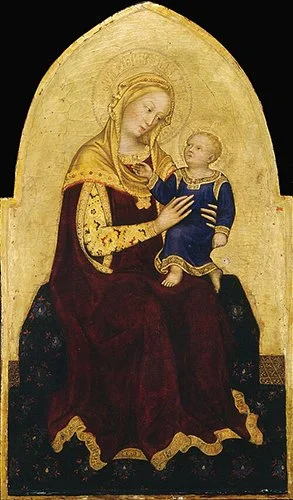
Gentile da Fabriano, Madonna and Child (about 1422), National Gallery of Art, Washington.
In Gentile’s shop, many people worked on a picture, but only one name went on it. The documents for the Adoration of the Magi he painted for Palla Strozzi name several assistants, including Michele and an engraver, Matteo Rondinelli, who brought his own crew. Yet scholars studying the altarpiece have had trouble finding any hand but Gentile’s. It left the shop looking as if one man had painted it.
Gentile didn’t keep every skill in-house either. For big commissions he hired goldsmiths, carvers, embroiderers and miniaturists, and he ordered materials from several cities. He understood what any good contractor knows: you don’t need every trade on the payroll if you know whom to call and you control the result.
Each big job led to the next. The Great Council Hall in Venice led to the Malatesta chapel in Brescia, then the Strozzi altarpiece in Florence, then Siena and Orvieto, and finally the pope’s own church, San Giovanni in Laterano. Gentile also sold smaller devotional pictures, and his assistants could make several versions from the same cartoon to meet the demand for the Gentile look. I don’t picture Gentile personally painting every small Madonna that left his shop.
Drawings made that possible. Once a face, a fold of drapery, a horse or a whole composition had been worked out on paper, an assistant could trace it, enlarge it, shrink it or adapt it. A good drawing was capital. Jacopo would eventually fill two enormous books with them.
Gentile’s career never faltered. He arrived in Florence already famous, in a city where Brunelleschi and Donatello were changing what art could do. He absorbed some of it: his spaces got deeper and his light more convincing. But he never turned Florentine, and nobody asked him to. Patrons kept wanting Gentile, and no younger painter ever pushed him aside. He died in Rome in 1427, still working for the pope.

Gentile da Fabriano, Orveto Chapel overview.
No wonder Jacopo thought he could have that kind of career too. In that sense, The Family Business begins with Gentile. Jacopo would eventually leave Gentile’s way of painting far behind, but he never turned his back on the man who showed him how a painter could live. When he built the workshop that produced Gentile Bellini, Giovanni Bellini and, by marriage, Andrea Mantegna, he wasn’t starting from scratch. He had spent his youth inside one of the most successful art businesses in Italy.
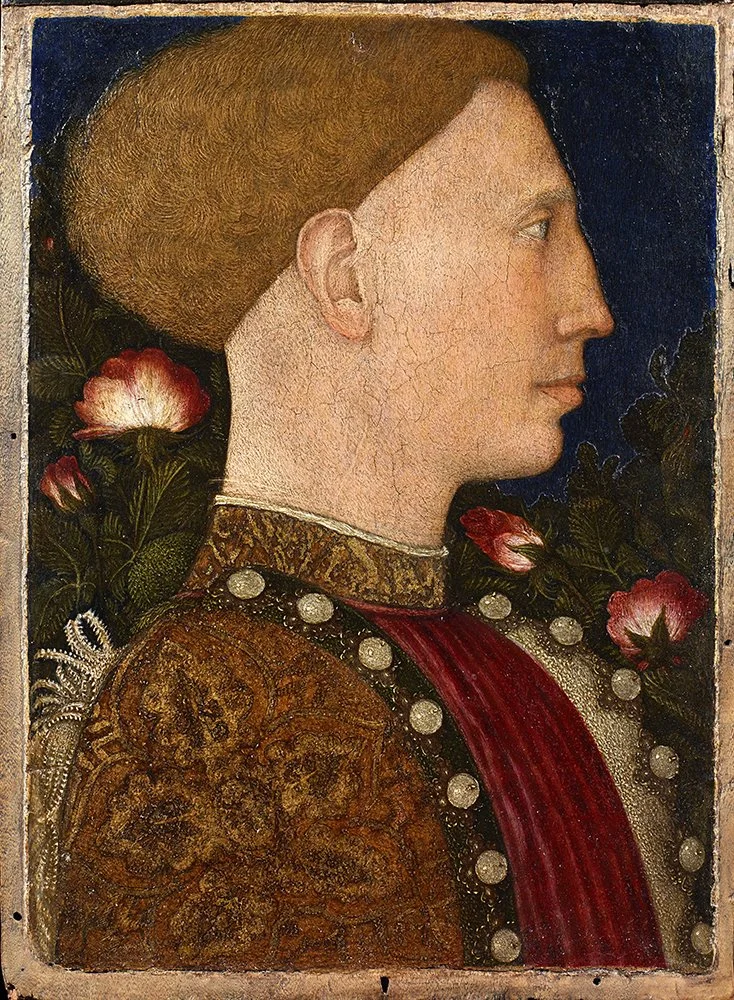
Pisanello passed through Gentile’s world too, and took away very different lessons (see Pisanello: The Other Heir to Gentile’s World).
YOU MAY ALSO LIKE


DEEP DIVE
Keith Christiansen, Gentile da Fabriano (Cornell University Press, 1982). The standard English monograph. Go here for Gentile’s chronology, his assistants, the Florentine workshop, and the court record that calls Jacopo his famulus et discipulus.
Laura Laureati and Lorenza Mochi Onori, eds., Gentile da Fabriano and the Other Renaissance (Electa, 2006). The catalogue of the big Fabriano exhibition. Andrea De Marchi’s essays follow Gentile from Venice to Brescia to Florence, including the 1419 safe-conduct and the artists working around him at the Malatesta court.
Daniel Wallace Maze, Young Bellini (Yale University Press, 2021). Maze on Jacopo’s years in Gentile’s household, the Padua and Verona inscriptions, and Vasari’s “loving father.”
Colin Eisler, The Genius of Jacopo Bellini: The Complete Paintings and Drawings (Abrams, 1989). A big book in every sense. Eisler is good on how long Gentile lingers in Jacopo’s work, and it’s the easiest way to page through the drawing books yourself.
THE FAMILY BUSINESS is my developing treatment for a television drama about the Bellini family, their workshop, and the world of Renaissance Venice.