
In June 1423, Jacopo Bellini was living in Gentile da Fabriano’s house in Florence, working on the most important commission of his master’s career. Then he got into a fight.
Paintings from the workshop had been set out to dry in the courtyard, and a group of boys started throwing stones at them. Jacopo went out to stop them. He singled out one, Bernardo, who was big enough that Jacopo took him for nearly grown. Words passed, Bernardo taunted him, and they came to blows. Bernardo later told the court that Jacopo had hit him on the arm with a wooden bat. It may well have been a fistfight that acquired a weapon somewhere between the courtyard and the courtroom. The real problem was Bernardo’s father, Silvestro, a Florentine notary with friends in the city’s courts.
Jacopo knew he was in trouble before anyone went to court. In Florence, as in Venice, a quarrel with one member of a family could become the business of all his relatives, friends and allies, some of them very distant. A notary’s son humiliated in the street by a Venetian outsider was exactly the kind of injury that invited revenge, and revenge could be violent.
Jacopo was also a foreigner. Bernardo’s family had standing in the city and Jacopo had nobody, so he could expect to lose in court. And the fight had started in Gentile’s courtyard, over Gentile’s paintings. A lawsuit or a feud could drag the whole workshop in with him.
But if he left, how would he live? Painting is a poor profession for someone trying to disappear. His best credential, that he had worked for Gentile da Fabriano, was the one thing he couldn’t advertise. He could hardly turn up in another town and start asking for commissions on the strength of his famous master.
So he went to sea. Florence had just bought a port and was building a merchant fleet, and the new galleys needed crews. A man could be hired for his back rather than his connections, and he would be fed, housed, paid and kept far from Bernardo’s relatives. Fear was probably the main reason, though a young man who had spent his whole life in workshops may not have minded seeing the world. Instead of going home to Venice, Jacopo signed on as a hired seaman on a Florentine galley, probably bound for the eastern Mediterranean (see Jacopo On Board).

He left none too soon. On September 2, 1423, Silvestro brought charges. The court records call the accused Jacopo di Piero of Venice, which is a problem, because Jacopo Bellini’s father was named Nicoletto. Did he give a false name to protect himself, or did a clerk get it wrong? Some scholars have doubted that this is our Jacopo at all. Daniel Wallace Maze makes the convincing case that it is. A judge who was a friend of Bernardo’s family convicted Jacopo in his absence and fined him 450 lire, plus another quarter if he didn’t pay within a month. Jacopo was at sea, and he didn’t pay.
He stayed away about fifteen months and seems to have come home without knowing he’d been convicted. On October 24, 1424, a few days after his merchant ship docked, he was arrested.
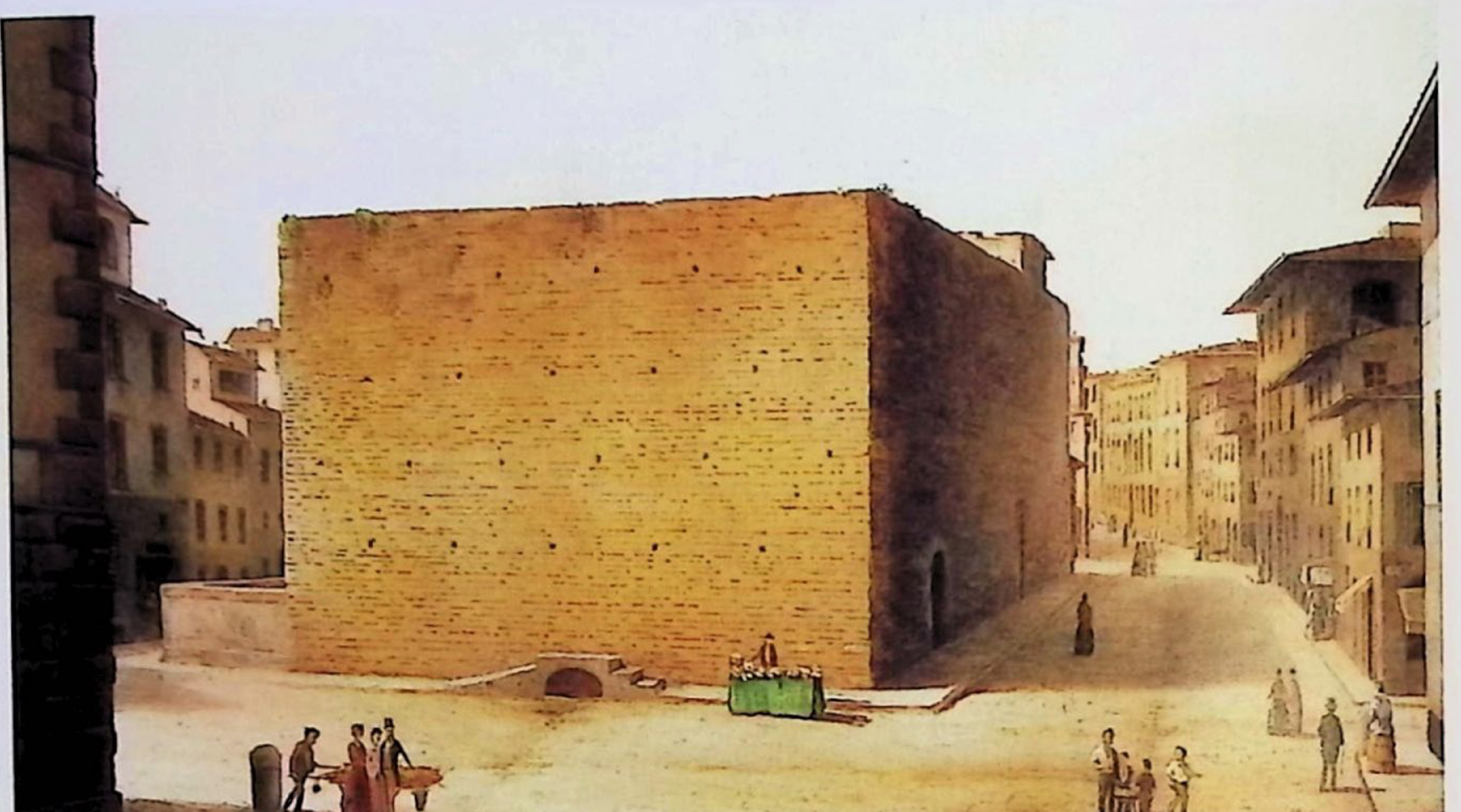
Le Stinche, the prison in Florence.
They took him to Le Stinche, one of the first buildings in Europe built specifically as a prison: a huge, windowless brick trapezoid that held mostly debtors. It had no kitchen. Prisoners ate whatever family, friends or charitable friars brought them. Jacopo was a Venetian with no family in Florence and no money, and a court document of 1425 describes him as poor and unable to pay his fines. Gentile was apparently still in town; his Quaratesi altarpiece is dated May 1425. Whether he sent food, nobody wrote down.
On November 28, Jacopo made his peace with Bernardo. He admitted wrongdoing and promised to pay him twenty-five gold florins, and Bernardo dropped his grievance. The fine owed to the city remained, so Jacopo stayed where he was. On Easter Sunday, April 8, 1425, after nearly six months, Florence let him go. Every Easter the city freed a few of its poorest prisoners and wrote off their debts, and Jacopo qualified. He walked out in a public penitential procession, or what we would call a perp walk: bareheaded, carrying a torch, with the other prisoners, through the streets to the Baptistery of San Giovanni while trumpets played.
Nearly two years had passed since the fight in Gentile’s courtyard. For what Jacopo came home to in Venice, see Jacopo Comes Home.
YOU MIGHT ALSO LIKE


DEEP DIVE
Daniel Wallace Maze, Young Bellini (Yale University Press, 2021), especially chapters 1 to 3. Everything in this post starts with Maze. He pieced together the Florentine court records of the courtyard fight, the conviction in absentia, the arrest, the settlement with Bernardo and the Easter release, and he makes the case that the “Jacopo di Piero” in those records is Jacopo Bellini. It reads like a detective story, because it is one.
Keith Christiansen, Gentile da Fabriano (Cornell University Press, 1982). Christiansen published the Florentine documents connecting Jacopo to Gentile’s household, and he was the first to ask why Jacopo might have given the court the wrong father’s name.
Robert Finlay, Politics in Renaissance Venice (Rutgers University Press, 1980). Finlay is about Venice, not Florence, but he is wonderful on how honor, obligation and revenge ran through whole family networks, sometimes into very distant branches. Read him, and you’ll understand why Jacopo didn’t wait around to see what Bernardo’s relatives would do.
SPECIAL THANKS
Special thanks to Crandall Public Library in Glens Falls, the Clark Art Institute Library, the Charles P. Stevenson Jr. Library at Bard College, and the Crossett Library at Bennington College. This kind of research depends on librarians who find obscure books, track down materials, answer peculiar questions, and make it possible to follow a trail wherever it happens to lead.
THE FAMILY BUSINESS is my developing treatment for a television drama about the Bellini family, their workshop, and the world of Renaissance Venice.