
When Jacopo Bellini walked out of Le Stinche on Easter Sunday 1425, it wasn’t because someone had paid his fine. Florence let a few dozen prisoners go every Easter, and the city absorbed their debts and jail costs, but only the poorest and most wretched qualified. The provision that released Jacopo says it plainly: pauperrimus est. He is very poor. That was his ticket out.
What he did next is a blank. Gentile da Fabriano was still in Florence in May 1425, finishing the Quaratesi altarpiece, and by late June he was in Siena. From there he went to Orvieto and then to Rome, where the pope finally had a job for him at San Giovanni in Laterano. Some scholars think Jacopo went along, and it would have been the natural thing for a broke young painter with nowhere better to be. Nobody has found a document that puts him there. Gentile died in Rome in 1427, and at some point Jacopo went home to Venice.
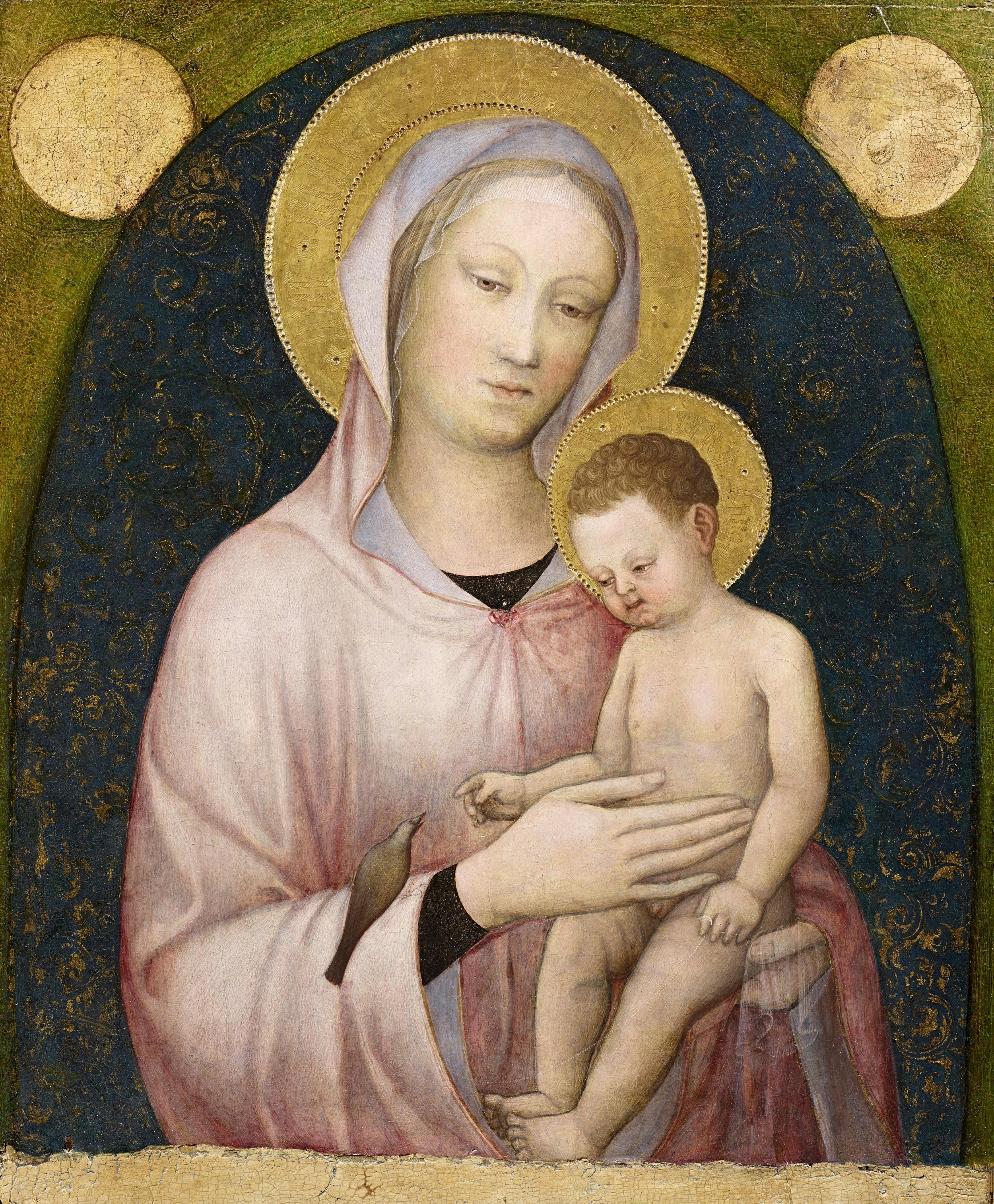
Jacopo Bellini, Madonna and Child, fifteenth century, Accademia Carrara, Bergamo. By 1429 Jacopo had returned to Venice, married Anna Rinversi, and was beginning the household that would become the Bellini workshop.
A lot had happened there without him. On April 11, 1424, while Jacopo was still working on a merchant galley somewhere in the Mediterranean, his father, Nicoletto, sent for a notary and made his will. He named Jacopo, the son of his first wife, Zanina, as his heir. He asked that a loan he had made Jacopo be repaid or taken out of his inheritance, and he made provision for his second wife, Franceschina Vendramin. It’s hard not to picture the old tinsmith settling accounts with a son who might never come back.
The will mentions only one son, because there was only one. Venetian law required a father to name every legitimate son in his will, even one he meant to disinherit, and Giovanni isn’t in it. Daniel Wallace Maze argues that Franceschina gave birth to him after the will was made, sometime between the middle of 1424 and September 1426. Nicoletto may not have lived to see him. Franceschina disappears from the records soon afterward, perhaps in childbirth. Venice was hit by the plague in these years, and in October 1427 a visiting humanist described the city as nearly deserted. Either parent may have died of it.
So the man who came home had a criminal record in Florence, a dead father, a dead stepmother, and a baby brother more than thirty years younger than he was. Who looked after Giovanni until Jacopo arrived, nobody knows. Franceschina’s sister, Samaritana Vendramin, lived nearby, and decades later she wrote in her will that Giovanni had always treated her like a mother. Whether she took him in as a baby, or whether that came later, the documents don’t say.
Venetian law had already decided how the two brothers would live. While Nicoletto was alive, Jacopo was legally under his father’s authority, grown man or not; as medieval lawyers put it, even a sixty-year-old son was still in his father’s power. Nicoletto’s death set Jacopo free. It also tied him to his brother. When a Venetian father died, his legitimate sons automatically became a fraterna compagnia, a family partnership that owned the estate together. This was how Venice kept family businesses from falling apart at a funeral. Maze argues that Giovanni’s birth overturned the old will, which made the toddler Jacopo’s legal partner in everything their father had left.
Jacopo also needed a wife, and a wife meant a dowry. Anna Rinversi brought 250 ducats. To put that in perspective, when Jacopo later took on his nephew Leonardo as an assistant, he paid him 12 ducats for the first year. One later painter trained in the Bellini workshop, Giovanni Mansueti, set up his own shop on a dowry of 200 ducats. Anna’s money was a business plan.
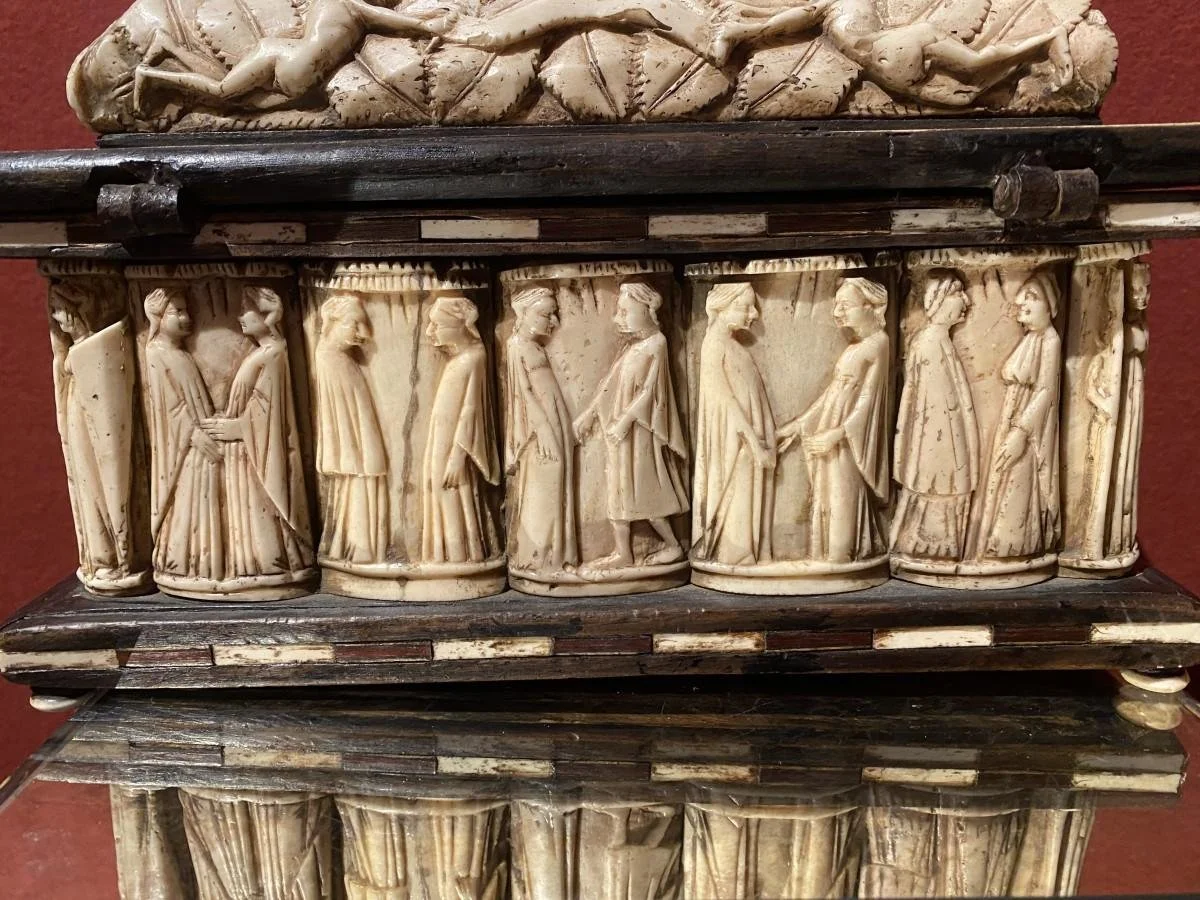
Fifteenth-century Italian wedding casket. Marriage brought property as well as a new household: Anna Rinversi’s dowry of 250 ducats gave Jacopo substantial capital as he established himself in Venice.
By February 1429 Jacopo and Anna were married and living in the parish of San Geminiano, on Piazza San Marco. That month Anna made a will of her own, as Venetian women often did before giving birth. She describes herself as pregnant and close to delivery, with no other children. The baby was Gentile Bellini, named after the master Jacopo never stopped calling his teacher. In July, Jacopo signed for the dowry, and the notary called him “a painter residing in the parish of San Geminiano, son of the deceased ser Nicoletto.” It’s the first document in which we meet Jacopo as a Venetian householder with a trade, an address and a family.
It was an odd family. There was a new wife, a new baby, a little brother who would grow up being called Jacopo’s son, and before long a nephew too, when Jacopo took in his sister Elena’s boy, Leonardo, in 1431. The brothers stayed in their partnership until September 13, 1440, when a notary drew up a division of their property. It names them as Jacopo and Giovanni, sons of the late Nicoletto Bellini. It’s a bare formality: no list of property, no mention of the workshop. Eleven days later, Jacopo was drafting a partnership with another painter. The deal fell through, but it explains the timing.
To everyone else, then and for the next five hundred years, Giovanni was Jacopo’s son. Jacopo signed an altarpiece with “his sons Gentile and Giovanni,” and Gentile, dying in 1507, left something to “my dearest brother.” In the only document where it legally mattered, Giovanni was Jacopo’s brother.
The workshop was ready. Venice was another matter.
YOU MAY ALSO LIKE

DEEP DIVE
Daniel Wallace Maze, Young Bellini (Yale University Press, 2021), especially chapters 1 to 3 and Appendix A, “The New Genealogy.” This is the book that rewrote the Bellini family tree. Appendix A walks through the will, the 1440 division, and Venetian inheritance law, and the notes are a treasure hunt of their own: the Florentine pardon, Samaritana’s will, and what a Bellini assistant earned.
Andrea De Marchi, essays in Laura Laureati and Lorenza Mochi Onori, eds., Gentile da Fabriano and the Other Renaissance (Electa, 2006). For Gentile’s last years: Siena, Orvieto and the Lateran.
Colin Eisler, The Genius of Jacopo Bellini (Abrams, 1989). Read it to see the Bellini story as everyone told it before Maze, including the idea that Jacopo may have followed Gentile to Siena and Rome.
THE FAMILY BUSINESS is my developing treatment for a television drama about the Bellini family, their workshop, and the world of Renaissance Venice.