Sacha Guitry and Monet in his garden in Giverny.
I have never understood how some artists manage to paint in their good clothes. In 1915, Sacha Guitry filmed Claude Monet painting beside his water lily pond at Giverny, dressed in a white suit. A white suit! Matisse was nearly as bad. Photographs show him standing in his studio with a palette, wearing a suit and tie, looking as though he might have an appointment with his banker later that afternoon. I can't walk within fifty feet of my studio without getting paint on my clothes.
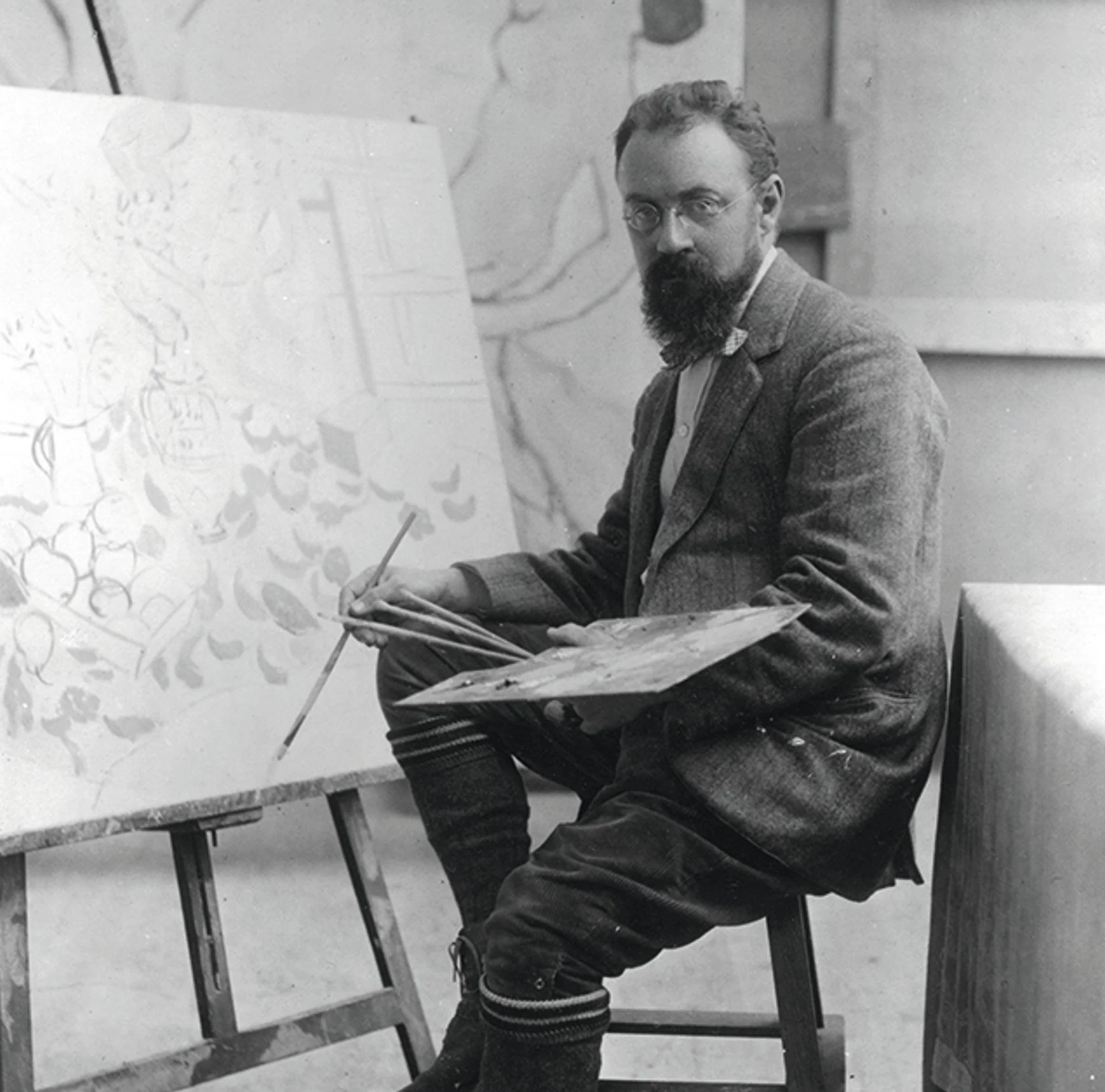
Matisse photographed by Alvin Langdon Coburn in 1913, formally dressed in his studio.
Of course, Monet and Matisse belonged to a generation in which respectable men wore suits. By the time Guitry filmed Monet, he was also a wealthy and successful artist, with a magnificent house and garden. He had no reason to dress like a struggling painter in a garret. Still, I have trouble imagining how he kept that suit white.
What artists wear has always interested me, partly because I have never quite figured out what I should wear myself. There is a considerable difference between dressing to make art and dressing to be seen as an artist. The first is easy. The second has caused me no end of trouble.
For many years, most of my clothes were hand-me-downs from friends. They weren't necessarily my colors or my style, or anything I would have chosen for myself. My principal criterion was that they fit, more or less. I had three categories of clothing: clothes too good to wear in the studio, studio clothes, and paint rags. Everything eventually passed through all three categories. A perfectly respectable shirt could begin its life as something I wore to dinner, acquire enough paint to become studio clothing, and finally end up wiping paint off my brushes.
It was a perfectly functional system, except that almost none of my clothes had been chosen by me. I don't like shopping for clothes. I don't like grocery shopping. I don't particularly like shopping at all. I like to be comfortable, and I like to paint.
My shoes, however, have become something else. They begin as ordinary sneakers, but over time the paint accumulates on them in extraordinary combinations of color. They are often the most interesting things I wear, and people comment on them all the time. I haven't designed them. Their colors have nothing to do with what I might have chosen. They are simply the consequence of working in my studio.
Other artists have taken a much more deliberate approach to clothing.
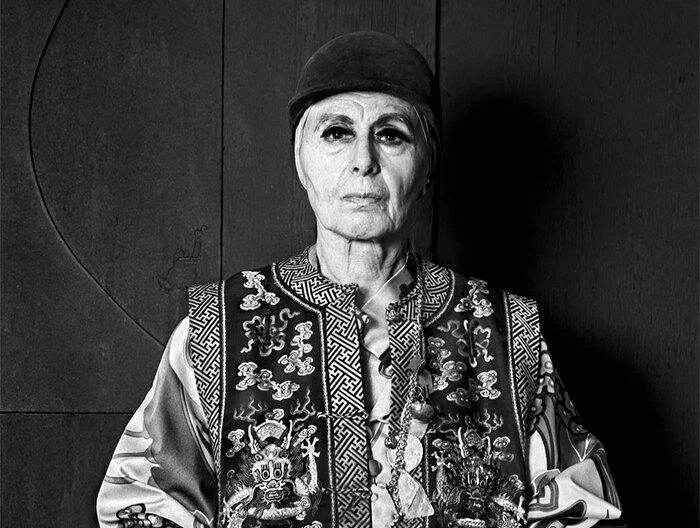
Louise Nevelson, whose clothing was an important part of her self-presentation.
Louise Nevelson portrait by Lynn Gilbert, 1976, as commissioned by the Pace Gallery, New York, 1976, Wikimedia Commons
Louise Nevelson made dressing an extension of her artistic identity. With her dramatic headscarves, enormous eyelashes, jewelry, and elaborate clothing, she was as carefully assembled as one of her sculptures. In a 1972 interview, she recalled that artists in America once wore berets and shabby clothes as a badge of their profession. Her own love of beautiful clothes could make people question her seriousness as an artist. She rejected the notion that dedication required looking disheveled.
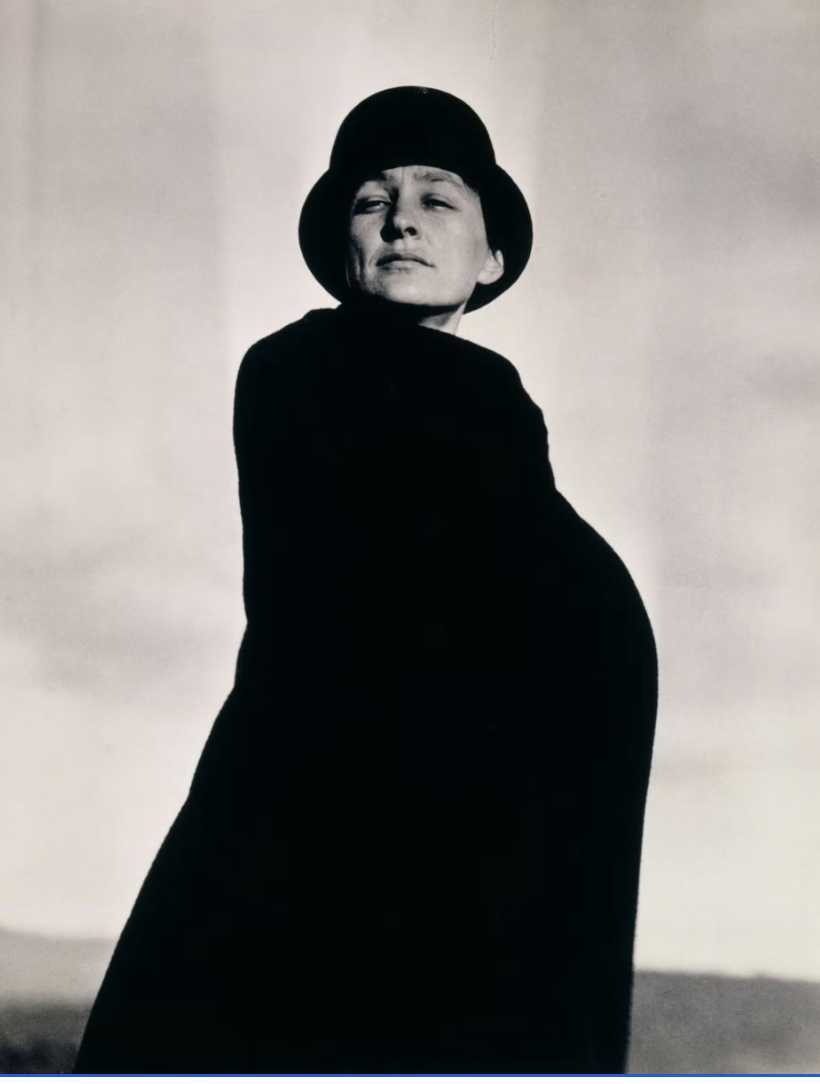
Georgia O'Keeffe took almost the opposite approach, developing a wardrobe of simple, often black-and-white clothes, some of which she made herself. Her clothing was carefully considered, but its restraint became as distinctive as Nevelson's extravagance. Both women made decisions about how they wanted to dress, and both became recognizable through those decisions.
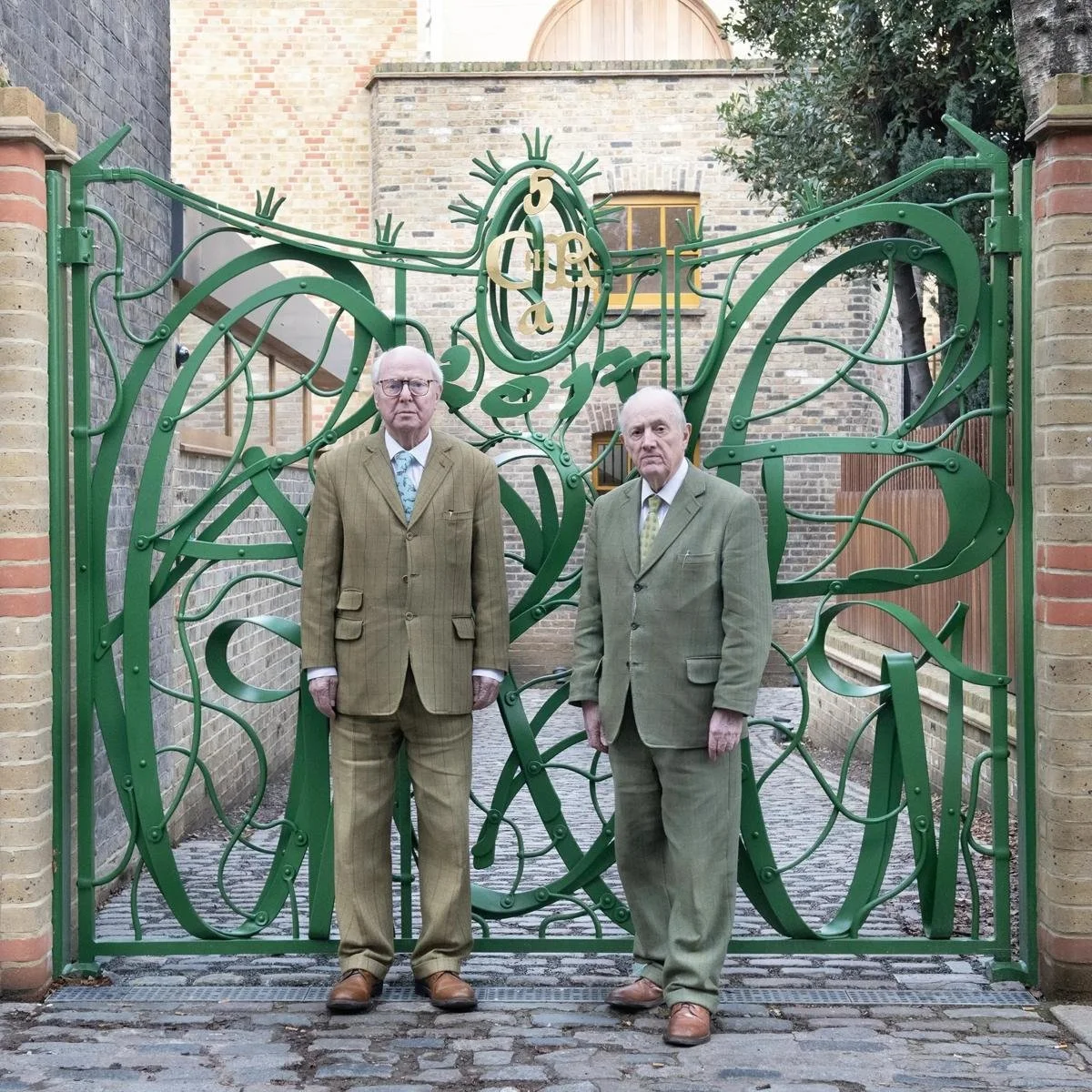
Gilbert & George, the business suit becomes part of the artwork. Gilbert & George, London, 2007. Photograph: DarTar / Wikimedia Commons, CC BY-SA 4.0. No changes made.
Image: https://commons.wikimedia.org/wiki/File:Gilbert_%26_George_2007.jpg
Gilbert & George wore conservative business suits throughout their careers. Beginning in the late 1960s, they declared themselves living sculptures. The suits are part of the work, a deliberate rejection of the notion that artists ought to look like bohemians. They might have been bankers or civil servants, except that they were standing on a table, painted bronze, singing an old music-hall song. The contrast was part of the point.
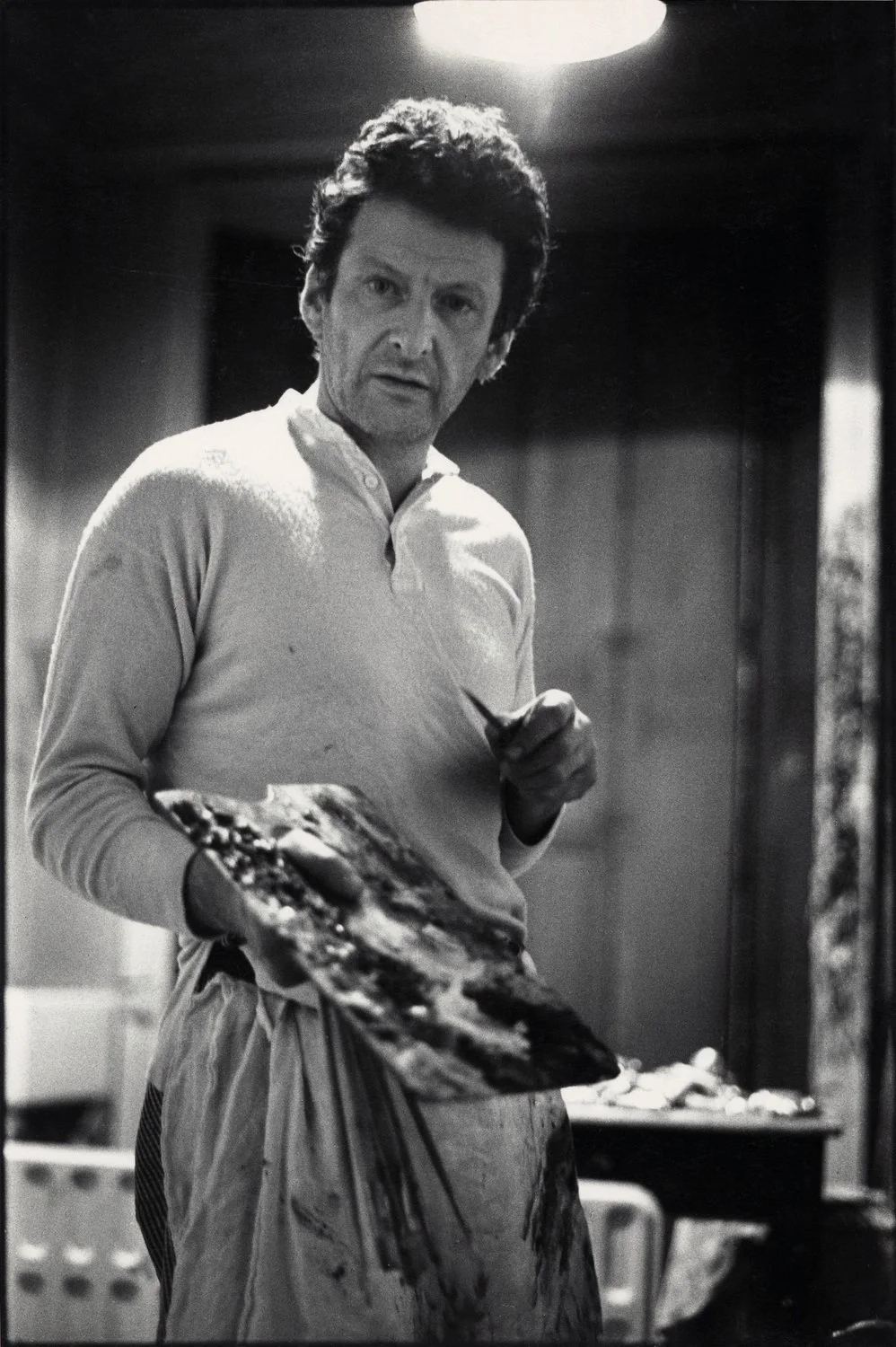
Lucian Freud
by Harry Diamond
gelatin silver print, 9 November 1969
11 1/2 in. x 7 1/2 in. (293 mm x 191 mm) image size
Bequeathed by Harry Diamond, 2012
Photographs Collection
NPG x135769 ©National Portrait Gallery, London
And then there is Lucian Freud, whose rumpled clothes and extraordinary hair seem to have anticipated the invention of the term bed head. I love the photograph of him with Queen Elizabeth II during the sittings for her portrait. Here are two people whose relationships to clothes could hardly have been more different. The Queen's wardrobe was calculated down to the smallest detail, while Freud seems almost oblivious to his own. Yet his dishevelment was every bit as recognizable as her carefully chosen hats and matching coats. He wanted her to come to his studio, but the sittings eventually took place at St James's Palace.
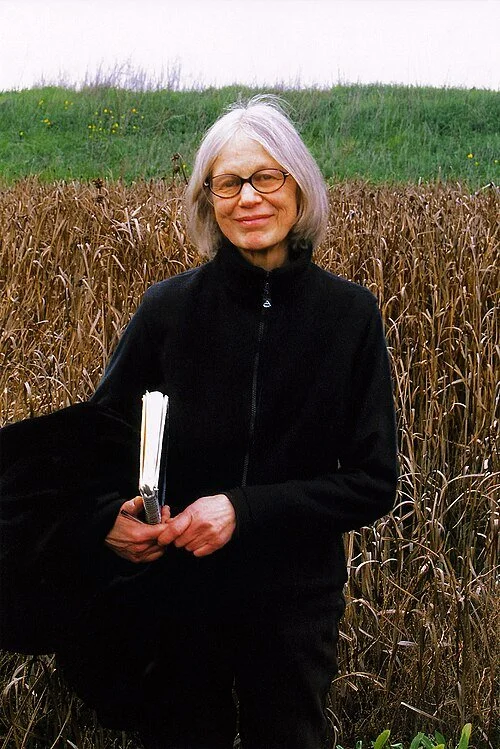
Pat Johanson by Scott Hess, Wikimedia Commons
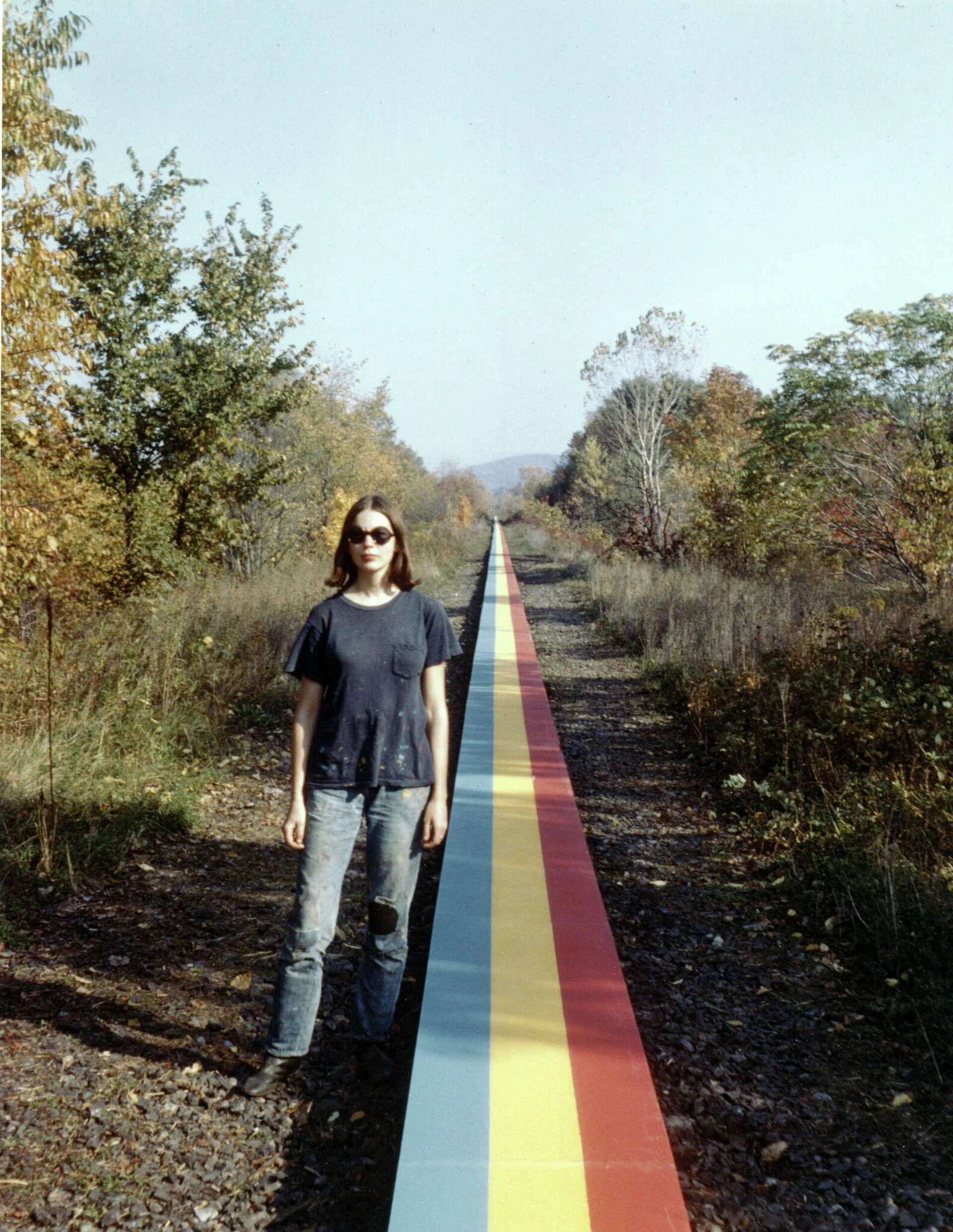
I prefer the solution my friend, environmental artist Pat Johanson, adopted. In 1964, while completing her master's degree in art history at Hunter College, Pat went to New Mexico to work with Georgia O'Keeffe, helping her catalogue her paintings and archives. Yet their approaches to clothing differed. Where O'Keeffe carefully considered what she wore, Pat chose a uniform: black pants, a black T-shirt, a black jacket, and a black fanny pack. She could travel without a suitcase, go to a construction site, attend an opening, or have dinner in a restaurant without changing clothes. She had figured out how to dress for every part of her life without having to think about it again.
I have always wanted to do the same thing, but I haven't taken the time to design my own uniform.
Perhaps my greatest difficulty comes with openings. I understand why artists often wear black. By the time you have made the paintings, organized the exhibition, shipped the work, and traveled to the gallery, you have already used up an enormous amount of creative energy. The last thing you want to do is make yourself into another artwork.
I have exhibited in cities such as Houston and Milwaukee, where people often dress up for openings. I hate having to figure out what to wear. I almost feel as though I need to become someone else. At home, I am the person who paints. At an opening, I am supposed to be the person who made the paintings, which apparently requires an entirely different wardrobe.
I have spent years making decisions about color, shape, proportion, scale, and the relationships between things. I can spend hours considering whether a particular red belongs in a painting. But when it comes to deciding what to put on in the morning, I would rather not have to make any decisions at all.
For now, at least, I have my shoes.


My painting shoes.
DEEP DIVE
Claude Monet, Ceux de chez nous (1915), directed by Sacha Guitry. Watch the film excerpt at the Museum of Fine Arts, Boston.
This may be the most entertaining source in the entire post. Guitry filmed Monet painting beside his water lily pond at Giverny, wearing an immaculate white suit. The film lets us watch the painter at work, moving between the canvas and the pond, apparently unconcerned about what might happen to his clothes. It is one of those rare occasions when we can see an artist of Monet's generation actually painting rather than posing for a photograph.
Louise Nevelson, interview with Arne Glimcher, January 30, 1972. Archives of American Art, Smithsonian Institution.
This interview is particularly revealing because Nevelson discusses her clothes in relation to her identity as an artist. She recalls a time when American artists wore berets and shabby clothes almost as a professional uniform. Her own preference for attractive, flamboyant clothing made people question her dedication. She was particularly irritated by the assumption that the worse an artist looked, the more seriously that artist must be working. She considered appearance an important expression of identity, not merely a superficial concern.
Wanda M. Corn, Georgia O'Keeffe: Living Modern (Prestel, 2017). Explore the exhibition through the Georgia O'Keeffe Museum.
I studied art history with Wanda Corn for a year when I was at Mills College. I had spent much of my childhood in museums, going to the Metropolitan Museum and the Museum of Modern Art at least once a week. By the time I went to Mills, I was completely focused on the artwork itself. At a time when most of my art history professors discussed one artwork after another, Wanda was interested in the environment in which artists lived. I remember being knocked off my axis when she began talking about Mondrian and how his painting extended into his living space, where everything became part of the artwork. Until then, I had thought about paintings as objects to look at, not as something that could encompass an entire environment. Which is strange, when you consider that my childhood wish was to live inside a painting.
Years later, Wanda organized Georgia O'Keeffe: Living Modern, an exhibition examining O'Keeffe's paintings, clothing, photographs, and domestic environments. O'Keeffe was an accomplished seamstress who made some of her own clothes and developed a remarkably consistent wardrobe. Wanda's exhibition demonstrated how thoroughly O'Keeffe's aesthetic extended into the way she lived. I wasn't surprised. It was exactly the sort of thing Wanda had been teaching us to look at years earlier.
Patricia Johanson and Georgia O'Keeffe, 1964. AWARE: Patricia Johanson and Georgia O'Keeffe Museum: Information for Researchers.
While completing her master's degree in art history at Hunter College, Johanson helped O'Keeffe catalogue her work and archives at Abiquiú. She helped reconcile entries in O'Keeffe's notebooks with photographs of the paintings and assisted in examining and measuring works in storage. This was archival work rather than assisting O'Keeffe in making paintings. It is an interesting way for a young artist to encounter someone she admired: not only through the paintings themselves, but through the objects, records, and domestic environment surrounding them.
Gilbert & George, Living Sculptures. Guggenheim Museum.
Gilbert & George have made their conservative business suits part of their artistic practice since the 1960s. Their early performances as living sculptures deliberately confused the distinction between artist and artwork. The Guggenheim's discussion of their work provides a useful introduction to their decision to treat their public existence as art. It also raises the question of why two artists making such unconventional work chose to dress so conventionally.
Lucian Freud and Queen Elizabeth II, photograph by David Dawson, 2001. National Portrait Gallery, London.
Dawson's photograph documents an extraordinary encounter between the painter and his royal sitter. Freud originally hoped to paint the Queen in his studio, but the sittings took place at St James's Palace. The portrait itself is unusually small, concentrating almost entirely on the Queen's face. The photograph offers another way of thinking about the differences between the artist's informal clothing and the Queen's carefully maintained royal identity.
YOU MAY ALSO BE INTERESTED