
The sartorial politics of The Diplomat
One of the things I love about the Netflix series The Diplomat, aside from its wonderfully complicated political and marital intrigues, is what it has to say about women in power and their clothes. Kate Wyler, played by Keri Russell, is a woman who knows how to negotiate her way through an international crisis but is considerably less adept at negotiating her way through the clothes other people want her to wear. Having spent much of her professional life in places where the functionality of her clothes was of some consequence, she finds herself, as the American ambassador to Great Britain, in the hands of people for whom the primary consideration is what her clothes communicate.
For her first big magazine profile, they dress her up to look like an Oscar statuette. On another occasion, she is put into a dress that looks like sausage wrapping dipped in glitter, so constricting that when she has an opportunity to have sex with the British Foreign Secretary against his desk, she can't get her skirt up. She subsequently has to enlist the help of her security detail to get out of the dress.
Her own preferred outfit is a black pantsuit that doesn't show stains, will get her into almost any room in which power is being exercised, and won't constrain her should she suddenly have to sprint out of the way of a sniper. Her high heels she spends a good deal of time carrying in her hands. They are an impediment to negotiating endless flights of marble stairs, and their heels dig into the lawn when she goes out into the garden to have conversations that can't be picked up by listening devices. I particularly enjoy the fact that in a series about international diplomacy, a woman's shoes are a recurring logistical problem.
For women, the clothes other people want us to wear, or require us to wear, often signal things we have no desire to signal: obedience, too much sexuality, Hausfrau. And even when we are free to choose our own clothes, how much of that choice is dictated by what we don't want to communicate? A man in a position of power has a perfectly good uniform at his disposal. He can vary the quality of the cloth, the cut of his suit, the color of his tie. In the evening he can change into a tuxedo without substantially altering our perception of him. But what happens when a woman we have been watching all day in a suit, making decisions of enormous consequence, appears that evening in a strapless ball gown? We are suddenly asked to consider her in an entirely different context. There is no comparable shift in our perception of the man standing next to her.

Detail of ‘The Rainbow Portrait of Queen Elizabeth I’ (c.1602). Attributed to Isaac Oliver. Oil on canvas. 127 × 99.1 cm. Hatfield House, Hertfordshire, UK. Image source Wikimedia Commons, The array of eyes and ears amid the folds of her dress was intended to show that the Queen sees and hears all.
I don't think there has been an entirely successful power suit for a woman since Queen Elizabeth I. There was certainly no mistaking Elizabeth for somebody's wife. Her clothes could accommodate all the elaborate trappings of femininity without diminishing her authority, although I doubt she could have sprinted out of the way of a sniper.
As President Grace Penn points out in The Diplomat, the best women in power have managed to do is to assign themselves a gimmick. Ruth Bader Ginsburg had her lace collars, Madeleine Albright her pins. Personally, I think Margaret Thatcher's helmet of hair served much the same purpose. What is particularly interesting about the collars and the pins is that, having established them as part of their uniform, both women could use them to comment on the very matters over which they exercised power. They had established their own sartorial vocabulary.
There is a particularly gratifying scene in The Diplomat in which the First Gentleman, played by Bradley Whitford, is sent off to Savile Row to be fitted for a bespoke suit. It was a pleasure, for once, to watch a man being dressed according to somebody else's notion of what his position required of him.
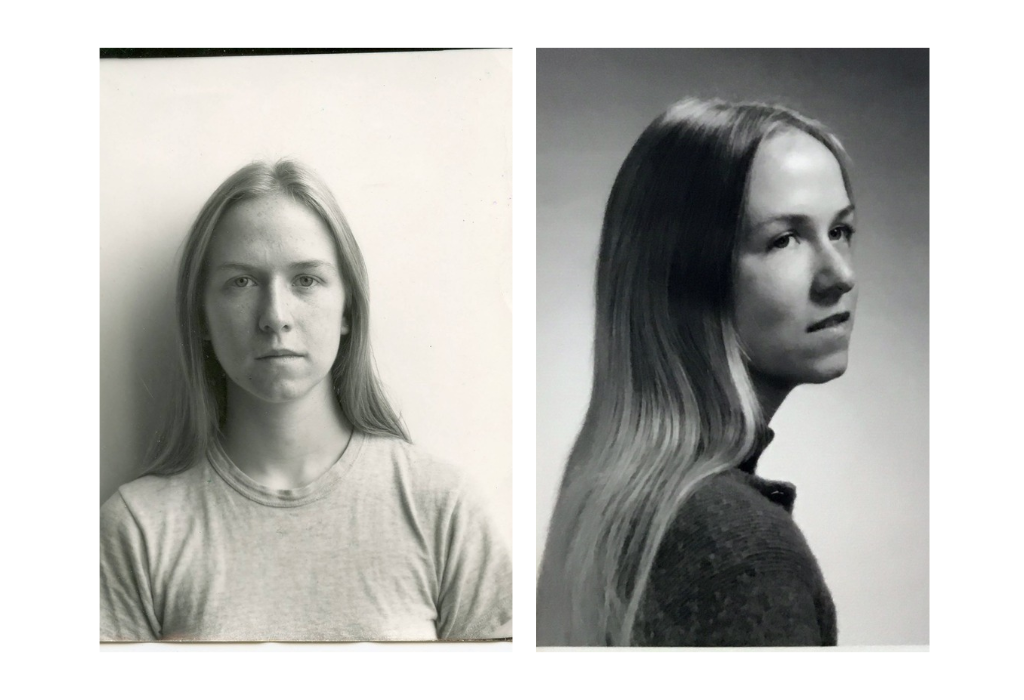
Taken a year apart, the first photo makes me look like a mug shot at a reform school. This is basically how I dressed in high school. The second photo is from my first year at Mills College, a woman’s college in Oakland, California.
The two photographs above are of me, taken a year apart. The first looks like my admission photograph to a reform school; the second was taken when I was a freshman at Mills College. At Mills, an institution devoted to the education of women, we were told that we should wear white gloves when we went into San Francisco. It was 1970. With everything that was going on in San Francisco at the time, I would love to know what the administration at Mills thought we were communicating with those gloves. I never wore them. A year later I left for Bennington, where nobody cared what you wore.
What I find particularly appealing about Kate Wyler is that she has worked out what she needs from her clothes. She is not indifferent to what they communicate; in fact, she is quite sophisticated about it. She has simply arrived at a different set of priorities from those of the people entrusted with dressing her. And what she wants to communicate about herself has far more to do with what she does than with what she looks like.
If you haven't watched The Diplomat, I highly recommend it. And pay particular attention to the clothes.