PAT JOHANSON: THE STRIPE LEAVES THE FIELD OF VISION
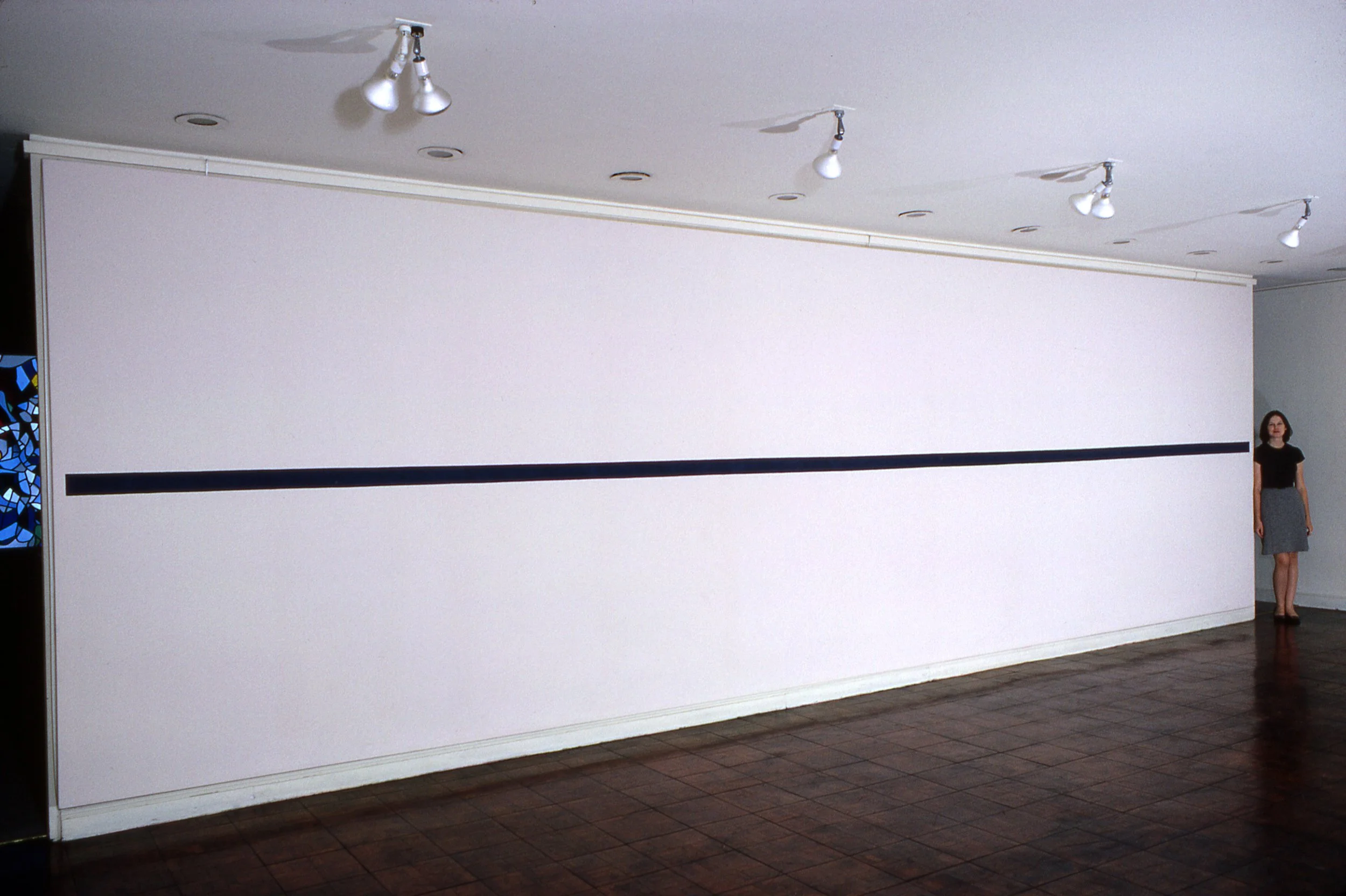
Patricia Johanson, Minor Keith, installation view
After Pat Johanson gave her talk at the Curiosity Forum, I walked her to her car.
She had come with almost nothing. A computer bag, a fanny pack, and the clothes she was wearing. She told me this was how she traveled, whether she was going to a dinner or to a site where she might have to walk through mud, look at drainage, think about water flow, plants, animals, erosion, construction, access, use. The same clothes. The same body. The same attention.
That is what stayed with me. Not just the work, though the work is remarkable, but the way she carried herself in relation to it. She did not seem to arrive anywhere with an idea to impose. She came prepared to look.
I have been thinking about this because Johanson began as a painter, and not just any kind of painter. She began with line, stripe, color, and scale. Before the environmental works, before the walkways, lagoons, gardens, dams, and public structures that made her one of the most important ecological artists of her generation, there were the long paintings.
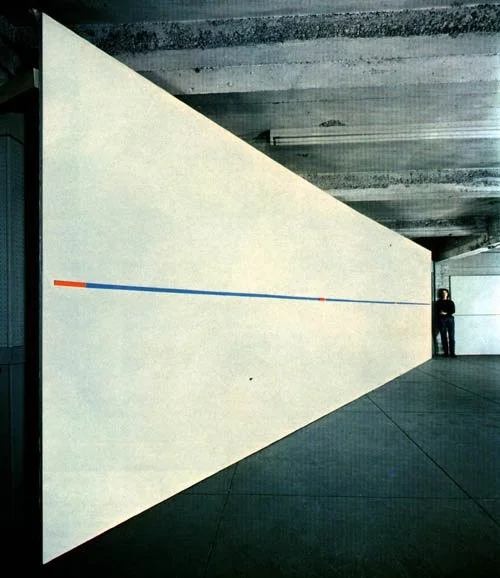
Patricia Johanson, William Clark, 1968
In 1968, her painting William Clark was included in The Art of the Real at the Museum of Modern Art. It was twenty-eight feet long: a stark white canvas bisected by a blue line marked with orange. There is something almost impossible about that description. It sounds simple, but it is not simple. A blue line on a white field. A long canvas. Orange interruptions. Scale stretched past the ordinary reach of a painting. Already, the work was asking the body to move in relation to it.
The stripe was not only an image. It was a measure.
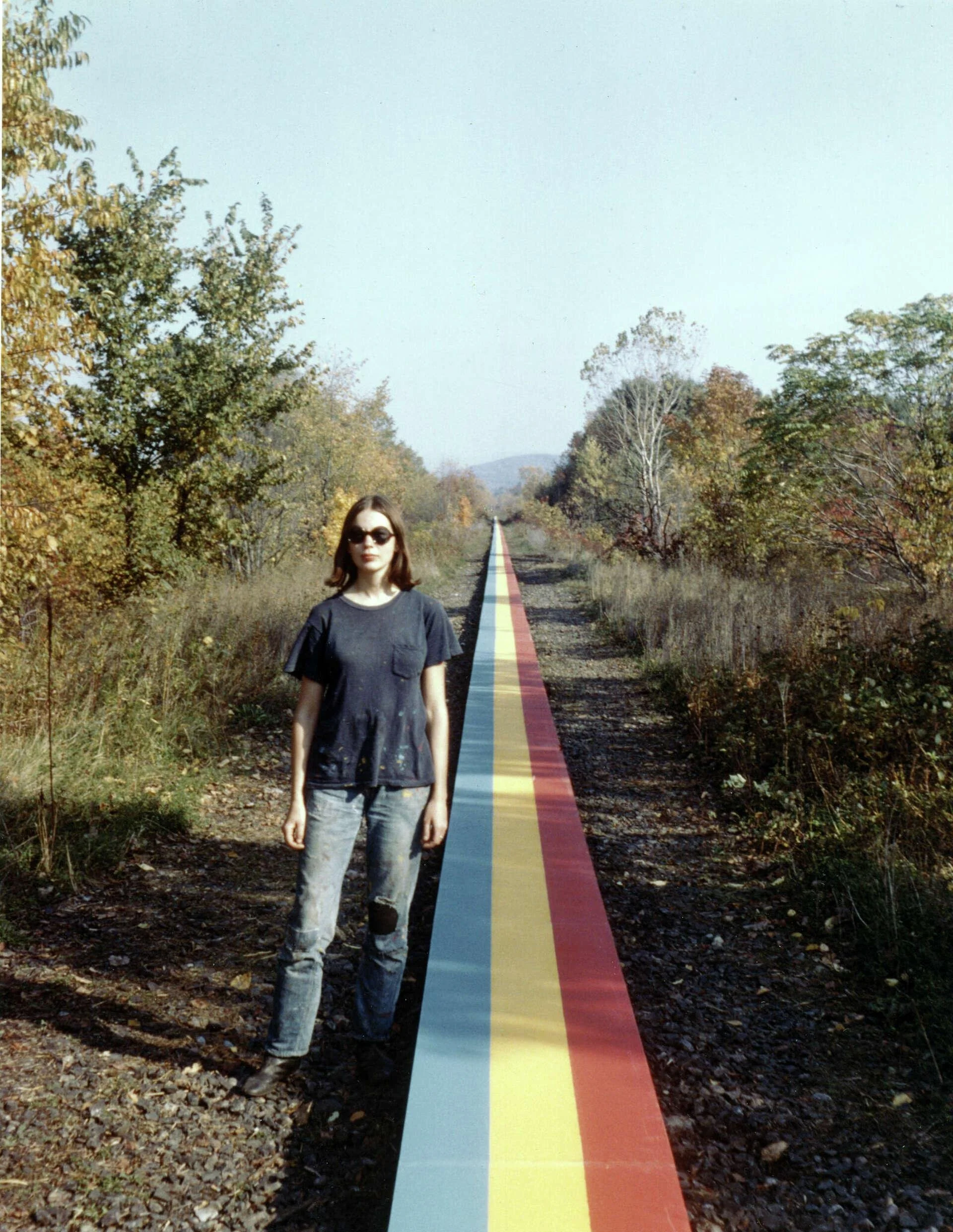
Patricia Johanson with Stephen Long, 1968
That same year, Johanson made Stephen Long on an abandoned railroad in Buskirk, New York. The work was 1,600 feet long, made of plywood planks painted in red, yellow, and blue and placed along the defunct railroad line. At that scale, the stripe no longer belonged to the wall. It entered actual distance.
Johanson later wrote that Stephen Long functioned almost like a piece of the landscape, “continually reflecting the changes going on around it.” The painted colors were not stable. Natural light altered them. At sunset, when red light fell on the work, blue shifted toward violet and yellow toward orange. Optical mixing occurred along the borders. Because the work extended beyond the viewer’s field of vision, movement mattered. Aerial views mattered. The work could not be mastered from one position.
This seems to me the essential beginning of Johanson’s later environmental work.
She did not abandon painting. She followed painting into the world.
With Stephen Long, color was no longer sealed inside the painting. It was exposed to atmosphere, time of day, weather, movement, distance, and the limits of the eye. The stripe did not sit in front of the viewer. It made the viewer move. It made seeing into an event.
That is what interests me most: the transition from the stripe as a formal device to the stripe as a way of directing attention.
My former partner, Michael Marton, filmed one of Johanson’s early works, Cyrus Field, in 1974. I have not seen the film recently, but the description of it has stayed with me because it sounded so much like Michael’s way of looking. Not a summary. Not a grand establishing shot. More the compulsion to see what was there, step by step, detail by detail, as if the only honest way to understand a work was to keep following it.
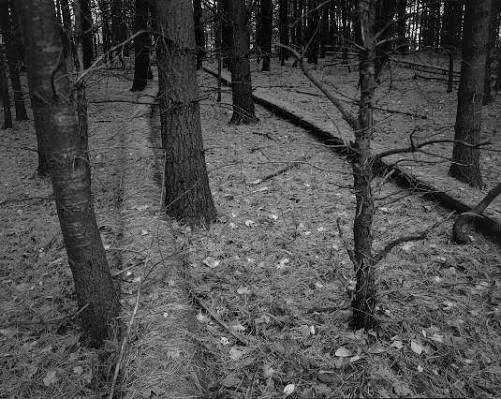
Patricia Johanson, Cyrus Field, Buskirk, New York, 1970
Michael had that kind of eye. He did not look in order to confirm what he already thought. He looked because something might reveal itself. A small irregularity. A shift. A glint. A wrong shape. In his case, that way of seeing came partly from childhood in postwar Germany, from a world where noticing could be a form of safety. But as a filmmaker, it became something else. It became attention without shortcut.
That is the link I feel with Johanson’s early work. Her stripes ask to be followed. You cannot glance at them and be done. You cannot reduce them to a pattern. Their scale defeats the usual habits of looking. They force the eye into time. This is where Johanson begins to distance herself from Minimalism, even as she uses its language.
A stripe painting can be understood as a formal reduction to line, color, interval, and field. But Johanson’s stripe paintings do not feel reductive to me. They are expansive. The line does not close something down. It opens a problem. How far can the eye see? What happens when color is stretched past the body’s ordinary ability to apprehend it? What does a painting become when it is too long to be seen all at once? What happens when the changing light of the world becomes part of the work? Once you ask those questions, the move into environmental work no longer feels like a break. It feels almost inevitable.
The stripe becomes a path. The path becomes a way through a site. The site becomes a living system.
In the early work, the viewer’s movement completed the piece. In the later work, the viewer is still moving, but now there are other lives and forces in the work as well: water, mud, fish, birds, turtles, children, runoff, erosion, plants, concrete, public agencies, weather. The work no longer exists only in relation to the eye. It exists in relation to use.
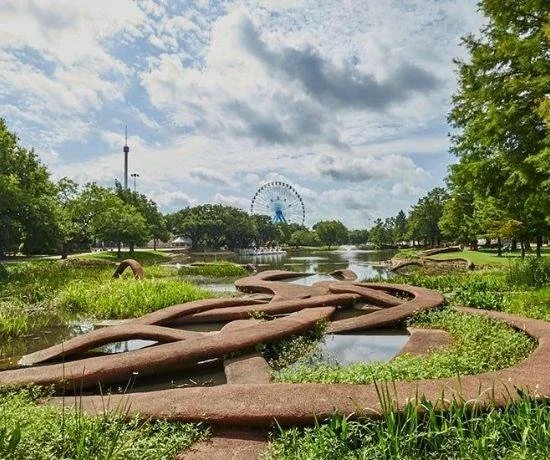
Patricia Johanson, Fair Park Lagoon, Dallas, Texas
Johanson’s first major ecological project, Fair Park Lagoon in Dallas, began in 1981. It was built in and around a flood basin beside the Dallas Museum of Art. She created a network of paths that ran through the water and helped reduce erosion while also creating habitats for fish, reptiles, and other wildlife. People could walk there. Children could play there. Turtles could use it. The sculpture was not an object set into nature. It was a structure through which people could enter a functioning ecology.
This is why the usual categories do not quite hold her. She was a painter, but the painting left the wall. She was a sculptor, but the sculpture became a walkway, a bank, a habitat, a piece of infrastructure.
She was connected to Land Art, but her relationship to land differed from the grand gestures of many of her male contemporaries. She was not cutting into the earth to leave a mark. She was asking how form could help a place function. What began as attention to line became attention to systems.
That is the part I keep coming back to. Johanson’s work did not become ecological because she added plants and animals to art. It became ecological because her way of thinking was already relational. Even in Stephen Long, the work depends on what surrounds it: light, distance, movement, the rail bed, the changing perception of the viewer. Nothing is isolated. Nothing is fixed. The stripe is not a stripe on its own. It is the stripe under red light, the stripe from the ground, the stripe from above, the stripe seen while walking, the stripe seen from too close, the stripe disappearing beyond the field of vision.
The latter environmental works enlarge this same idea. A path is not only a path. It is a way to slow erosion. It is access. It is a place from which to see water. It is something a child can run along. It is something a turtle can cross. It is a line in space, but it is also a negotiation among needs.
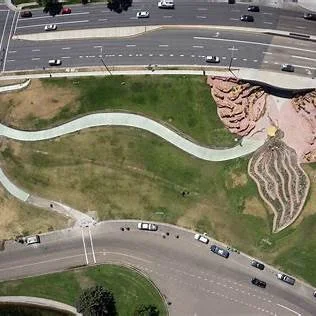
Patricia Johanson, The Draw at Sugar House, Salt Lake City, Utah
That is what made Johanson so far ahead of her time. Long before sustainability became a civic slogan, she understood that infrastructure did not have to be deadening. A flood basin did not have to be treated as an eyesore. A pump station did not have to be hidden or disguised. A public project could solve a practical problem and still ask people to notice where they were. This is where beauty enters.
Johanson once recalled Buckminster Fuller telling her not to think about beauty when solving problems. Solve the problem first. But she went on to say that if the solution comes and it is not beautiful, it is wrong. That is not a decorative idea of beauty. It is more demanding than that. Beauty, in Johanson’s work, is evidence that the solution has found the right relation among things. Water, use, structure, plant life, animal life, human movement, color, scale, time.
I think again of her getting into her car after the Curiosity Forum. There was no posturing, no artist's costume. Just the woman, her bag, her fanny pack, and the work that had required her to keep looking for decades.
It is tempting to call her environmental work a departure from painting, but I don’t think it was. The early stripe paintings already contain the question that would occupy her for the rest of her life: how can a work of art change the way we see what is there?
The answer grew larger.
First, a line crossed a canvas. Then a stripe crossed a railroad. Then a path crossed water. Then the work became a way of holding people, animals, plants, weather, engineering, and perception in the same field.
Pat Johanson did not leave painting behind. She kept extending its field until the field included the world.
YOU MAY ALSO LIKE: