
THE INVENTOR WHO ACCIDENTALLY DYED THE BRITISH ARMY RED
I found Cornelis Drebbel the way you find the best characters: in a footnote in someone else’s story.
He turns up in Amy Butler Greenfield’s A Perfect Red, which I’m reading this month, as the man behind the brilliant scarlet that made cochineal even more valuable than it already was. But the dye was only one piece of him. Drebbel was an inventor, an engraver, a chemist, a maker of improbable machines, and, apparently, a man spectacularly bad at converting genius into money.

He was born in Alkmaar, Holland, in 1572, trained as an engraver, and eventually made his way to England, where King James I became his patron. If you begin listing his inventions, he starts to sound fictional. A “perpetual motion” clock powered by changes in air pressure and temperature. Early experiments with thermometers. Possibly an early compound microscope. Self-regulating ovens. Fountains. Optical devices. Court entertainments. Then, because that was not enough, he built a submarine.
Not a drawing. Not a fantasy. A working vessel.
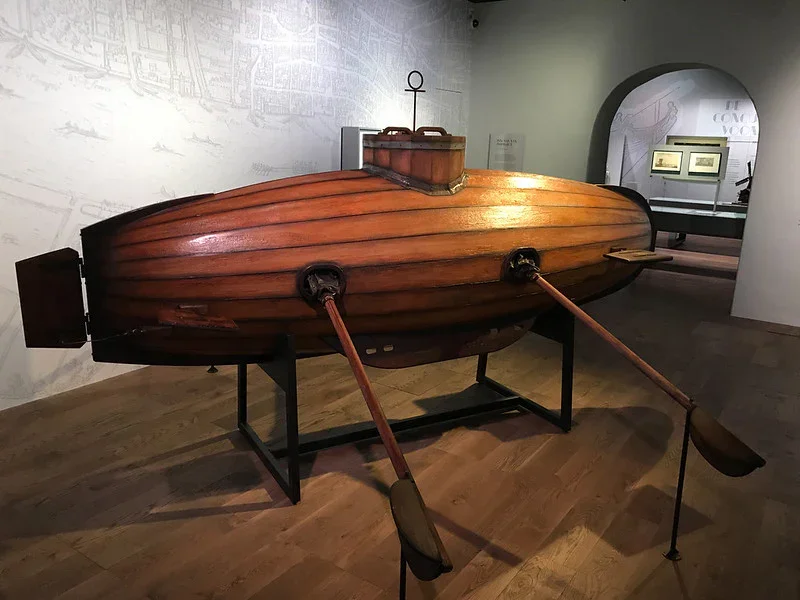
A prototype of one of Drebbel's smaller submarines is shown in the picture above. It was shown during the 2017 Gamechangers Exhibition in Amsterdam's Maritime Museum.
Around 1620, Drebbel built what is generally considered the first navigable submarine: a wooden boat sealed with greased leather, propelled by oars, and designed to travel under the surface of the Thames. The famous story is that King James himself climbed aboard and became the first monarch to travel underwater. I love that story. I also distrust it. The best version of any historical anecdote is often the one that has had a hundred years to improve itself.
What seems safer to say is this: Drebbel built the thing. It submerged. It moved. It impressed people. It was strange enough that people kept talking about it for centuries.
The Royal Navy did not buy one.
This is already a familiar story. The inventor sees the future. Everyone else sees an expensive inconvenience.
Then comes the red.
Sometime around 1606 or 1607, Drebbel was working with a colored liquid for a thermometer when, according to later accounts, a tin solution in aqua regia spilled into cochineal. Cochineal was already famous. It was one of the great luxury dyes of the early modern world, made from tiny insects grown on cactus in Mexico and guarded fiercely by the Spanish. But with the usual alum mordants, cochineal could produce pinks, crimsons, and reds that did not quite have the blazing authority of true scarlet.

Cochineal (Dactylopius coccus) are immobile scale insects native to tropical and subtropical South America, as well as Mexico and Arizona. These insects live on the pads of prickly pear cacti, feeding on the plant’s moisture and nutrients.
Tin changed that.
Whether the discovery really happened as an accident, with smoke and spilled liquid and a dramatic laboratory mishap, I do not know. The story comes down to us too neatly. But the chemistry was real. Tin pushed cochineal into a brighter, sharper, more stable scarlet. It made red more red.
This is the part that gets me. Drebbel did not become rich from it. He did not build a great dye empire. He did not even get his name attached to the color in any lasting way. He died in London in 1633, poor enough that the last version of his life has him running an ale house.
The business came later. His sons-in-law, Abraham and Johannes Kuffler, took the formula and opened a dyeworks at Bow, London, in 1643. The color became known as “color Kufflerianus,” or Bow dye.
Not Drebbel red. Kuffler red.
There is something almost perfect about that. You invent a color that changes European cloth, and history files the paperwork under your in-laws.
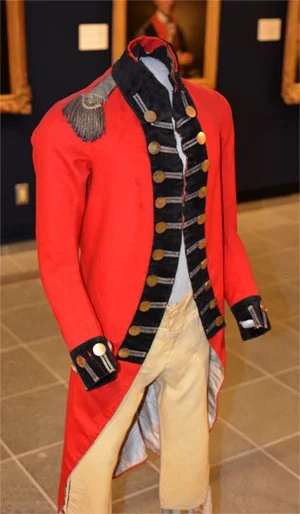
The red kept going. Officers in the British Army wore coats dyed in brilliant cochineal scarlet, while ordinary soldiers often wore the cheaper, duller madder red. So the color was not just decorative. It was rank. It was money. It was hierarchy made visible at a distance.
That is what I love about the history of materials. A color is never only a color. It carries trade routes, accidents, insects, chemistry, secrecy, money, labor, vanity, and war. Scarlet was not simply beautiful. It was expensive. It said so from across the room.
Drebbel built a submarine before navies knew what to do with one. He found a better red and did not profit from it. He moved through the courts of kings and emperors and ended up broke in London.
He has a lunar crater named after him now.
That seems like a very Drebbel kind of consolation prize.
A red-coat from Ticonderoga.