
THE PAINTER AND THE SULTAN: How a Venetian Artist Walked into Another World and Never Quite Came Back
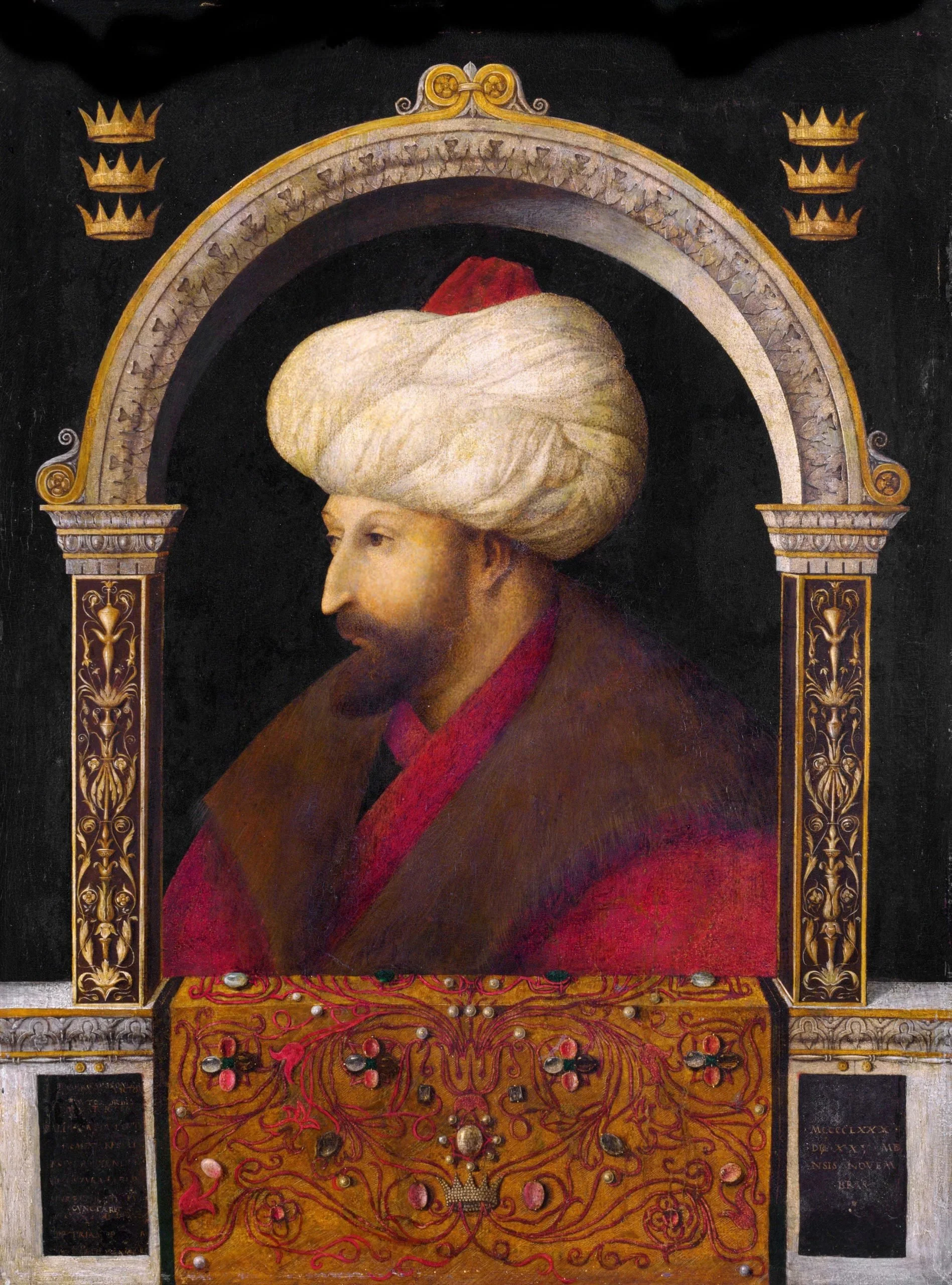
There is a portrait of Sultan Mehmed II in the National Gallery in London that has been nagging at me for years.
The first time I saw it, I was not thinking about diplomacy, trade, or the fall of Constantinople. I was looking at the painting itself.
The arch around the figure did not feel like ordinary Renaissance architecture to me. It felt like the edge of a manuscript page. The decorated cloth, the jewels, the gold, the contained darkness behind the Sultan, all of it seemed closer to ornament, calligraphy, and courtly display than to the kind of Venetian portrait I thought I knew.
Even the profile seemed to have crossed a border.
Something about the painting felt translated. Not wrong. More like a sentence spoken in another accent. The grammar was familiar, but something underneath it had shifted.
What surprised me was that the painter was Gentile Bellini.
The Bellinis were not marginal figures in Venice. They were the family business. Jacopo, the father, had established the workshop. Gentile, the older son, became the official painter of the Republic. Giovanni, the younger brother, became the painter whose portraits and altarpieces seem to hold light inside them. Together they formed one of the great painting dynasties of the Venetian Renaissance.
Before we get to the Sultan, it helps to look at what the Bellinis knew how to do.
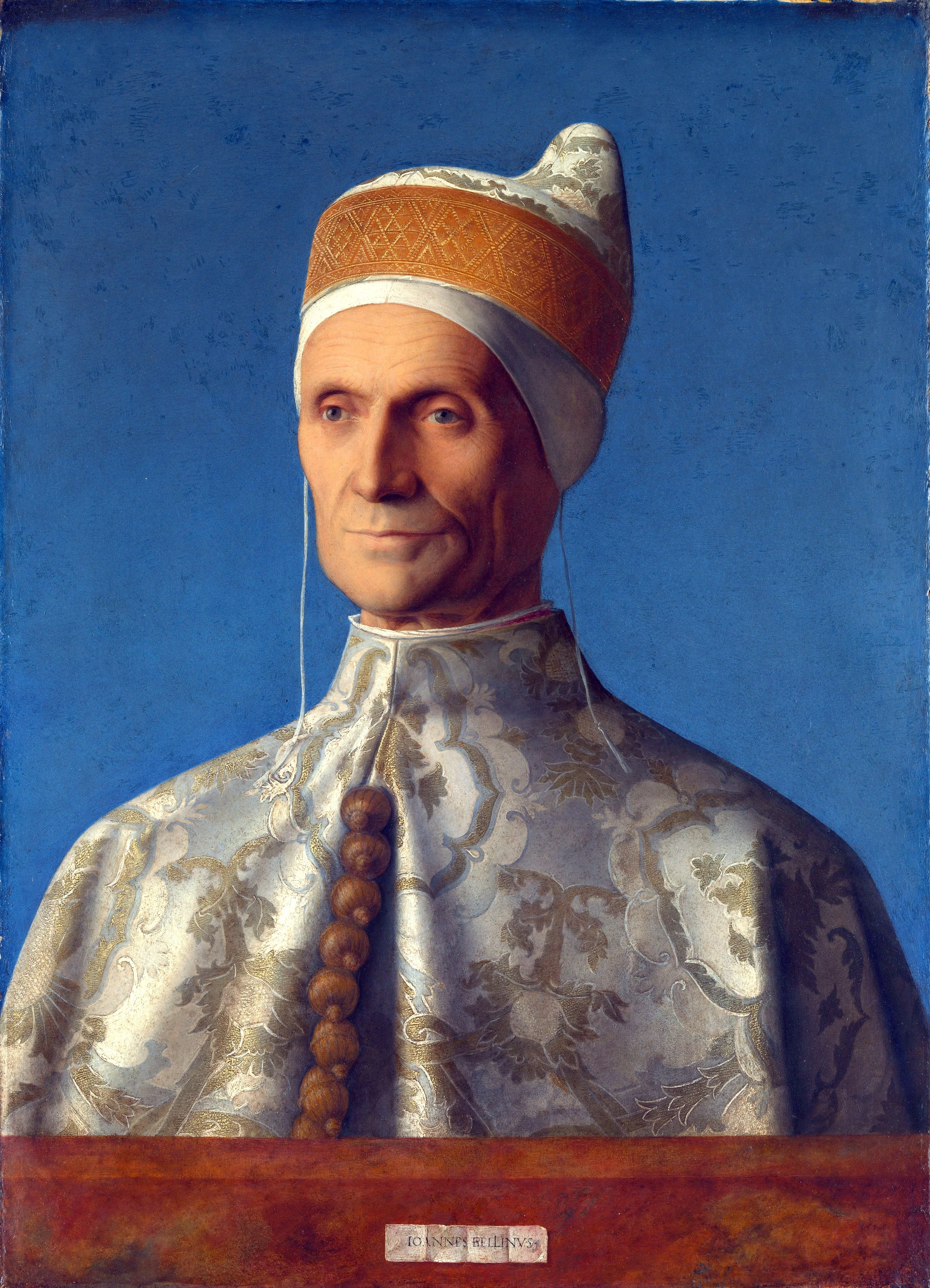
Giovanni Bellini, Doge Leonardo Loredan, about 1501–2, National Gallery, London
Giovanni Bellini’s portrait of Doge Leonardo Loredan is almost unbearably controlled. The doge faces us in three-quarter view, dressed in white and gold, set against a blue field that has air in it. The face is modeled by light. The skin has weight. The robe has texture. He is both man and office, body and state.
He is not exactly available to us. That is part of the point. He knows he is being looked at, but he does not meet us as an equal. He is Venice looking back at itself in ceremonial form.
Gentile’s doge portraits operate differently. They are more official, more emblematic, closer to the image of authority than to the intimacy of a person sitting across from you. He knew how power wanted to be seen.
That may be the most important thing about him.
Because in 1479, Mehmed II asked Venice for a painter.
Not just any sitter. Mehmed the Conqueror. The man who had taken Constantinople in 1453. The ruler of an expanding Ottoman empire. A man interested in European culture, yes, but also in power, strategy, technologies, objects, images, and anything else that could enlarge the idea of rule.
Venice sent Gentile.
It was a diplomatic mission disguised as an artistic commission, or an artistic commission doing diplomatic work. Gentile crossed the Mediterranean and entered a court whose visual language was not his own.
That is where the story becomes interesting.
Mehmed did not need a Venetian painter because his own court lacked artists. That is the dull version of the story. He wanted something specific. Italian painters had developed a way of making the human face appear present, weighted, particular, almost physically there. A person could be made to seem as if he occupied the same air as the viewer.
For a ruler, this was not a small matter.
A portrait is never just a likeness when power is involved. It is a claim. It says: This is the face of authority. This is how I am to be remembered. This is how I enter the minds of people who may never stand before me.
Mehmed seems to have understood that. He had already shown interest in Italian medals and portraits. He knew that images could travel where armies, treaties, and ambassadors could not. So he asked Venice for a painter, and Venice, always alert to trade, diplomacy, and advantage, sent him one of its best.
I imagine Gentile arriving in Constantinople and trying to make sense of what he was seeing.
This is not history now. This is looking.
He would have seen textiles, tiles, carpets, metalwork, manuscripts, architectural ornament, objects in which pattern was not decoration added after the fact, but a whole way of thinking. He would have encountered a culture in which calligraphy had the status painting held in Venice, and where a page could be as complete, as dense, and as controlled as an altarpiece.
It is difficult to imagine that he did not see manuscripts. Mehmed’s library was famous. Persian and Ottoman books circulated through courtly life, and Gentile was not a tradesman admitted through a side door. He had been invited by the Sultan himself. If you invite a Venetian painter across the Mediterranean because you are curious about European picture-making, you do not hide your own pictures from him.
And Gentile, to his credit, appears to have looked.
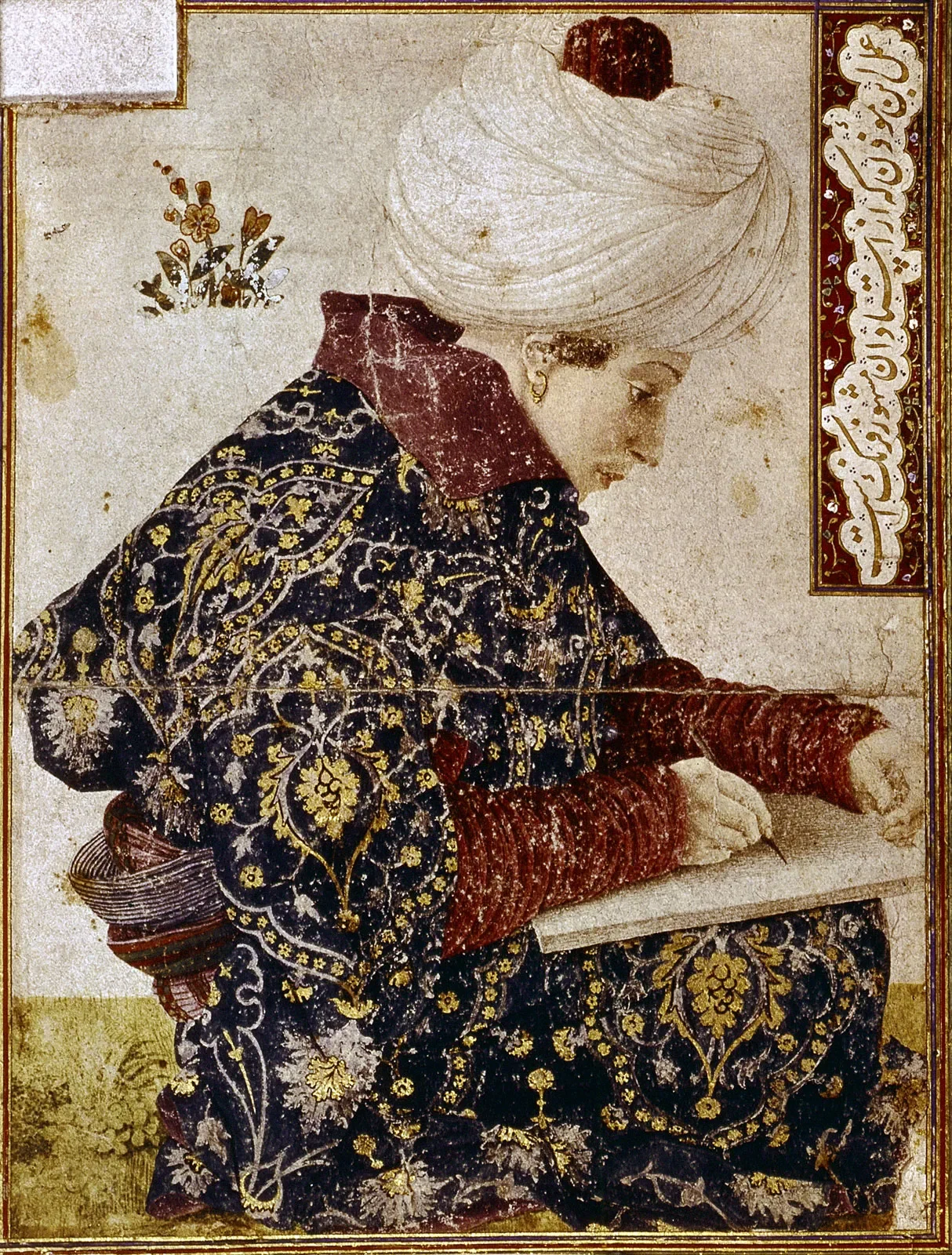
Gentile Bellini, Seated Scribe, 1479–81, Isabella Stewart Gardner Museum, Boston
The Gardner Museum has a small work by Gentile called Seated Scribe, made during or just after his stay in Constantinople. It is a man seated cross-legged, bent over his writing pad, wrapped in the concentration of his own task.
The drawing is not Gentile doing Venice in Ottoman costume. It is more intimate than that. The line is flatter. The figure is patterned rather than sculpted by light. The space does not open behind him in the usual Western way. The man sits inside the page.
That is what moves me about it. Nobody needed this picture from him. It was not a state portrait. It was not a grand commission. It has the feeling of a painter teaching his hand another language.
He was not just observing the difference. He was practicing it.
Then comes the portrait.
Gentile Bellini, Portrait of Sultan Mehmed II, 1480, National Gallery, London
The first thing that struck me, and still does, is the arch.
In many Renaissance portraits, architectural framing creates the illusion of a world behind the sitter. A window opens. A landscape appears. A room is implied. Space behaves itself.
Here, the arch does something stranger. It does not release Mehmed into space. It contains him. He is held within it the way a figure might be held inside the border of a manuscript page.
Then there is the cloth draped over the ledge in front of him. Gentile gives us embroidery, jewels, pattern, and surface. The textile does not simply sit there as an accessory. It announces another set of values. The eye not only moves into depth. It moves across the surface.
And yet the face is Gentile doing what Mehmed asked him to do.
The Sultan has weight. The skin is modeled. The features are particular. The mouth, the nose, the downward turn of the eye, the soft heaviness of the face, all of it insists on the presence of one man. Not an emblem. Not a type. This person.
That is the collision I cannot stop looking at.
The painting is not simply Western realism brought to an Eastern court. It is not simply an Ottoman ruler dressed up in a Venetian format. It is stranger and better than that. Gentile seems to have made a picture that could speak in two directions at once.
The face says: I can give you presence.
The frame says: I know I am not in Venice anymore.
Whether Gentile did this deliberately, as an act of visual diplomacy, or whether it happened because two years in Constantinople had entered his eyes, I do not know. Probably both. Artists are always more porous than they pretend to be.
That may be the part of this story I care about most.
We like to imagine influence as a clean transaction. One culture gives, another receives. One artist teaches, another learns. But looking does not behave that neatly. You go somewhere. You think you are there to perform a task. You are the expert. You have been summoned because of what you know.
Then something gets in.
A border. A textile. A way of placing a figure in space. A different respect for surface. A different understanding of what makes an image powerful.
You go home, but not entirely.
Gentile returned to Venice in 1481, honored by Mehmed and restored to his place in the Republic. But the East did not disappear from his work.
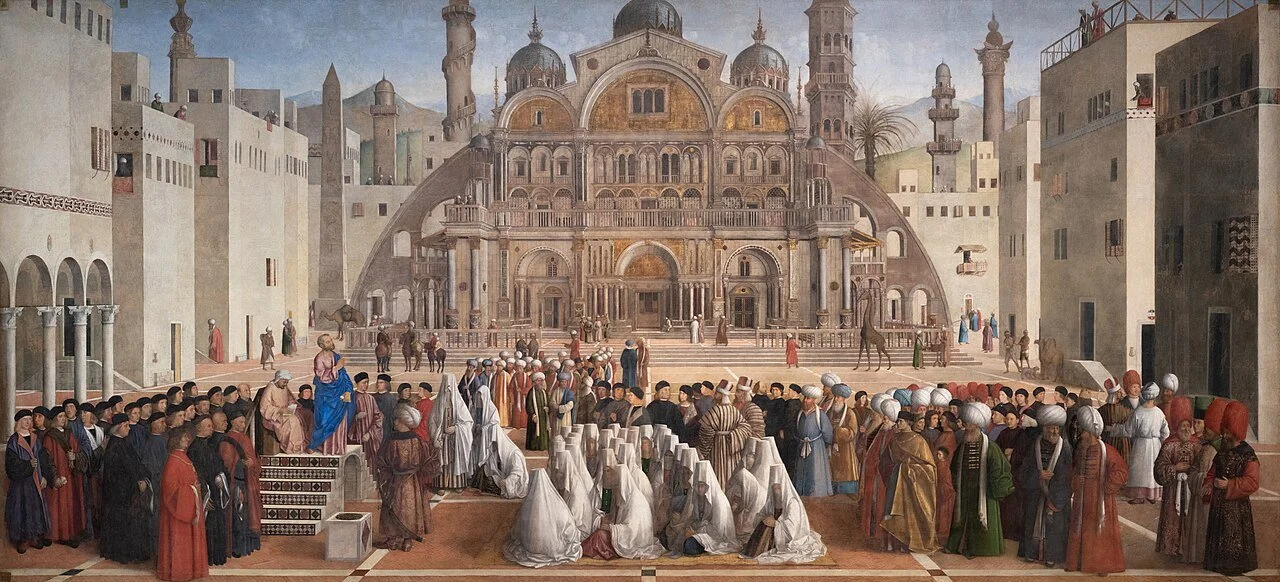
Gentile Bellini and Giovanni Bellini, Saint Mark Preaching in Alexandria, begun 1504, Pinacoteca di Brera, Milan
Near the end of his life, Gentile began Saint Mark Preaching in Alexandria, an enormous painting now in the Brera in Milan. It is supposed to show early Christian Egypt, but what Gentile gives us is something much more unstable and alive: turbans, veils, minarets, Islamic architecture, animals, ceremonial crowds, a world assembled out of memory, travel, invention, and Venetian theatricality.
He is painting Alexandria, but Constantinople is still there.
Gentile died in 1507 before he could finish the canvas. Giovanni completed it at his brother’s request. Which brings us back to the family.
One brother stayed in Venice and made images of such luminous authority that they seem to have been breathed into existence. The other crossed the Mediterranean, painted a Sultan, looked hard at another visual world, and came back altered.
Gentile interests me because he is the Bellini who left Venice.
He carried the family training with him to Constantinople, but he did not simply impose it on what he found there. He looked. He adjusted. Something entered his hand.
That is why he belongs in this story.
The encounter between Gentile Bellini and Mehmed II is often told as a story about a Western painter bringing realism to an Eastern court. That is true as far as it goes, but it does not go far enough.
The better story is reciprocal.
Mehmed wanted to see himself through Venetian eyes.
Gentile came home with Ottoman light still lodged in his own.