
Jacopo Bellini, Drawing from the Louvre Sketchbook, c. 1450, Leadpoint on parchment, 426 x 286 mm,
Musée du Louvre, Paris
Jacopo Bellini is the Bellini nobody remembers. Giovanni gets the museums, and Gentile gets the Sultan's portrait. Jacopo, their father, gets a footnote, mostly because almost everything he painted is gone. His most famous work, a huge Crucifixion fresco in Verona Cathedral, was destroyed on purpose in 1759.
What survives are his two drawing books. One is in the British Museum and the other is in the Louvre, and they are packed with something Venice had never seen before: deep, measured space. Arcades run off into the distance, and palaces turn their corners toward you with staircases you could actually climb. If you want to know where the Venetian Renaissance learned to build a room on a flat surface, you start with these pages.
I wanted to know how good he really was at it. So I took two of his Louvre drawings and put a ruler on them.
Linear perspective comes down to one idea. Parallel lines that run away from you appear to meet at a single point, and that point sits on a horizontal line at the height of your eye. Painters call it the horizon line, even indoors.
If one face of a box is square to you, everything running back into depth heads for one point. Turn the box, and each set of edges gets its own point, both on the same horizon. That's one-point and two-point perspective, and almost every architectural space in fifteenth-century painting is built from one or the other.
One-point and two-point perspective. Diagram by the author. Move slide.
The harder half is depth. Getting lines to converge is easy. The Florentines finally pinned down with geometry how much to shrink each step, each tile, each column as it recedes. Leon Battista Alberti wrote it up in De pictura in 1435, and an Italian version followed in 1436. Jacopo's earliest drawings may predate that book.
In 1425, Venice did something telling. It needed new mosaics for the façade of San Marco, and instead of hiring a local, it sent to Florence for Paolo Uccello. The Republic didn't think much of its own painters.
Uccello was the most perspective-obsessed artist alive. Vasari has him up all night with his diagrams, ignoring his wife. He and Jacopo were almost the same age (Uccello was born in 1397), and both were superb painters of animals. Both were trying to master perspective at the smae moment.
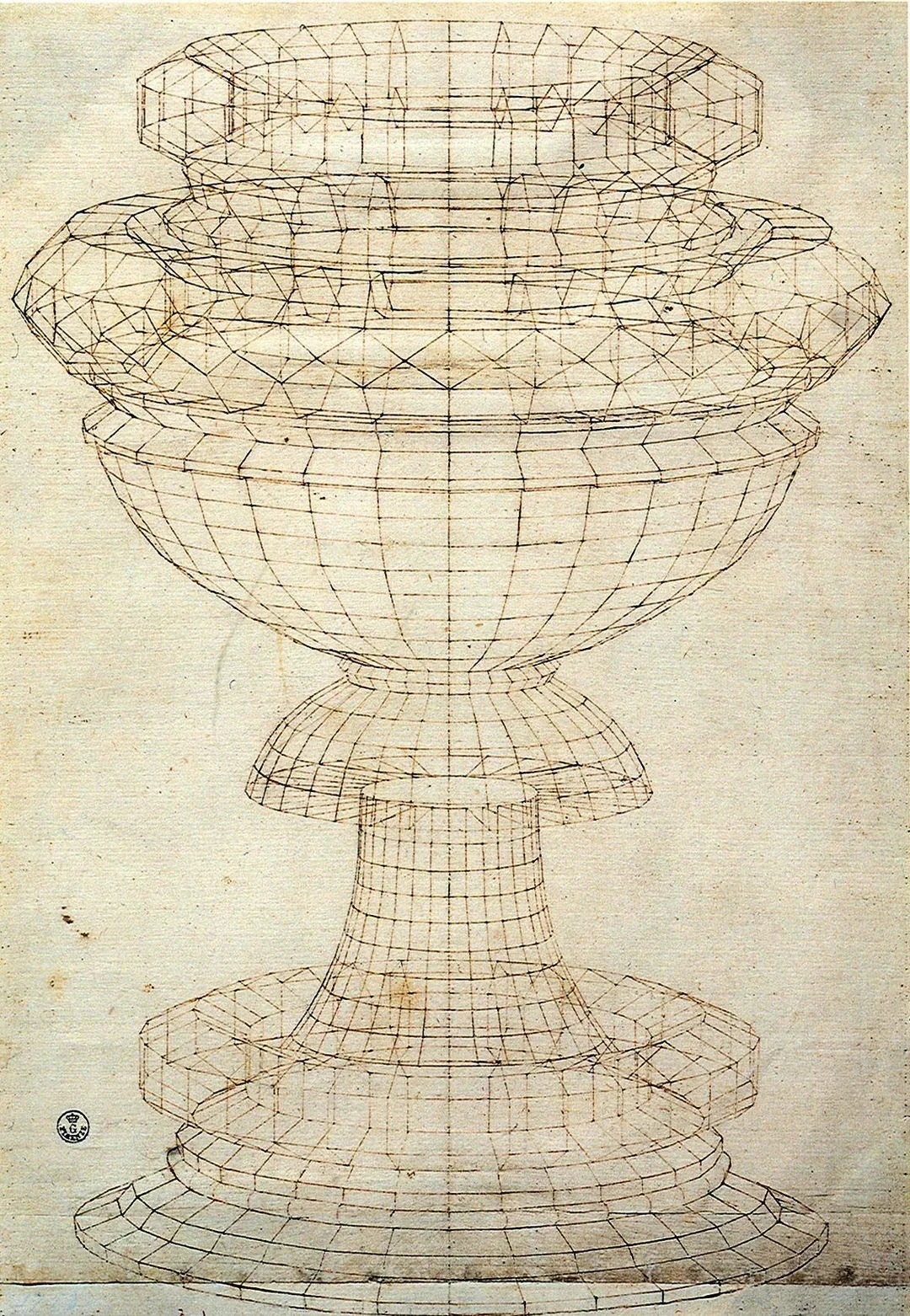
Paolo Uccello, Perspective study of a Chalice, (1450).
What I find interesting is that this wasn't master and pupil. Jacopo had been an independent master since at least 1421, when the Scuola di San Marco commissioned an altarpiece from him. Colin Eisler, whose 1989 book is still the big catalogue of Jacopo's work, suggests the influence could have run both ways. They were two peers comparing notes in the same city.
Jacopo kept company with the theorists too. A Paduan scientist named Giovanni della Fontana dedicated a treatise on perspective to him and called him the famous painter of Venice. Sadly, that text is lost.
I went in expecting to catch him out. I didn't.
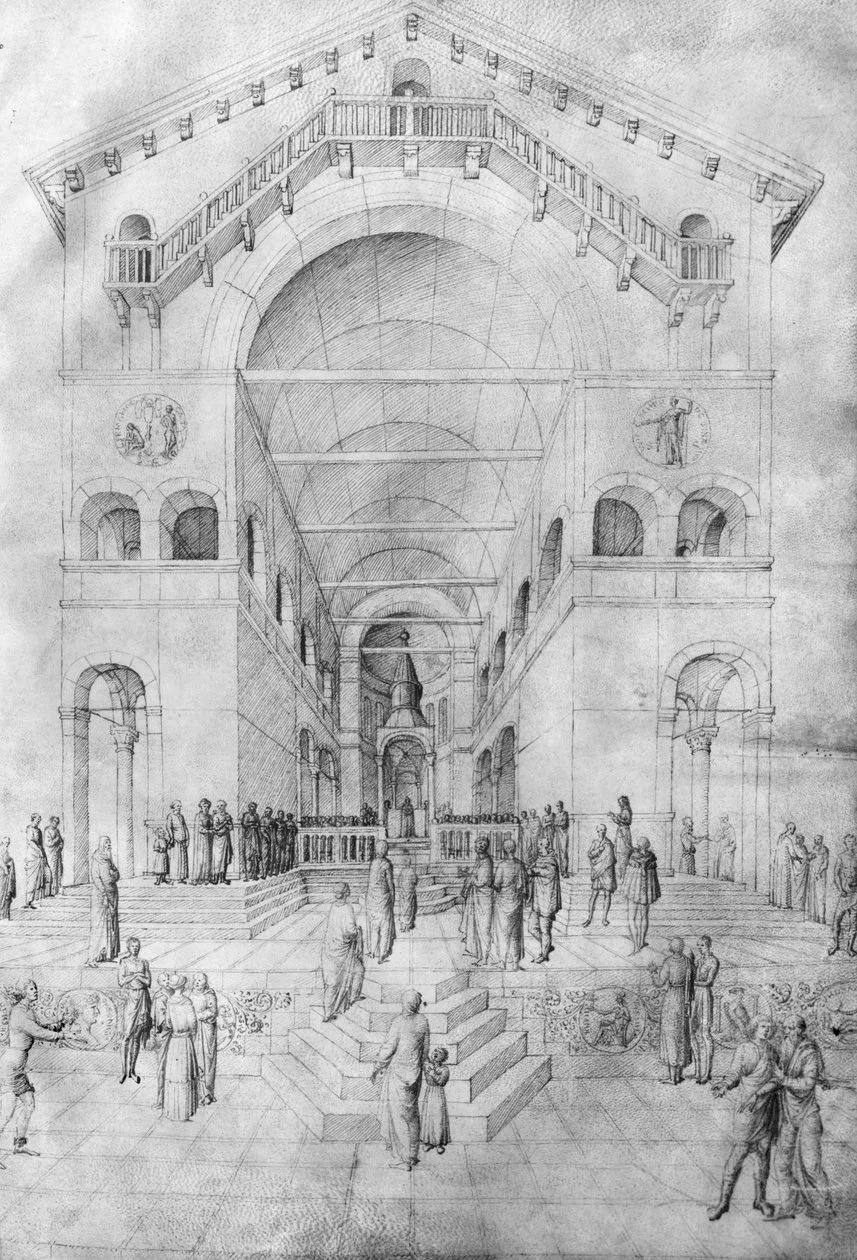
Jacopo Bellini, The Presentation of the Virgin in the Temple, pen and ink on vellum, Musée du Louvre, Paris, RF 1496, fol. 28. Photo: Studio Giraudon / Bridgeman Images.
The temple is sliced open like a dollhouse so you can see straight down the nave. When you extend the lines of the nave walls and the floor tiles, they all land on the same spot, just above the altar. Nothing is forced in the overlay. Every ochre line is traced from the drawing itself and carried forward, and they arrive at the point on their own.
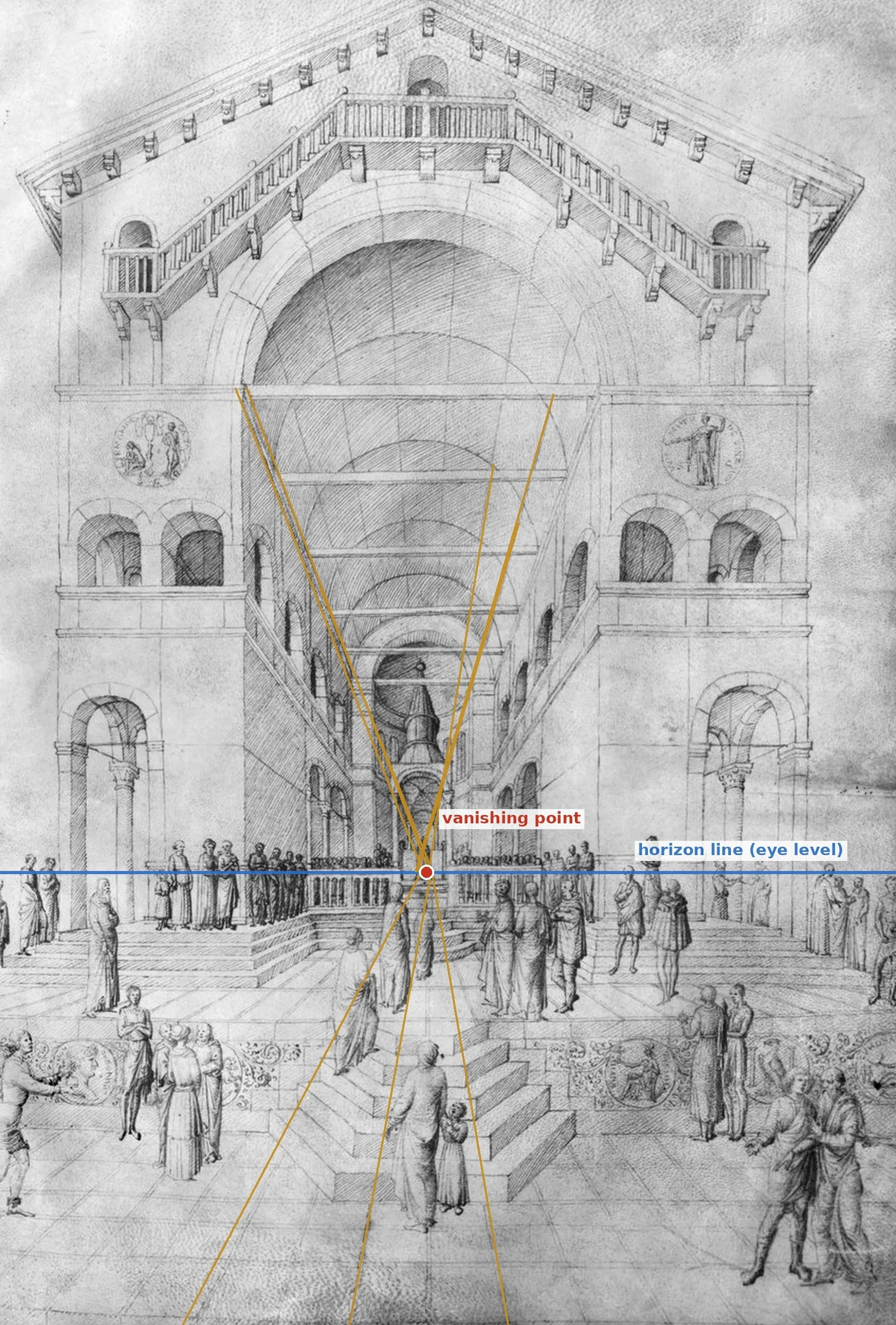
Jacopo Bellini, The Presentation of the Virgin in the Temple with its perspective traced. The nave walls and the floor all run back to one vanishing point, just above the altar.
The depth is right too, which surprised me more. The iron tie beams across the nave shrink at the correct rate for evenly spaced bays, at least from the second one back. Each transverse arch is a true semicircle, and its two ends come down on the walls exactly where its own beam meets them. That's not someone eyeballing it. That's a system.
Then there's where he puts you. The horizon runs straight through the heads of the people standing on the temple platform. You aren't down in the crowd at the bottom of the steps. You're up there among them, at their eye level, which is a lovely choice for a scene about a little girl climbing up to the temple.
The only soft spot is the first bay, from the front of the building to the first beam. It's shallower than the rest, but that could be the thickness of the façade, so I won't call it a mistake.
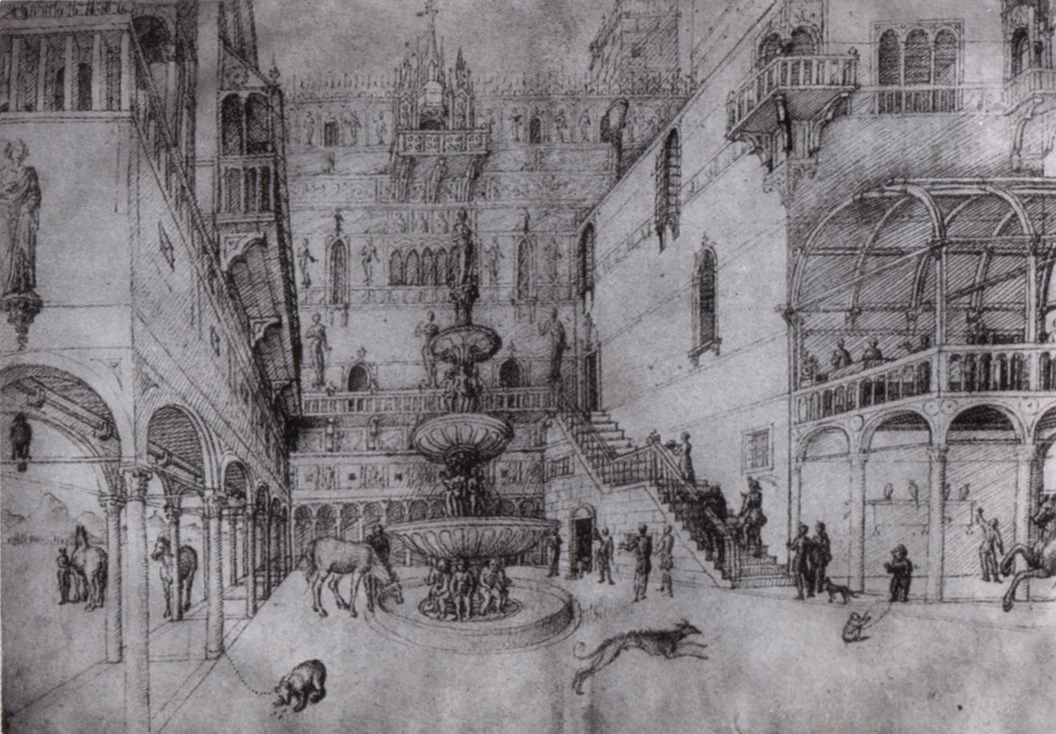
Now look at this one. Jacopo drew the Flagellation seven times across his two books, and he liked to bury Christ in a corner of some enormous palace. Here he's under the arcade in the middle of the page, tied to a column, barely bigger than the bystanders.

Jacopo Bellini, Flagellation, c. 1450, leadpoint on parchment, 426 x 286 mm, Musée du Louvre, Paris.
The palace is turned at an angle, so its long arcade runs away from us to the left. The arches do exactly what they should. Their tops step down and in as they recede, and each one is narrower than the last. By the far end, an arch is about a third as wide as the one framing Christ.
The people inside that arcade don't follow along. Look at their feet: Christ, his tormentors and the little groups of onlookers in the far arches all stand on the same level line across the page. And they barely shrink. The far figures are about seventy percent as tall as the near ones, while the arches around them have dropped to a third.
Flagellation, measured. The far arch is a third as wide as the near one, but the figures in it are about seventy percent as tall, and everyone's feet sit on one level line.
In true perspective, figures standing along a receding arcade would climb toward the horizon and shrink right along with the arches. Jacopo built the architecture in perspective and then lined the people up across the front as if they were on a stage, with the building painted on a backdrop behind them. The far onlookers end up about twice as large as they should be for the arches they're standing in.
One caution before we pile on. Eisler points out that several hands worked on these books, and that Gentile and Giovanni later went back over many faded drawings in pen. Some of these figures may not be Jacopo's line at all.
So he could do it, and sometimes he didn't bother. The figures in the Flagellation read like a man who thought of space as a stage set and people as actors walking across the front of it.
Trace Jacopo's DNA forward and he turns up everywhere. His daughter Nicolosia married Andrea Mantegna in 1453, and Mantegna's spaces owe a great deal to his father-in-law's pages. In the 1460s Giovanni and Mantegna each painted an Agony in the Garden, both now in the National Gallery in London, and both sit close to one of Jacopo's drawings. Gentile and Giovanni kept his books for the rest of their lives and kept referring to them.
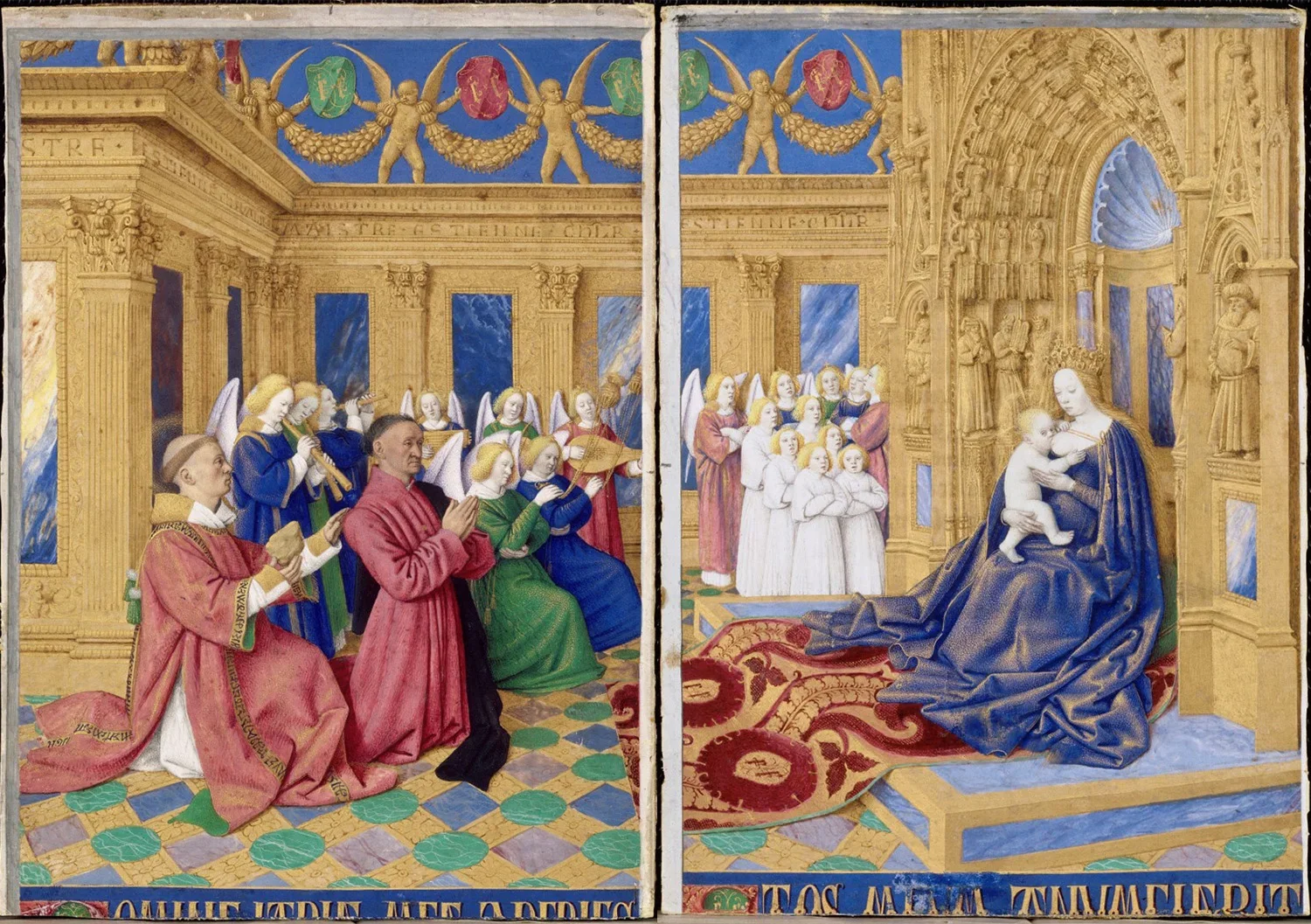
Fouquet, Hours of Étienne Chevalier, c.1450, manuscript on vellum.
The strand I like best goes north. Eisler argues that Jean Fouquet, the greatest French painter of the century, learned his command of perspective from Jacopo's art during his Italian trip in the 1440s. Fouquet was in Rome in the mid-1440s, where he painted Pope Eugenius IV, a Venetian. No document puts the two men in a room together, so treat this as Eisler's reading rather than fact. But look at the receding loggias in Fouquet's Hours of Étienne Chevalier and tell me you don't see a little Venice in them.
YOU MAY ALSO LIKE

THE DEEP DIVE
Colin Eisler, The Genius of Jacopo Bellini: The Complete Paintings and Drawings (Abrams, 1989). The big one. Every page of both drawing books is reproduced, and his opening chapters are where the Uccello visit and the Fouquet connection come from.
Bernhard Degenhart and Annegrit Schmitt, Jacopo Bellini: The Louvre Album of Drawings (Braziller, 1984). The whole Paris book in color, at full size, in the order the authors think Jacopo himself bound it. Their notes on each sheet are the place to check which lines are his.
The British Museum Collection Online. The London book is catalogued page by page and free to browse. Jacopo's later drawings are here, looser and faster than the Paris sheets.
Leon Battista Alberti, On Painting, trans. Cecil Grayson, introduction by Martin Kemp (Penguin Classics, 1991). The rulebook itself, written in 1435, is short enough to read in an afternoon. Book One is where he builds the floor of squares.
Samuel Y. Edgerton, The Renaissance Rediscovery of Linear Perspective (Basic Books, 1975). The story of how Florence worked perspective out, told for people who don't do geometry for fun.
Martin Kemp, The Science of Art: Optical Themes in Western Art from Brunelleschi to Seurat (Yale University Press, 1990). Kemp shows how each painter actually constructed his space, mistakes included.
Giorgio Vasari, Lives of the Artists, life of Paolo Uccello. Vasari's Uccello stays up all night with his perspective drawings while his wife calls him to bed. Probably embroidered, but it tells you how the obsession looked from outside.
Jacopo Bellini, National Gallery of Art. A short, reliable biography. It describes his perspective as effective by eye even when it was less correct than Alberti's, which is exactly what the Flagellation shows.
THE FAMILY BUSINESS is my developing treatment for a television drama about the Bellini family, their workshop, and the world of Renaissance Venice.