DAVID HOCKNEY: A LIFE PROPERLY FRAMED
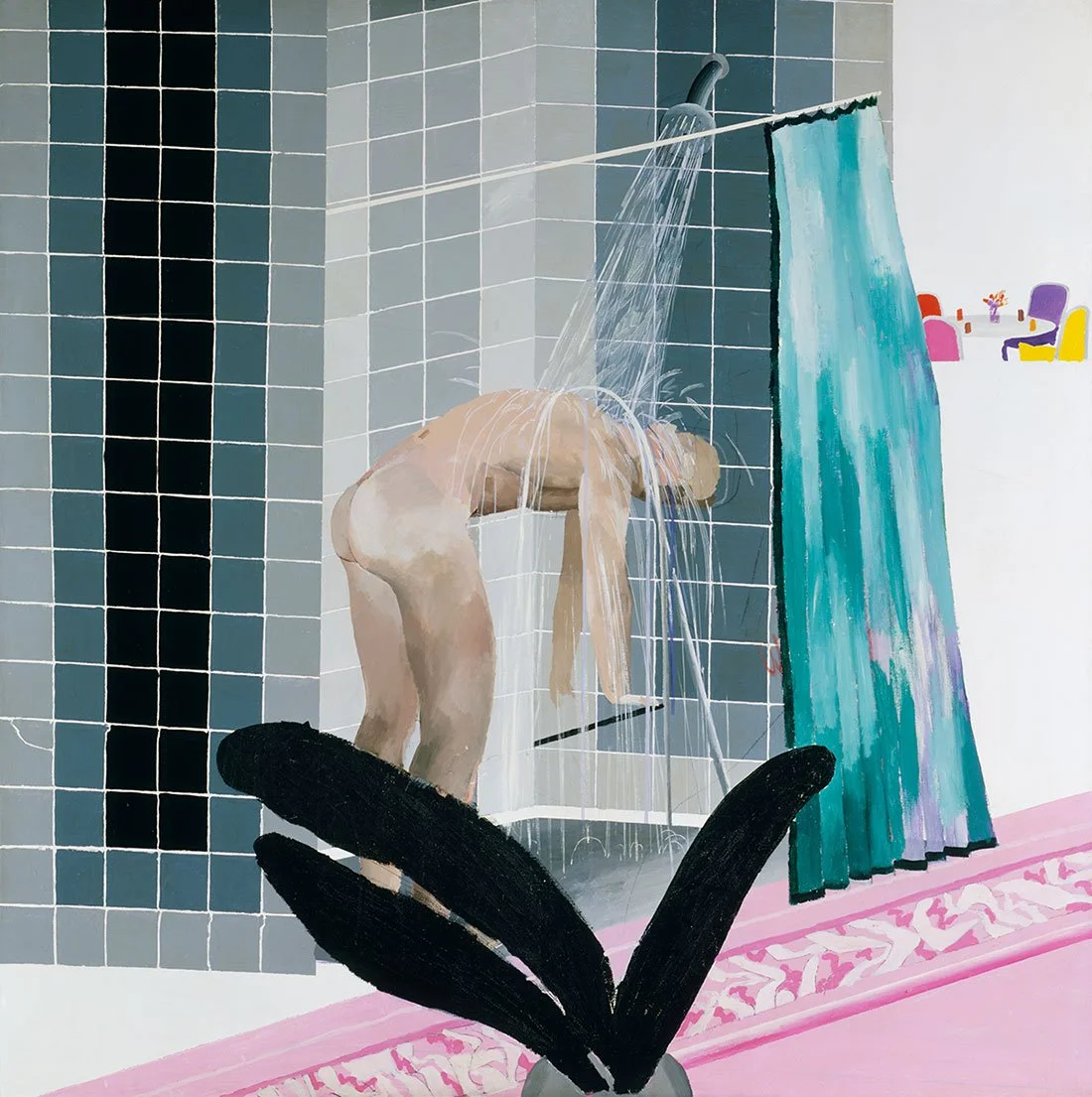
David Hockney, Man in Shower in Beverly Hills, 1964, Acrylic on canvas, 167.3 × 167 cm, Tate: Purchased, © David Hockney
I grew up with David Hockney.
Not literally. I never knew him. But his work appeared at regular intervals throughout my life as a painter, and each time it seemed that he had gone off somewhere I hadn’t expected.
When I first became aware of him, it was through his portraits, drawings, and paintings of flowers. I was struck by the fact that he was so unapologetically representational at a moment when so much of the contemporary painting around me seemed to be heading in the opposite direction. I wasn’t quite sure what to make of him. In my mind, he sat somewhere between Matisse and Fairfield Porter. There was Matisse’s flattening of space and pleasure in color, but also something of Porter’s conviction that the world immediately around you, your friends, your rooms, the flowers on the table, was sufficient material for serious painting.
His subjects were personal. His friends. His lovers. The rooms they inhabited. The places he lived. Yet somehow that very particular world became ours as well.
Then came California.
And the swimming pools.
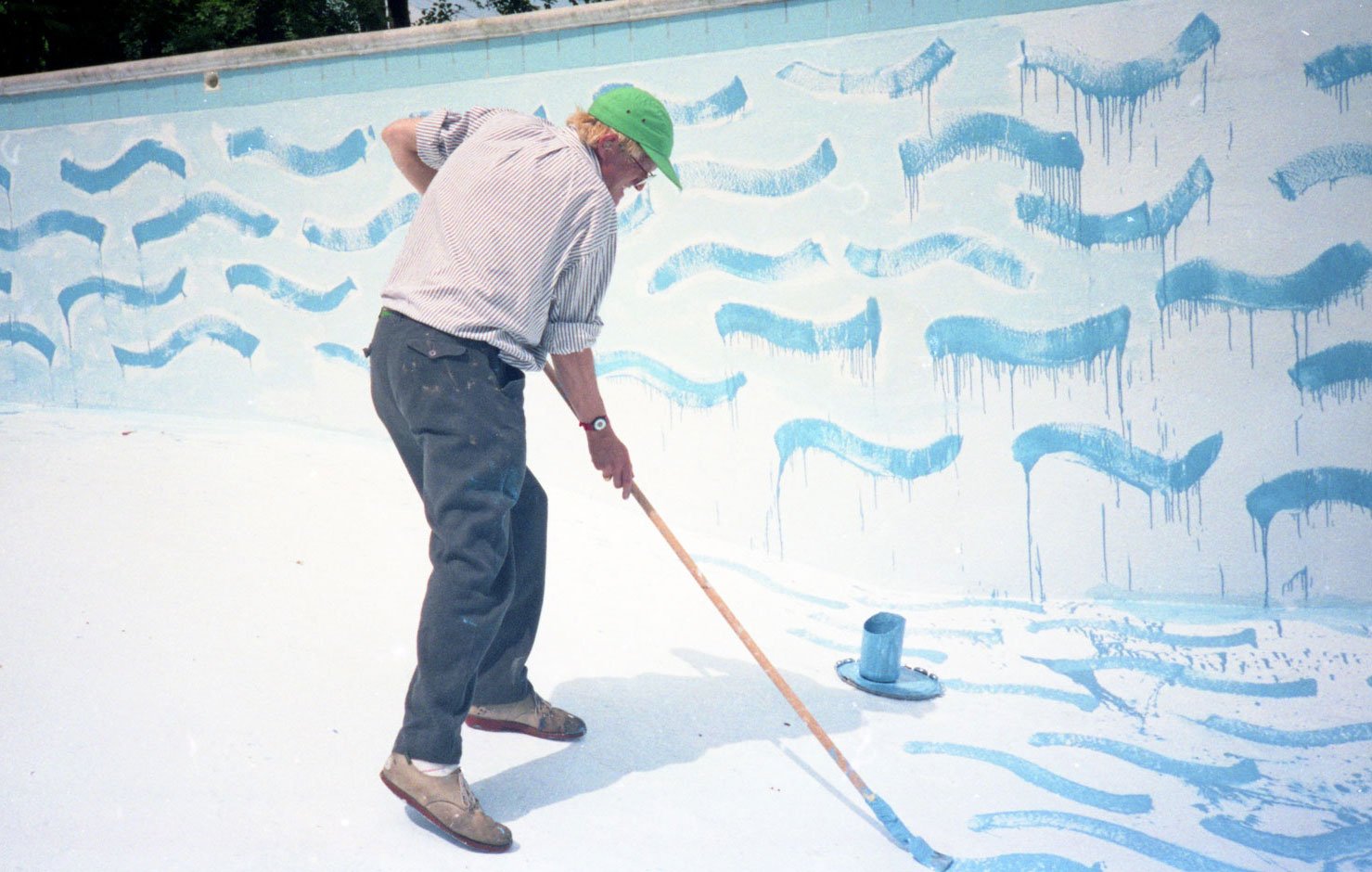
David Hockney painting Kenneth Tyler’s swimming pool, Bedford Village, New York, May 1987, photo: Kenneth Tyler, National Gallery of Australia, Canberra, Gift of Kenneth Tyler 2002
I remember looking at those paintings and thinking: How could a swimming pool be seen any other way?
That is one of the things Hockney did repeatedly. He would make an image that seemed so obvious after he had made it that it was hard to remember that the image had not always existed.
But he wasn’t satisfied with having found a way to paint swimming pools. He kept moving.
In the early 1980s he began making his Polaroid composites, photographing a subject in pieces and putting the pieces back together. Later he used ordinary photographs in increasingly complicated collages. At first I thought of them simply as photographic constructions. Eventually I understood that they were about something much more interesting: the act of seeing itself.
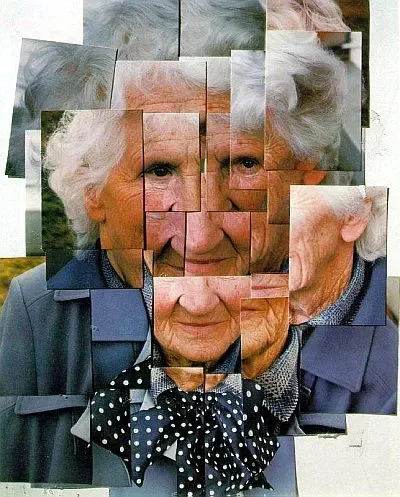
David Hockney, Mother
A camera gives us a rectangle. It fixes the viewer's position. It stops time. But that isn’t really how we see.
We turn our heads. Our eyes move. We look at one thing and then another. We move closer. We move away. Time passes while we are looking. Something that was at the edge of our attention moves to the center. Hockney became increasingly suspicious that the camera's single-point perspective was equivalent to human vision.
His photographic collages were an attempt to put some of that movement back.
By the time he made Pearblossom Hwy. in 1986, from hundreds of individual photographs, he had taken the idea remarkably far. One place could contain many acts of looking.
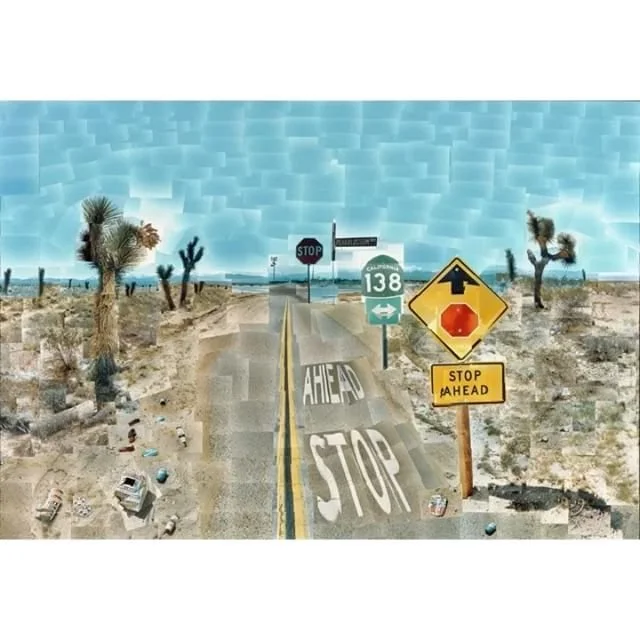
David Hockney, Pearblossom Hwy., 11 - 18th April 1986, #2
This is where Hockney became particularly interesting to me, because he never seemed to care very much about defending a medium.
He cared about the problem.
If photography could help, he used photography. If Polaroids could do something a painting couldn’t, he used Polaroids. He experimented with papermaking. He made prints. He used photocopiers. He made drawings by fax. Later he began drawing on an iPhone and then an iPad.
I loved that.
I had experimented with papermaking myself, and I understood the impulse. The question wasn’t, Am I still a painter if I do this? The question was, What can this material do?
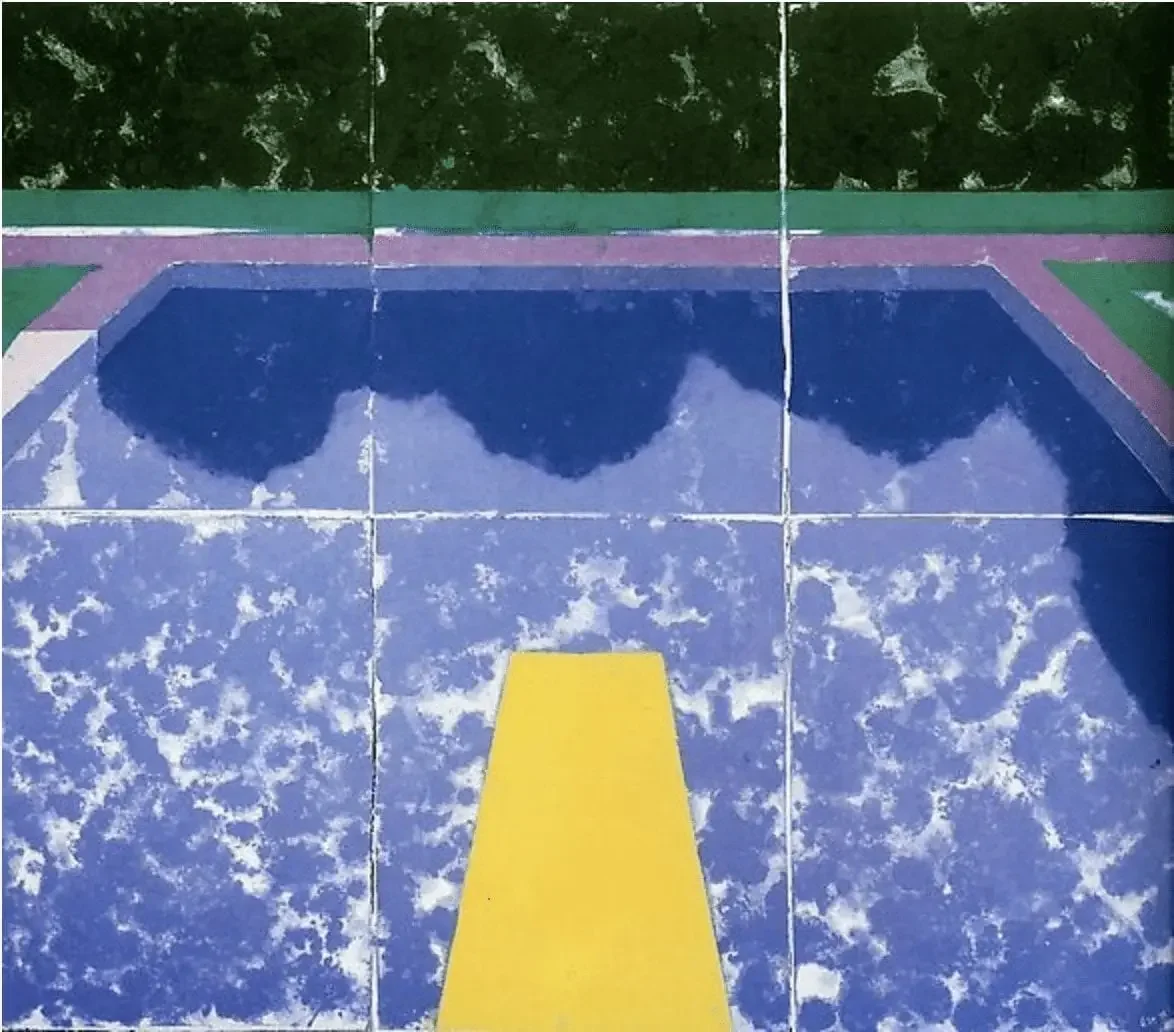
Swimming Pool with Reflection (Paper Pool 5), 1978, colored and pressed paper pulp
What interested me was not that David Hockney was keeping up with technology. It was that he was still curious.
Then, after decades in California, he went home.
In the 2000s he returned to England and began painting the countryside of East Yorkshire, the landscape around Bridlington and the Yorkshire Wolds that he had known since childhood. He went out into the landscape and painted it directly. Some of the works consisted of multiple canvases joined together into a single enormous image.
This was not Monet setting up a series of canvases and painting the same subject as the light changed. Hockney was breaking one field of vision into pieces and assembling it again. The canvases were almost tiles in a much larger act of looking.
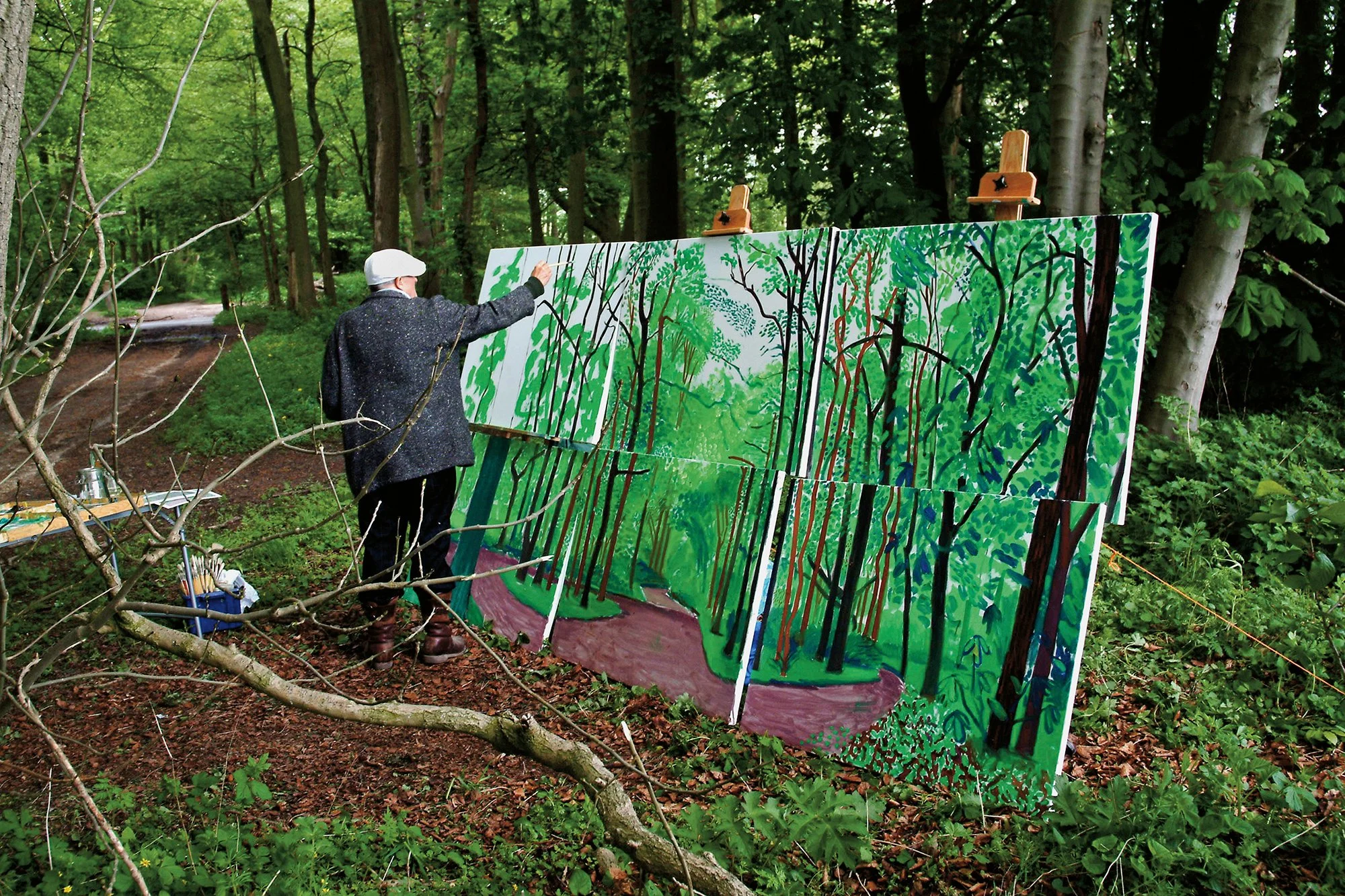
Hockney painting in Woldgate Woods, East Yorkshire. Photograph: Jean-Pierre Goncalves de Lima
And suddenly the Polaroids made sense again.
So did the swimming pools.
And the portraits.
And the iPad.
For all the astonishing variety of his work, I think Hockney spent much of his life worrying away at essentially the same problem: What do we actually see, and how can we make an image that corresponds to the experience of seeing it?
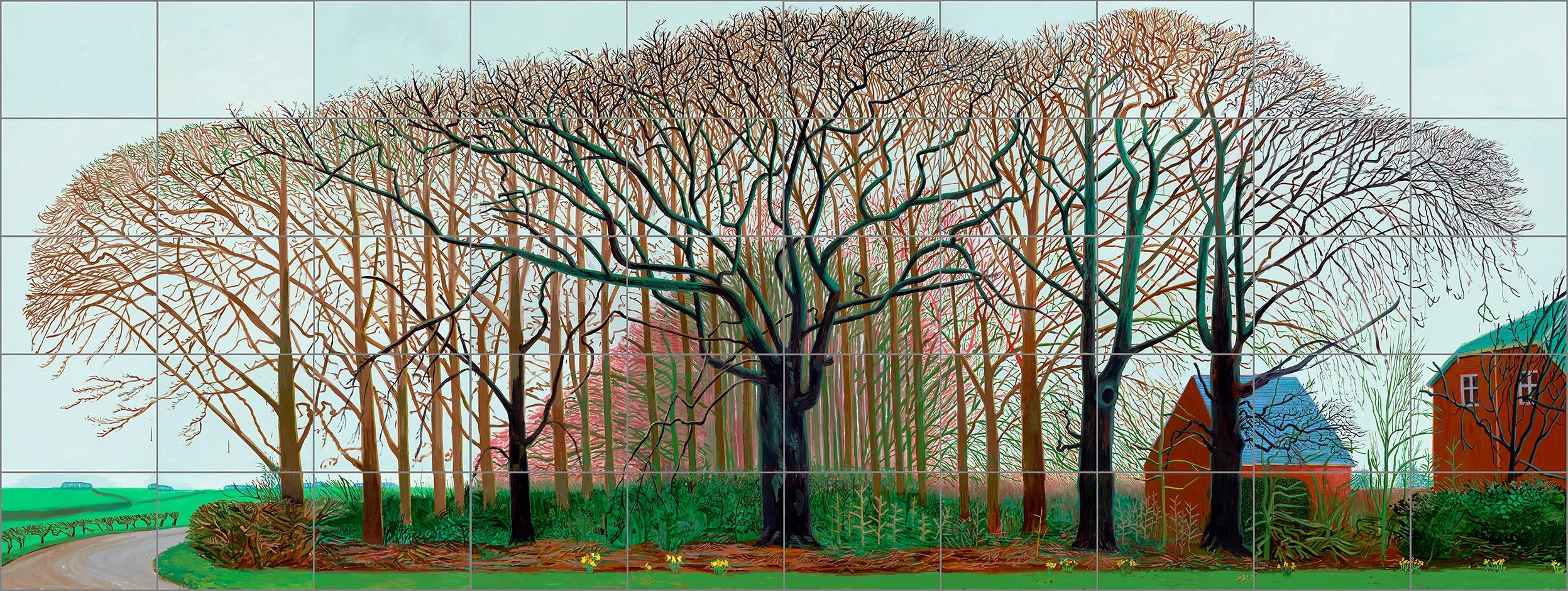
David Hockney, Bigger Trees near Warter or / ou Peinture sur le Motif pour le Nouvel Age Post-Photographique, 2007, Oil on canvas, 50 parts, each 91.4 × 121.9 cm, total 457.2 × 1219.2 cm, Tate: Presented by the artist 2008, © David Hockney
Not what does a camera see.
Not what does perspective tell us we ought to see.
What do we see?
That question kept taking him someplace new, and I was always happy to follow.
David Hockney died on June 11, 2026. He was eighty-eight.
By then his life had been extraordinarily public. We knew his houses and his friends. We knew the men he loved. We saw his dachshunds. We saw his mother. We saw the roads he drove, the rooms he occupied, the trees outside his window, and the arrival of spring. His life moved in and out of his work until the distinction between biography and subject sometimes seemed beside the point.
And then there was the funeral.
Hockney had left instructions that only two people were to attend: his longtime partner, Jean-Pierre Gonçalves de Lima, and his great-nephew Richard Hockney. No art world. No public ceremony. Two people.
I think of it as his last work.
A decision that precise seems to me an artistic act, perhaps even a final self-portrait. After a lifetime of showing us how he saw the world, Hockney left us one last image, but this time he did not make it for us. He gave us only the frame: a funeral, two people, and everyone else absent.
The rest we have to complete in our heads.
Acknowledgment: Biographical details and information about Hockney’s funeral were drawn from published accounts and material from the David Hockney Foundation.
YOU MIGHT ALSO LIKE;