
SHELL GOLD: How Renaissance painters turned scraps of gold leaf into paint
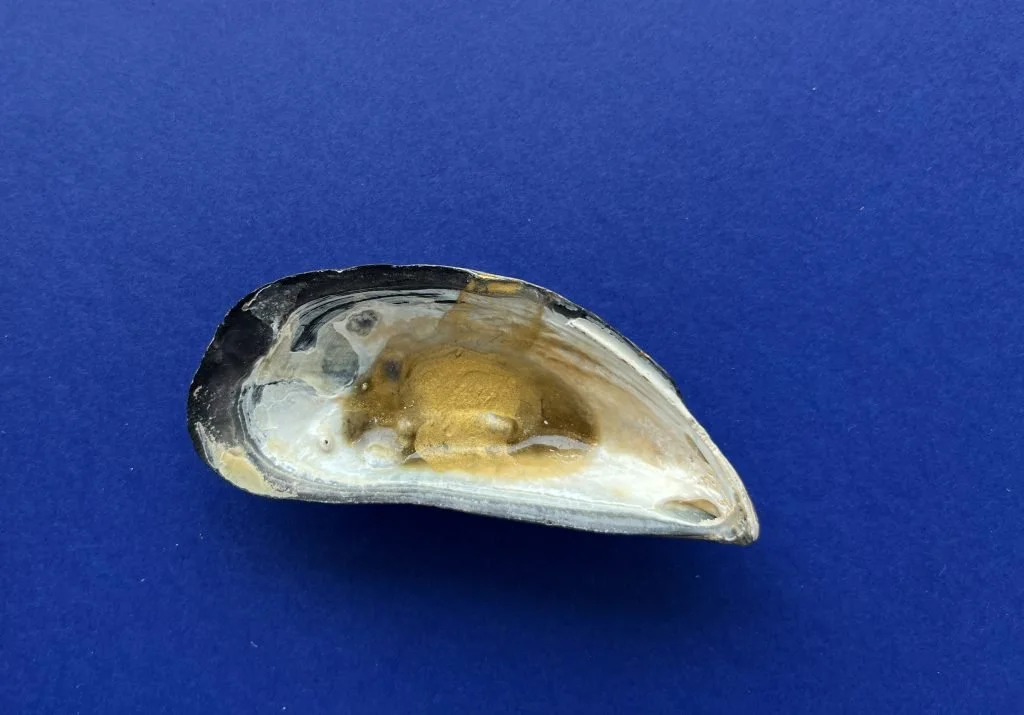
Gold leaf is extravagant, but gilding produces scraps. The leaf is so thin that it tears, folds, and extends beyond the area being covered. When the excess was brushed away, a careful workshop did not necessarily discard it. The loose pieces and trimmings—what gilders call skewings—could be gathered and made into shell gold: real gold that could be applied with a brush. Historical recipes describe using either fresh gold leaf or the remnants left over from gilding.
To make it, the gold was ground into extremely fine particles. Around 1400, Cennino Cennini recommended placing gold leaf on a smooth stone and working it with a pestle, using either beaten egg white, known as glair, or gum arabic. Other recipes called for honey, salt or a combination of the two. The grains of salt helped break apart the resistant, malleable gold; the honey kept the fragments together while they were being ground.
The mixture was then repeatedly washed with water. The heavier gold settled to the bottom while the honey, salt, and other grinding materials were poured away. The cleaned gold powder was mixed with a binder—often gum arabic—and allowed to dry in a mussel or clam shell. When it was needed, the painter moistened it again and used it much as one would use watercolor.
The shell was primarily a paint container. Its smooth, nonabsorbent interior kept the precious material from sinking into the vessel and allowed the dried paint to be lifted easily with a damp brush. Shells had been used to hold pigments since antiquity, and images of medieval painters sometimes show rows of them serving as small paint pans.
The equipment was simple: a smooth grinding stone or mortar, a pestle, water, honey or salt, gum arabic, a small shell, a fine brush and, occasionally, a polished burnisher. Once dry, shell gold could be gently burnished to increase its brilliance, although it never produced quite the uninterrupted, mirrorlike surface of gold leaf. The tiny particles remain perceptible, giving painted gold a softer and more granular light.
Shell gold was particularly useful where leaf would have been cumbersome: fine lines, lettering, embroidery, the borders of garments, strands of hair, jewelry, haloes and narrow touches of light. It allowed the artist to draw with gold rather than merely cover a surface with it.
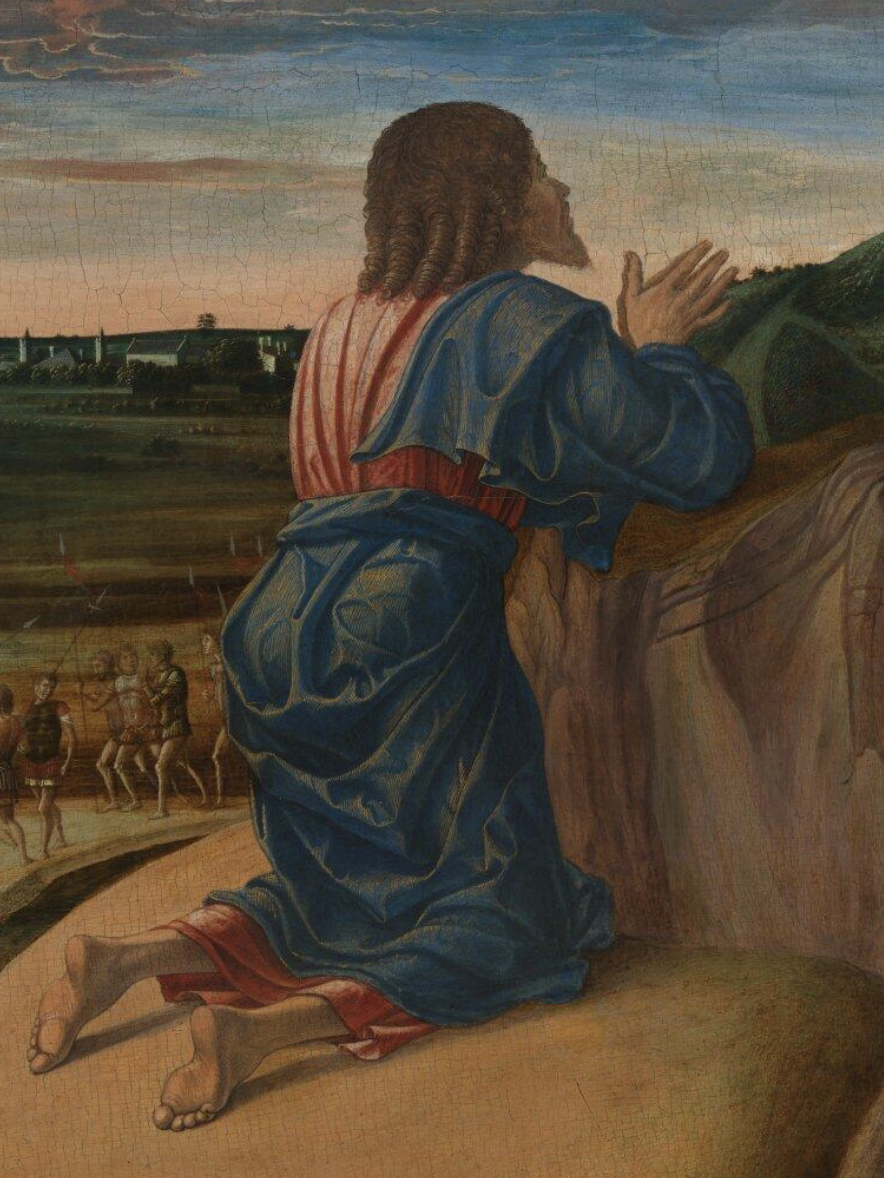
Giovanni Bellini, Detail of The Agony in the Garden, c. 1465, egg tempra on panel, The National Gallery, London.
Giovanni Bellini used shell gold with extraordinary precision in The Agony in the Garden, painted around 1458–60. Fine strokes of gold articulate the clothing and catch the dawn light falling upon Christ. The National Gallery believes that Bellini adopted the device from Mantegna, but in Bellini’s hands the gold participates in the atmosphere of the painting: it belongs both to the early morning light and to Christ’s divinity.
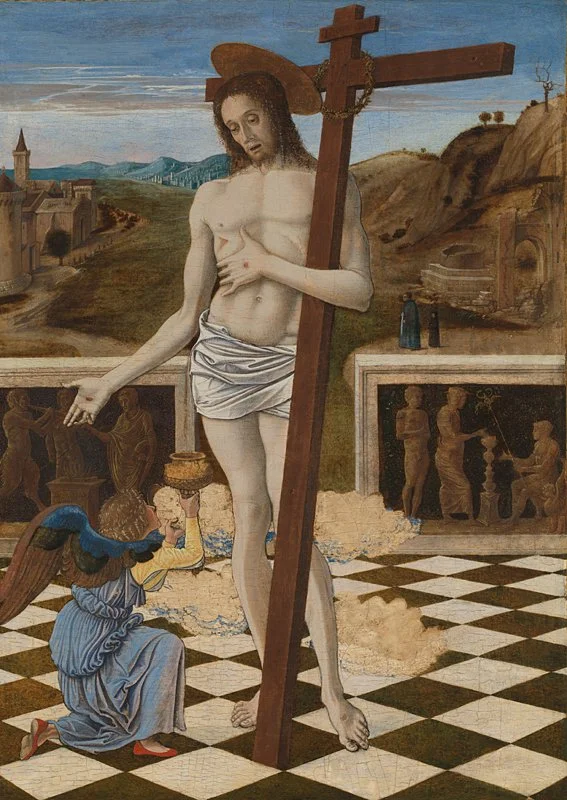
Giovanni Bellini, The Blood of the Redeemer, egg tempra on wood panel, probably polar, c.1465, The National Gallery, London
Bellini returned to the material in The Blood of the Redeemer, using shell gold in Christ’s halo and in the angel’s chalice. In the later Transfiguration, the rays surrounding Christ’s head were painted with shell gold, while the rays of the ordinary sun were painted with yellow pigment. Technical examination confirms that Bellini distinguished divine light from natural light through the actual materials he chose.
A small mussel shell on the workshop bench could therefore hold more than an expensive color. It also held the remains of another process: yesterday’s fragments of leaf, collected, washed and returned to use.
RELATED TO THE FAMILY BUSINESS
THE DEEP DIVE
Cennino Cennini, Il Libro dell'Arte: A New English Translation and Commentary with Italian Transcription, trans. Lara Broecke (Archetype, 2015). The primary source. Cennini gives instructions for grinding gold to paint with, and Broecke's commentary is far more current than the older translation. Daniel V. Thompson's The Craftsman's Handbook (Dover) is the cheap paperback alternative.
Theophilus, On Divers Arts, trans. John G. Hawthorne and Cyril Stanley Smith (Dover, 1979). A twelfth-century German monk's workshop manual, with recipes for grinding gold for manuscript painting. Smith was a metallurgist, so the notes on the metalwork are unusually good.
Daniel V. Thompson, The Materials and Techniques of Medieval Painting (Dover, 1956). The chapter on metals covers leaf gold, powdered gold and the alternatives painters used when they couldn't afford the real thing.
David Bomford, Jill Dunkerton, Dillian Gordon and Ashok Roy, Art in the Making: Italian Painting Before 1400 (National Gallery, London, 1989). Conservators examining actual panels under magnification. The best place to see where leaf stops and painted gold begins.
Jill Dunkerton, Susan Foister, Dillian Gordon and Nicholas Penny, Giotto to Dürer: Early Renaissance Painting in the National Gallery (Yale University Press, 1991). Carries the technical story into the fifteenth century, which is your Bellini period.
National Gallery Technical Bulletin. The back issues are free online and searchable. Good for specific paintings if you want to name one where shell gold has been identified.
Jeanne Nuechterlein, From Medieval to Modern: Gold and the Value of Representation in Early Netherlandish Painting (University of York, 2013). Free online, with a brief overview of gilding techniques. It focuses on Northern painting, so use it for comparison rather than Venice. Wikipedia
Spike Bucklow, The Alchemy of Paint (Marion Boyars, 2009). A Cambridge conservation scientist on what medieval painters believed their materials were. Readable, and the gold chapter is good on why gold meant more than money.
Michael Baxandall, Painting and Experience in Fifteenth-Century Italy (Oxford University Press, 1972). The classic on contracts that specified how much gold and how good the blue had to be. It ties the materials to the money, which suits the blog's theme.
THE FAMILY BUSINESS is my developing treatment for a television drama about the Bellini family, their workshop, and the world of Renaissance Venice.