
THE COUNCIL OF TEN: SECRECY, SURVEILLANCE, AND PUNISHMENT IN VENICE
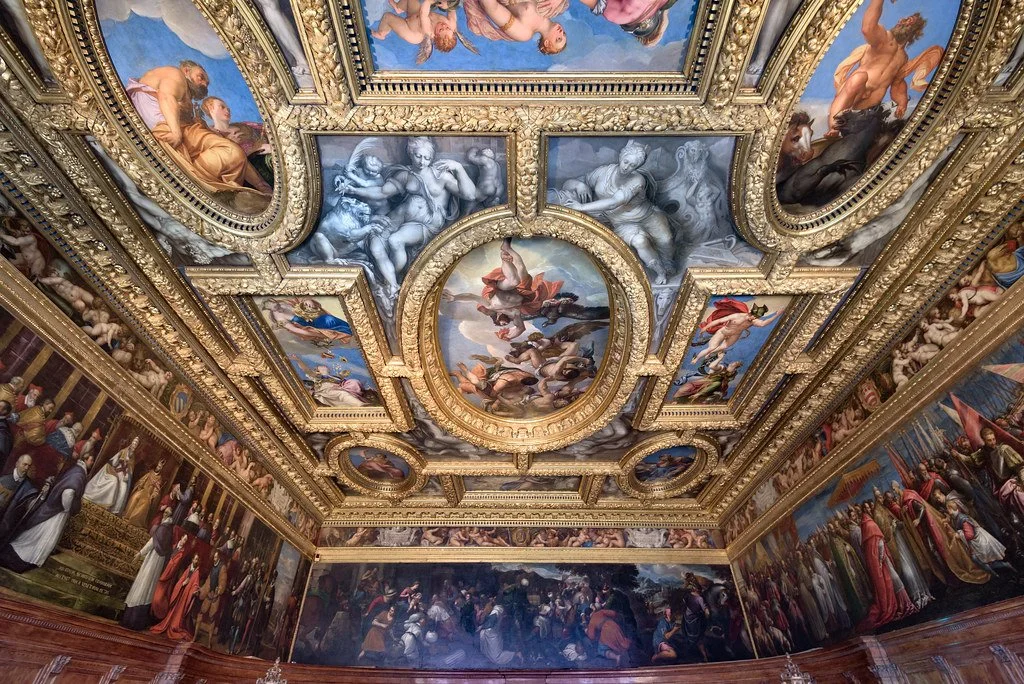
Chamber of the Council of 10, Doge's Palace, Venice
Venice had a complicated system of government. Power was distributed among councils, committees and elected officials, all carefully arranged to prevent any one person from taking control.
Then, in 1310, a group of Venetian noblemen tried to overthrow it.
The conspiracy failed, but it frightened the ruling class badly enough that they created a special committee to investigate what had happened and make certain it did not happen again. It was called the Council of Ten because ten patricians were elected to serve on it. The name was slightly misleading. The doge and his six councillors also attended its meetings, making seventeen men in the room before any additional members were called in.
It was intended to be temporary. Like many emergency powers, it proved difficult to give up.
The Council was repeatedly renewed and eventually became a permanent part of the Venetian government. What began as a committee formed to investigate treason gradually acquired authority over foreign affairs, intelligence, state security and crimes that Venice believed threatened the stability of the republic.
By the time of the Bellinis, the Council of Ten had become one of the most powerful and feared institutions in the city.
A CITY PROTECTED BY GOD
To understand the Council of Ten, it helps to understand how Venice saw itself.
Venice did not think of itself as merely successful. It believed it was exceptional: a republic blessed by God, protected by Saint Mark and spared the disorder that plagued other Italian cities. Venetian writers praised the city for its stability, harmony, good government and freedom from the factional violence found elsewhere. The state church of San Marco, the public ceremonies in the Piazza and the magnificence of the Doge’s Palace all reinforced the idea that Venice enjoyed divine favor.
This was certainly useful propaganda. It gave the ruling patricians a reason for why they, and not everyone else, should govern. But it was more than propaganda. Many Venetians appear to have believed that the prosperity and survival of their city depended upon maintaining its special relationship with God.
That belief had a darker side.

Gabriele Bella, The Room of the Council of Ten, Doges' Palace, Venice
If Venice was blessed because it was well governed and morally ordered, disorder could place the entire city in danger. A private act was not necessarily private if it might provoke God’s anger. Plague, fire, military defeat or economic disaster could be interpreted not simply as misfortune, but as punishment.
In 1497, a Franciscan friar preaching in San Marco told the doge that Venice could avoid plague by eliminating the sins that caused it. His list included blasphemy, sodomy, usury, corruption and the sale of justice. These were very different kinds of conduct, but they were gathered together as offenses capable of bringing disaster upon the city.
The protection of Venice therefore required more than guarding its gates. It required watching the Venetians.
FROM TREASON TO PRIVATE LIFE
The Council of Ten had been created to uncover a conspiracy. Its natural territory was secrecy: hidden alliances, private meetings, information passed from one person to another.
Over time, that logic expanded.
The Council investigated political plots, espionage, dealings with foreign powers, and misconduct by members of the ruling class. It also became increasingly involved in policing sodomy. By the fifteenth century, a sexual act could be treated by the same institution that investigated treason.
This did not mean that the Council pursued every case in the same way or imposed the maximum punishment every time. Venetian justice was inconsistent. Rank, age, social connections, the role attributed to each participant, and the willingness of the councilors to prosecute could all affect the outcome.
But the Council had the power to intervene, and everyone knew it.
WHAT DID SURVEILLANCE LOOK LIKE?
In Venice, an accusation slipped into one of the carved mouths set into the walls of the Doge’s Palace and other government buildings could be enough to set the machinery of the state in motion. Accusations against private individuals were generally supposed to be signed and supported by witnesses. An unsigned piece of paper was not automatically treated as evidence.
That does not mean the system was harmless.
The government actively encouraged people to report certain crimes. Informants could be offered substantial rewards when their information led to an arrest and conviction. In one campaign against sodomy, the Council promised 2,000 lire to a successful accuser. When one councilor proposed adding an explicit warning that false accusers would themselves be prosecuted, the Council rejected it. The desire for information appears to have outweighed its concern about encouraging false reports.
An accusation could therefore become a weapon. A rejected lover, a rival, an angry servant, a competing workshop or a family member with something to gain could threaten to report what he claimed to know. We cannot know how often such threats were made and never recorded. By their nature, they would have taken place in private. But the opportunity was there.
In the 1450s, the Council went further. It appointed two noblemen in every parish to spend a year looking for evidence of sodomy. They were instructed to pay attention to suspicious houses, gatherings, relationships between older and younger men, and people whose behavior appeared questionable.
Think about what that would have meant on the ground.
Venice was not a large place. People worked near their homes. Neighbors saw who entered a house, who left it, and who remained after dark. Apprentices slept in or near workshops. Servants overheard conversations. Gondoliers knew where they had delivered their passengers. Shopkeepers watched the street all day.
You did not need to see an official spy following you. You needed only to know that two men in your parish had been charged with noticing.
And once suspicion began, perfectly ordinary behavior could acquire another meaning. A young man repeatedly visiting an older one. A door closed after the workshop had emptied. A servant dismissed unexpectedly. Two men seen together in a tavern, a garden or a particular house.
The system encouraged Venetians to watch one another, but it also encouraged them to watch themselves.
JUSTICE AS SPECTACLE
The Council’s investigations took place in secrecy. Its punishments did not.
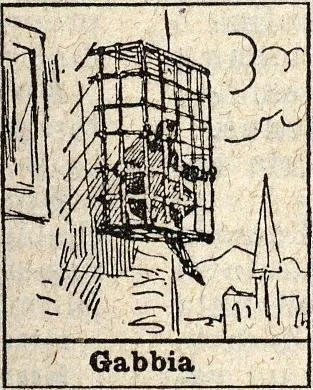
An undated representation of the chèba, the wooden and iron cage suspended from the Campanile of San Marco. A condemned prisoner remained exposed above one of the busiest public spaces in Venice, visible to anyone crossing the Piazza.
Executions were staged in public, often between the two columns in the Piazzetta beside the Doge’s Palace. This was one of the most important ceremonial spaces in Venice. It was where government, religion, trade and public life came together. It was also a place of execution.
In 1474, six men identified as members of a homosexual group were denounced to the Council of Ten. The Council divided them according to the sexual roles it believed they had taken. Two men, Paduano d’Otranto and Marino Alegreti, were identified as the active partners. They were decapitated between the columns, and their remains were burned. The other four received lesser punishments based upon their age and the passive roles attributed to them.
This was not punishment hidden in a prison courtyard. It was a public lesson.
People going to San Marco would have passed the place. Government officials, foreign visitors, merchants, sailors, craftsmen, apprentices and children could see what the state had done. Even those who avoided the execution itself would hear about it. They might smell the fire or encounter the crowd dispersing afterward.
The point was not only to kill the condemned men. It was to place the image of their punishment in the minds of everyone else.
THE SERENE REPUBLIC
Venice called itself La Serenissima—the Most Serene Republic.
The phrase suggests calm, dignity and balance. And Venice did achieve an extraordinary degree of political continuity. Its government lasted for centuries while other Italian states were repeatedly overturned by coups, invasions and civil war.
But serenity had to be maintained.
The Council of Ten protected Venice from genuine conspiracies. It also protected the ruling class, the public reputation of the republic and the story Venice told about itself. The city was harmonious because discord was investigated. It was morally favored because forbidden conduct was exposed and punished. It was serene because people understood what could happen when they disturbed the serenity.
This is one of the central contradictions of Venice in the time of the Bellinis. The same city that covered San Marco with gold mosaics placed execution columns just outside it. The same government that commissioned paintings celebrating justice conducted investigations in secret. The same republic that presented itself as blessed and harmonious encouraged neighbors to report upon one another.
The Bellinis painted the splendor of that system. They also lived inside its reach.
WHERE THIS RELATES TO THE FAMILY BUSINESS
In The Family Business, the Council of Ten is not simply part of the historical background. Its presence helps explain Jacopo Bellini’s entire way of thinking. He understands that talent alone will not protect the family. The Bellinis depend upon commissions, reputation, political access, and the confidence of men who also have the power to investigate, punish, and destroy them. This is especially important in Jacopo’s dealings with Giovanni. Whatever Jacopo may feel privately about Giovanni’s sexuality, he knows what an accusation could do—not only to Giovanni, but to Gentile, the workshop, and everyone attached to the Bellini name. His need to control Giovanni is therefore inseparable from his fear of losing him. To Jacopo, authenticity without protection is exposure, and the Council of Ten represents what can happen when private life becomes visible to power.
THE DEEP DIVE
Guido Ruggiero, The Boundaries of Eros: Sex Crime and Sexuality in Renaissance Venice. The essential source for the Council of Ten’s prosecution of sodomy, including informants, rewards, parish surveillance, the treatment of active and passive partners, and the 1474 case described in this post.
Guido Ruggiero, Violence in Early Renaissance Venice. A broader study of crime, criminal justice, and the state’s use of punishment. Particularly useful for understanding how rank, reputation, and judicial discretion could affect the outcome of a case.
Guido Ruggiero, “Law and Punishment in Early Renaissance Venice.” This article examines the logic of Venetian criminal justice and the distinction between private investigation and public punishment. It can be read online through Northwestern University.
https://scholarlycommons.law.northwestern.edu/jclc/vol69/iss2/8/
Ioanna Iordanou, Venice’s Secret Service: Organizing Intelligence in the Renaissance. A modern study of the intelligence system directed by the Council of Ten, including spies, informants, coded correspondence, secrecy, and the organization of information across Venice and its territories.
https://global.oup.com/academic/product/venices-secret-service-9780198791317
Edward Muir, Civic Ritual in Renaissance Venice. Particularly valuable for understanding the “myth of Venice,” the city’s belief in its exceptional stability and divine favor, and the use of ceremony, architecture, and public punishment to reinforce the authority of the Republic.
Robert Finlay, Politics in Renaissance Venice. A detailed account of how power operated within the Venetian Republic, including the patrician families, councils, elections, factions, and political anxieties that shaped the Council of Ten.
The Doge’s Palace: Layout and Collections. The official museum guide to the political chambers of the palace, including the rooms occupied by the Council of Ten and the other governing bodies of the Republic.
https://palazzoducale.visitmuve.it/en/layout-and-collections/
THE FAMILY BUSINESS is my developing treatment for a television drama about the Bellini family, their workshop, and the world of Renaissance Venice.