
Jacopo Bellini left two great books of drawings, one in the British Museum in London and one in the Louvre in Paris. Between them, they hold hundreds of figures, animals, buildings, biblical scenes, and exercises in perspective. Most of Jacopo's paintings have disappeared, so for generations these books have been our best evidence of how he thought. Now, art historian Norberto Gramaccini has argued that the Louvre book may not be Jacopo's at all. He thinks it came out of the Padua workshop of Francesco Squarcione (see FRANCESCO SQUARCIONE: PADUA'S GREATEST TEACHER, ACCORDING TO FRANCESCO SQUARCIONE), whose star pupil, Andrea Mantegna, married Jacopo's daughter.
Books of drawings were nothing new. The Morgan Library in New York owns a model book from around 1370 with more than seventy drawings on parchment, and another, associated with Giovannino de' Grassi, survives in Bergamo. These books stored a vocabulary of useful forms. An apprentice who needed a lion didn't have to find one. He copied a drawing by someone who had seen a lion, or more likely by someone who had copied someone who had.
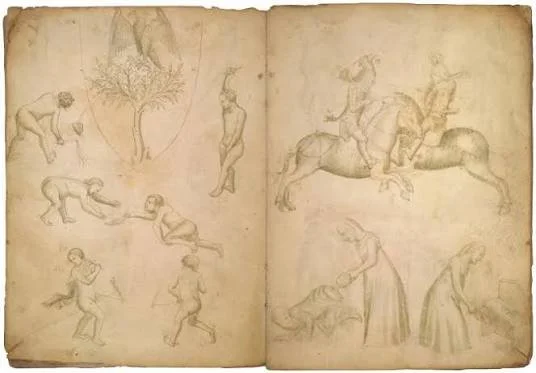
A page from the fourteenth-century model book at the Morgan Library, New York.
Squarcione didn't invent this practice, but he ran it like a business. His students copied from his collection of drawings, sculpture, and plaster casts, and his contracts show how jealously he guarded it. He had started as a tailor and embroiderer, in a trade built on patterns that could be used again and again. No document says that experience shaped his teaching, but the parallel is hard to miss.
Jacopo came to drawing by a different route. He probably trained with Gentile da Fabriano and moved in the same circle as Pisanello, a prodigious draftsman of animals, costumes, and antique sculpture. It would be strange if he came out of that world without the habit.
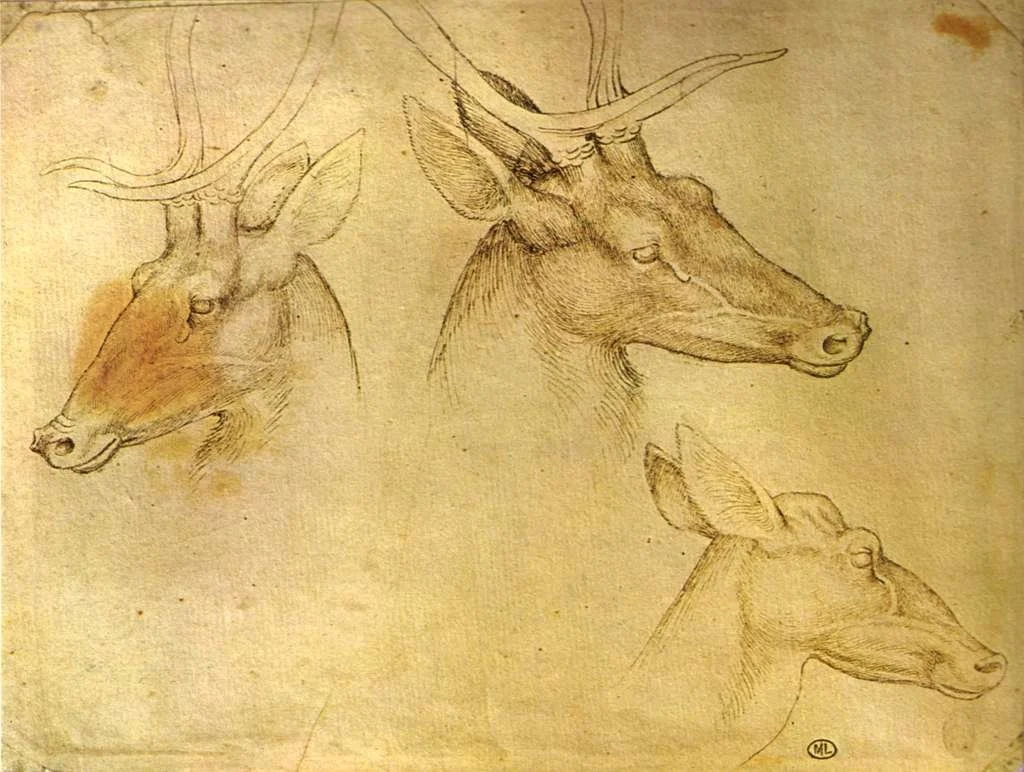
Pisanello, Studies of Animals, Musée du Louvre, Paris.
The two Bellini books are about the same size and share many subjects, but they are made of different stuff. The London book is on large sheets of good paper, drawn almost entirely in leadpoint, which leaves a faint gray line. The Louvre book is on parchment, with many drawings gone over in ink.
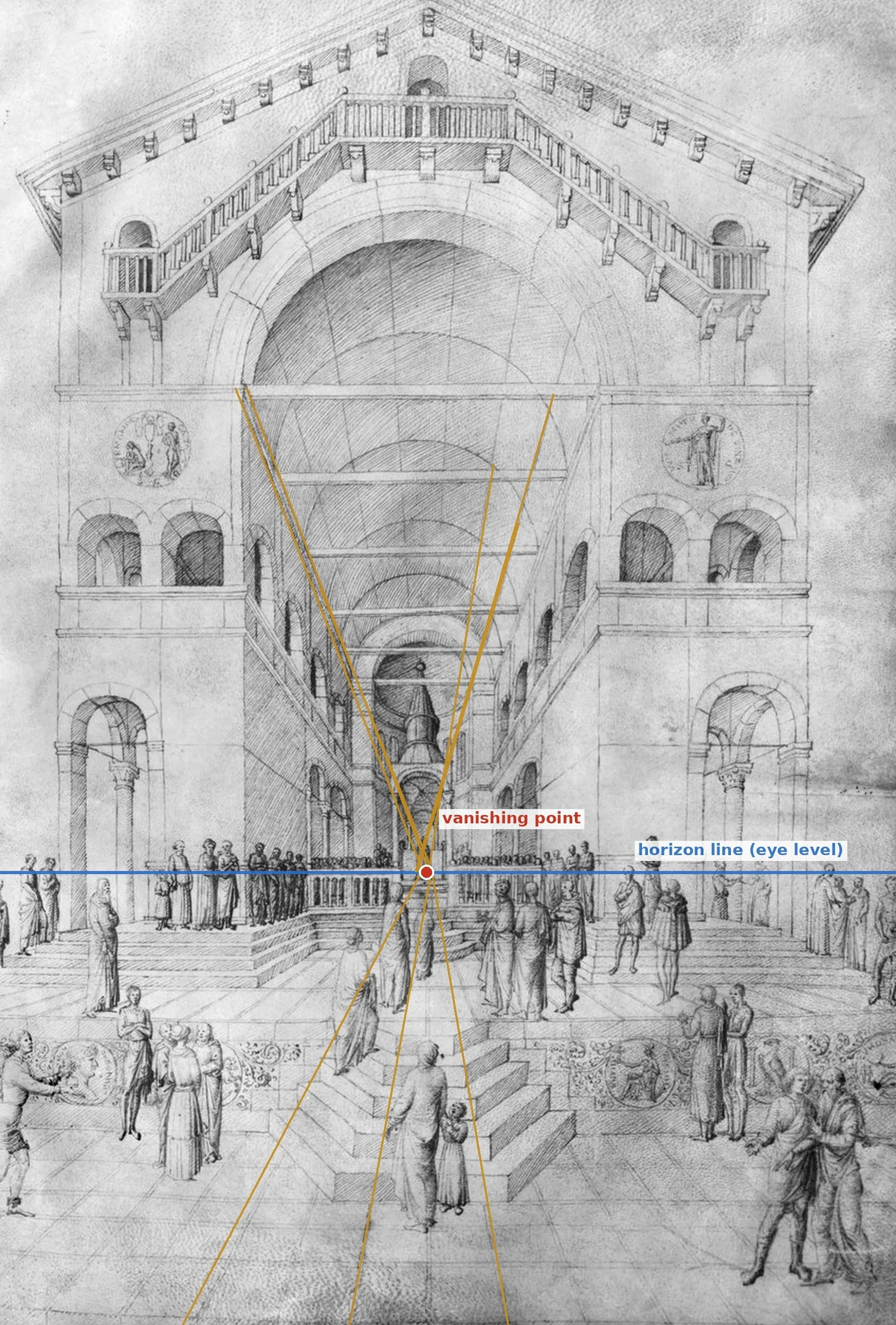
The London paper all came from one mill at about the same time, and the sheets were probably sewn into gatherings before the drawings were made. Someone bought a stack of expensive paper and set out to fill it. Someone bought a stack of expensive paper and set out to fill it. Charles Hope noticed that the drawings move from single figures toward increasingly elaborate architecture and perspective, and suggested that Jacopo was teaching himself the new Florentine methods of building space. Leadpoint suits that kind of trial and correction. The drawback is that many of the London drawings have now faded almost to nothing.

Jacopo Bellini, The Twelve Apostles in a Barrel-Vaulted Passage, British Museum, London.
The Louvre book is stranger. Some of its parchment had been used before. Older designs were scraped off, covered with a ground of chalk or bone dust, or simply drawn over, and in places they still show through. Among them are fourteenth-century textile patterns, repeating designs for woven silk filled with birds, animals, and foliage borrowed from imported Eastern cloth. Related drawings survive in London and elsewhere, part of a late-fourteenth-century Venetian or Lucchese textile tradition.
[Image: Fourteenth-century textile patterns, Louvre drawing book, RF 1545, 98 (folio 77 verso).
Gramaccini suggests the former tailor could have supplied those skins. That is possible, but the patterns are older than Squarcione's career, a whole industry produced them, and where a sheet of parchment came from tells us nothing certain about who later drew on it. Parchment was expensive enough to be worth reusing.
His larger argument is that the Louvre book was planned in Squarcione's workshop, mostly in the 1440s, as a teaching program covering perspective, anatomy, antiquity, and figure composition. That is the curriculum Squarcione promised students in his 1467 contract. Gramaccini sees Squarcione as organizer and financier, with several hands at work, and Mantegna as a likely participant in the Triumph of Bacchus and the Triumph of Cupid. He admits he can't say who drew what.
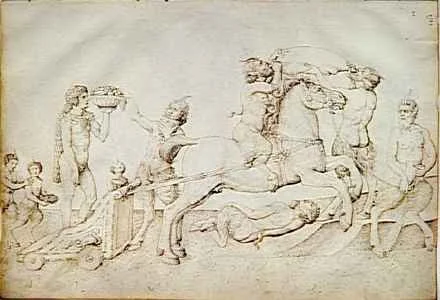
The Triumph of Bacchus, Louvre drawing book, folio 40.
The question would be easier to settle if more of Jacopo's paintings survived for comparison. In 1441 he beat Pisanello in a competition to paint Leonello d'Este. Pisanello's portrait hangs in Bergamo, and Jacopo's winning portrait is lost. Fire took much of the rest, including the family's paintings at the Scuola Grande di San Marco in 1485. The Louvre still catalogues the book under Jacopo's name, and that attribution has serious scholarly support. The case for his hand in the London book is stronger still.
If the Louvre book did start in Padua, how did it reach Jacopo? Mantegna is the obvious link. He broke with Squarcione in 1448, married Nicolosia Bellini in 1453, and kept pressing his old master for payment for work done as an apprentice. Squarcione sometimes paid departing students in drawings and casts instead of cash, so the book could have been part of a settlement. No document says so.
What we do know is that the books ended up with the family. Jacopo died around 1471, and his widow, Anna Rinversi, left his books of drawings to their son Gentile. The London book stayed in Venice. It went to Giovanni, was in Gabriele Vendramin's collection by 1530, and was bought by the British Museum in 1855.
The Louvre book traveled much further. In 1479 Venice sent Gentile to Constantinople to paint Sultan Mehmed II, and the book went with him and stayed at the Ottoman court. It turned up again in Smyrna in 1728, where a French antiquarian described it. It then made its way to France, losing some pages along the way, and entered the Louvre in 1884.
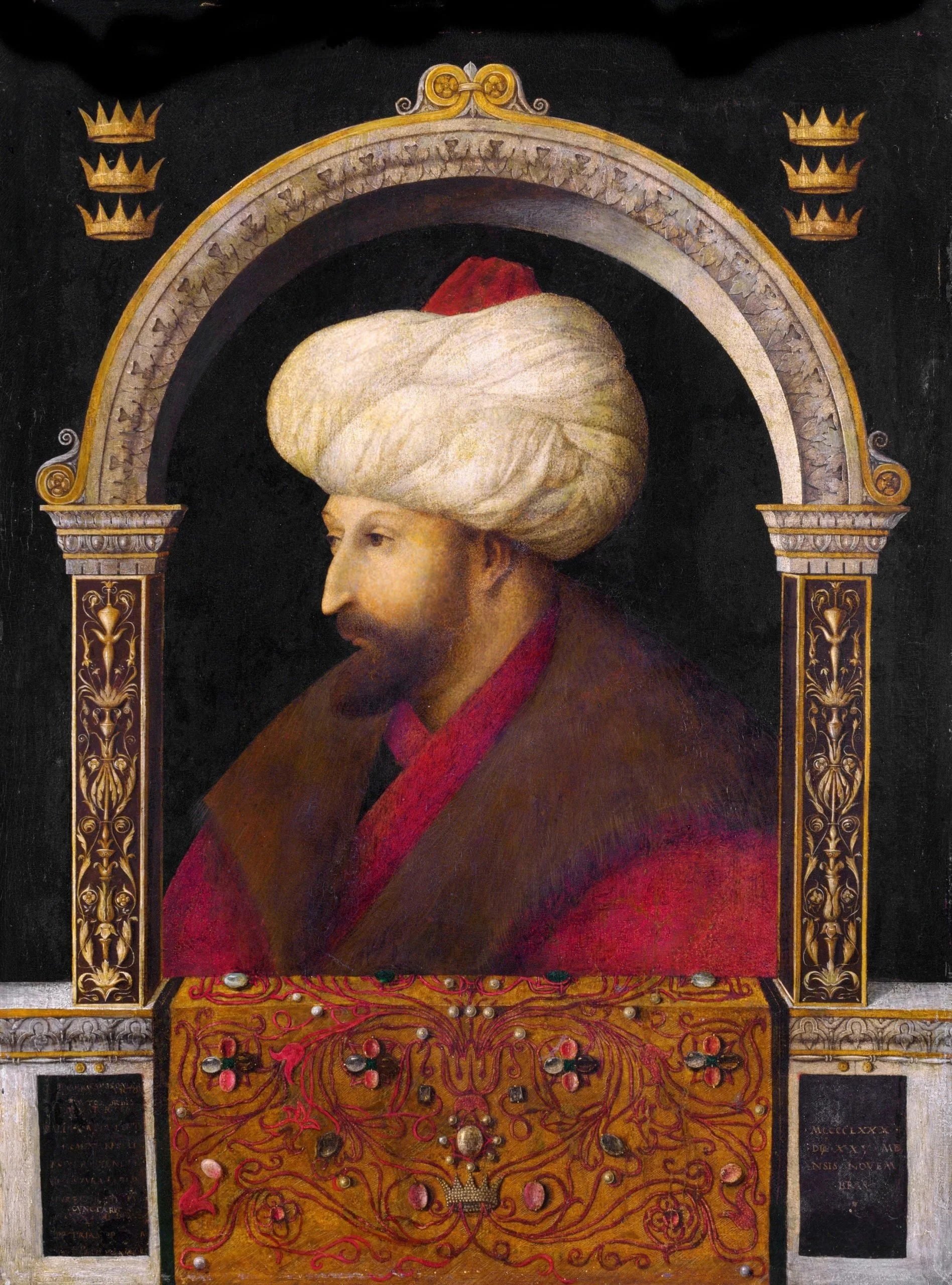
[Image: Gentile Bellini, Portrait of Sultan Mehmed II, National Gallery, London.]
Whoever drew it, the book began on skins that had once carried patterns for silk, and it ended up with the sultan who conquered Constantinople.
DEEP DIVE
Colin Eisler, The Genius of Jacopo Bellini (1989). This is the big book, with both drawing books reproduced. Albert Elen's appendix on how the volumes were physically put together is where the paper-mill evidence comes from.
Charles Hope, "Rediscovering the Bellinis," The New York Review of Books, July 19, 1990. A review of Eisler that is clearer than most books on the subject. Hope contends that the London book was Jacopo teaching himself. Read the article.
Norberto Gramaccini, Jacopo Bellini's Book of Drawings in the Louvre and the Paduan Academy of Francesco Squarcione (De Gruyter, 2021). The source of the controversy. It's substantial and worth arguing with.
Howard Coutts, Mark Evans, and Lisa Monnas, "An Early Italian Textile Drawing in the Victoria and Albert Museum," The Burlington Magazine, June 2008. Four pages on the silk patterns that turn out to be hiding under the Louvre drawings. Read the article.
The Morgan Library & Museum, Model Book, c. 1370. You can page through it online and see what an artist's reference library looked like before Squarcione. Explore the model book.
Musée du Louvre, Jacopo Bellini album. Each drawing has its own catalogue entry. RF 1545 is the one with the textile patterns. View the Louvre entry.
YOU MIGHT ALSO LIKE



THE FAMILY BUSINESS is my developing treatment for a television drama about the Bellini family, their workshop, and the world of Renaissance Venice.