
Jacopo Bellini wasn’t the only young painter to come out of Gentile da Fabriano’s circle. Pisanello did too. They took different things from Gentile, worked for different courts, and eventually competed for the same patrons.

Gentile da Fabriano, Adoration of the Magi, 1423, Uffizi, Florence.
Scholars disagree about where Pisanello fits. Luke Syson and Dillian Gordon, who organized the National Gallery’s Pisanello exhibition in 2001, argue that he was Gentile’s pupil and then worked beside him in Venice on the great narrative cycle in the Hall of the Great Council. Keith Christiansen, Gentile’s biographer, wasn’t convinced. He thought the dates too murky to prove that Pisanello was a pupil, and he allowed that Pisanello may have been closer to a colleague. Jacopo, on the other hand, joined Gentile as a boy and stayed for years. Nobody can show that all three ever worked in the same room.

Pisanello (attributed), Madonna of the Quail, c. 1420, Museo di Castelvecchio, Verona.
You can see Gentile all over Pisanello’s earliest surviving work: the same long noses and arching brows, the winding drapery, the glowing flesh, the close attention to birds and animals, even parts of Gentile’s tempera technique. And when Gentile died in Rome in 1427, Pisanello took over his unfinished frescoes at San Giovanni in Laterano. You hand a dead master’s commission to the person who can make the new work look as if it belongs to the old.

I keep wondering what Jacopo made of that. Gentile had been the central figure of his young life, and Jacopo may even have been with him in Rome at the end. Someone else got the job of finishing one of Gentile’s last great commissions. From then on, each of them had a real claim to being Gentile’s heir.
Pisanello took Gentile’s habit of close observation about as far as it would go. He drew birds from odd angles and horses from behind. He drew costumes, armor, plants, faces, dead animals, and men hanging from a gibbet. Every workshop kept model books and reusable drawings, Gentile’s included, but Pisanello built an archive. His assistants copied his animals, heads, and draperies until they could draw them without him. Sometimes Pisanello himself reused one of Gentile’s figures instead of going back to life.
Jacopo’s drawing books started from the same habit and went somewhere else. He cared less about the single bird or horse than about where it stood: figures in a landscape, people moving through architecture, roads, crowds, and buildings sharing one space. He used his drawings to work out whole compositions.
Their careers crossed in Ferrara in 1441, and this time somebody kept score. Both painted portraits of Leonello d’Este. Pisanello was already one of the most sought-after court artists in Italy, and Jacopo was still a Venetian painter trying to be known outside Venice. Jacopo won. Leonello’s father, Nicolò III, reportedly preferred his portrait, and the court poet Ulisse degli Aleotti wrote two sonnets celebrating the victory. The humanist Angelo Decembrio, recalling the contest later, called the two men “the finest painters of our time,” a diplomatic compliment.
Pisanello hardly suffered for it. His portrait medals became some of the century's most influential objects, and he went on to work for the Este, the Gonzaga, the Visconti, and eventually Alfonso of Aragon in Naples. But the less famous of Gentile’s two heirs had come out ahead, and people wrote poems about it.
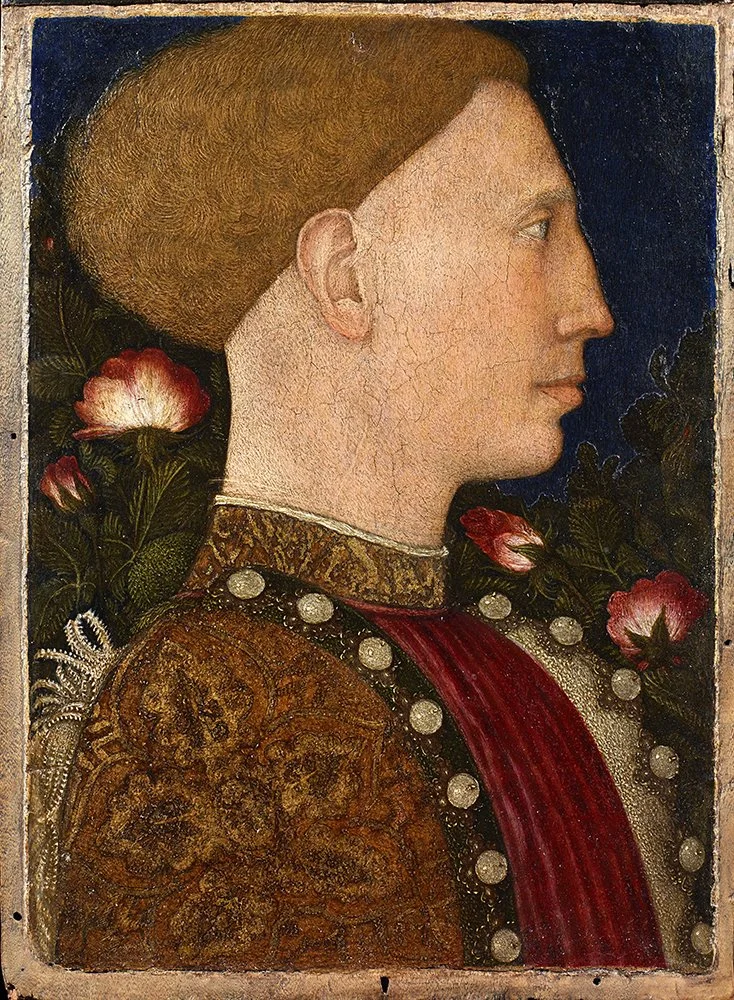
Pisanello, Portrait of Leonello d’Este, c. 1441, Accademia Carrara, Bergamo. Jacopo’s portrait no longer exists.
Jacopo kept watching. Years later he drew several versions of the Vision of Saint Eustace, a subject closely tied to Pisanello. Syson and Gordon think one of the more elaborate drawings may have been a competitive answer to Pisanello’s, and they call Jacopo Pisanello’s “perceived rival,” which seems about right.
Bono da Ferrara signed himself Pisanello’s disciple. Before long he was working in Padua alongside the young Mantegna, and he had dropped nearly every trace of his old master. Pisanello had passed on his style perfectly, just as that style was going out of fashion. It’s like learning to paint exactly like Rothko just as the galleries filled up with Warhol and Lichtenstein.
Jacopo learned a different lesson. He never stopped calling Gentile his teacher, but he stopped trying to paint like him. He kept the business: the workshop, the patrons, the drawings, the specialists, and the authority of the master’s name.
YOU MIGHT ALSO LIKE


DEEP DIVE
Luke Syson and Dillian Gordon, Pisanello: Painter to the Renaissance Court (National Gallery Company/Yale University Press, 2001). The catalogue of the National Gallery exhibition, and the best book on Pisanello in English. The drawings alone are worth the price. It’s the source for nearly everything here: his training, the Lateran frescoes, his workshop, Bono da Ferrara, the Ferrara contest, and Jacopo as the “perceived rival.”
Keith Christiansen, Gentile da Fabriano (Cornell University Press, 1982). Read this for the skeptic’s side. Christiansen doesn’t think the evidence proves that Pisanello was Gentile’s pupil, and he explains why.
Daniel Wallace Maze, Young Bellini (Yale University Press, 2021). For the Ferrara contest from Jacopo’s side, including Aleotti’s sonnets and Decembrio’s verdict.
THE FAMILY BUSINESS is my developing treatment for a television drama about the Bellini family, their workshop, and the world of Renaissance Venice.