
Andrea Mantegna, the painter who married Jacopo Bellini's daughter, learned his trade in the house of a Paduan named Francesco Squarcione. Squarcione is remembered as the teacher of a generation of north Italian painters, including some of the best of the fifteenth century. He had an extraordinary collection of drawings and antiquities, a thriving workshop, and a reputation that extended well beyond Padua. He also had a remarkable talent for getting himself sued by his students.
The flattering version of his life comes from Bernardino Scardeone, a Paduan canon who published a book about the famous men of Padua in 1560. According to Scardeone, Squarcione traveled throughout Greece and Italy, collecting drawings of everything worth seeing and making friends with noblemen along the way. Although he had little formal training, he had a passion for teaching, and 137 students passed through his workshop. Scardeone called him pictorum gymnasiarcha singularis, the one and only headmaster of painters. Where did Scardeone get this glowing account? Largely from a memoir Squarcione wrote about himself. Apparently, Squarcione understood the importance of good publicity.
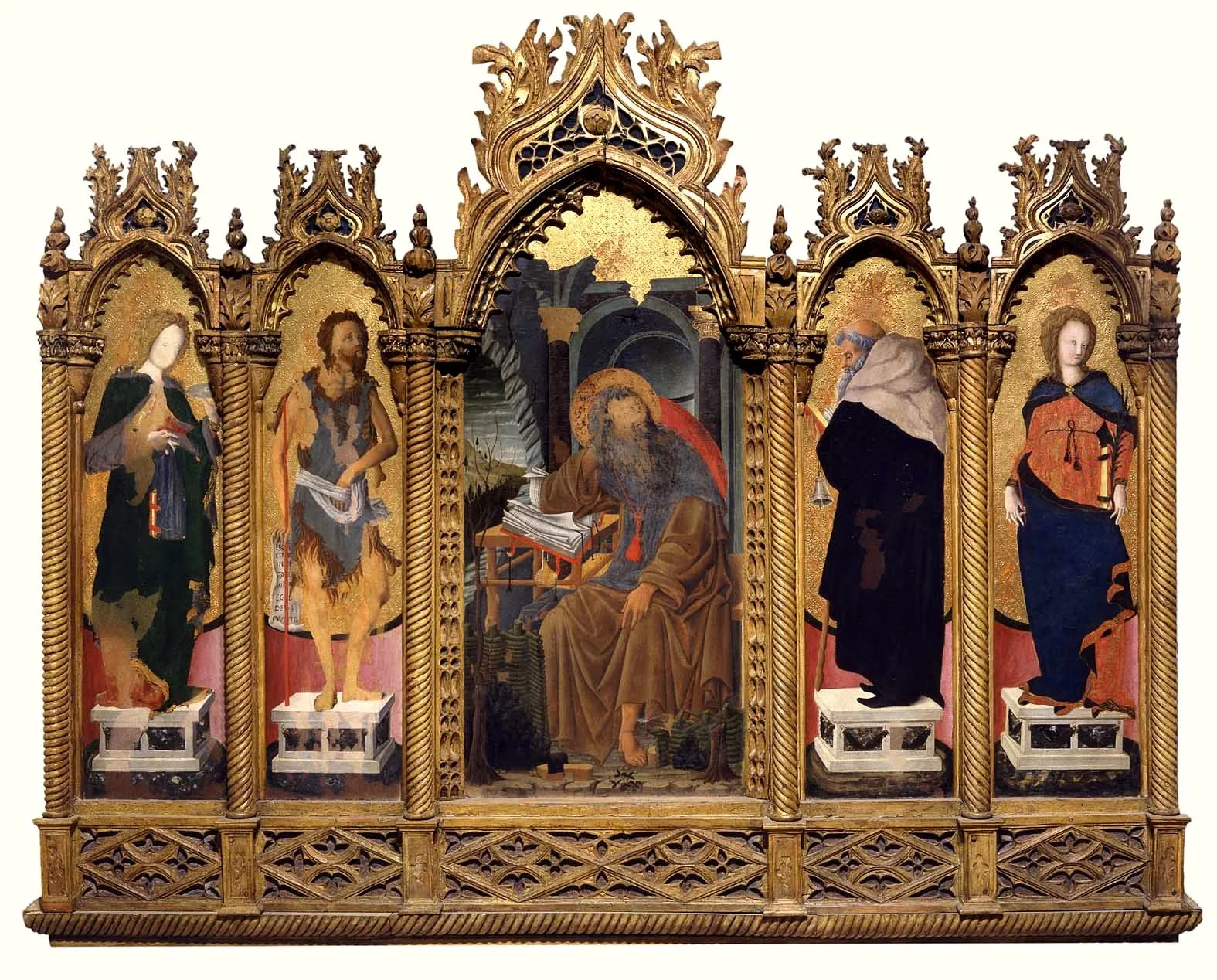
Francesco Squarcione, De Lazara Polyptych, 1449–52, Musei Civici, Padua
The documents tell a somewhat different story. Squarcione was born in Padua sometime between 1394 and 1397, making him roughly the same generation as Jacopo Bellini and Pisanello. His father was a notary who died while Francesco was young, and his mother's brother, a tailor, raised him. Until 1426, the records describe Squarcione as a tailor and embroiderer. After that, they call him a painter. In 1418, he married a dyer's daughter, Francesca, and her father bought the young couple a house in Padua's Pontecorvo district. That house became Squarcione's workshop. By 1440, business was good enough for him to buy the neighboring property and combine the two buildings.
What made his workshop exceptional was the collection he assembled. Vasari describes plaster casts of ancient sculptures and paintings on canvas brought from Tuscany and Rome. Other sources suggest drawings, marble reliefs, coins, inscriptions, and carved gems. A 1455 document describes a large studio filled with reliefs and drawings, along with a smaller studio in what people called the "house of reliefs." At a time when there were no public museums or printed reproductions, Squarcione gave his students access to material they might otherwise never see. They could study classical sculpture, examine how other artists constructed figures, and copy drawings that had traveled from workshops hundreds of miles away. For a young painter in Padua, this was an extraordinary education.
And Squarcione knew how to teach. A contract from 1467, when a Paduan painter enrolled his son for a four-month course, gives us an unusually detailed account of his methods. Squarcione promised to teach the boy how to construct a perspective floor, arrange figures at different distances, and position furniture within the space. He taught foreshortening, the proportions of the nude body, and the placement of facial features. He supplied model drawings and corrected the student's work in white lead. This was a systematic course in drawing, proportion, and perspective, taught at a time when those skills were transforming Italian painting. Scholars disagree about how sophisticated Squarcione's methods actually were, but the contract makes one thing clear: he had a curriculum, and he understood how to organize instruction.
His workshop also operated as a business. Squarcione took boys into his household ut filium, as sons, supplying their food, clothing, and sometimes even their visits to the barber. In exchange, they worked for him. Michele, a barber's son from Vicenza, entered the household in 1431 and agreed to do everything possible for Squarcione, both in painting and around the house. Other students paid for their instruction. In 1447, a seventeen-year-old Venetian named Matteo da Pozzo entered the workshop after his father agreed to pay 25 gold ducats a year. Squarcione also employed experienced painters on salary. In 1440, he hired Dario da Udine, described as a pictor vagabundus, a wandering painter, and promised to teach him by showing him drawings. There was one condition: Dario was not to steal them.
The prohibition tells us something about the value of a workshop's drawings. They were teaching materials, but they were also property, accumulated knowledge, and commercial assets. Squarcione understood their value well enough to keep track of individual sheets. In 1466, he lent Pietro Calzetta a drawing by his former student Nicolò Pizolo, allowing him to make a quick copy. The loan was recorded in writing. These drawings circulated between painters, sometimes as gifts or loans, sometimes through less agreeable arrangements. This becomes important when we get to Jacopo Bellini's drawing books.
Squarcione's most famous student was Andrea Mantegna, a carpenter's son from near Padua. Mantegna entered Squarcione's household as a boy, and the painter adopted him. Between 1441 and 1445, the Paduan painters' guild recorded Mantegna as Squarcione's son. He spent about six years in the workshop, where he received the education that helped make him one of the most remarkable painters of his generation. Squarcione had every reason to be pleased with his investment.
Instead, he managed to alienate him. Mantegna painted pictures that sold for substantial sums, and Squarcione kept the proceeds. Adoption apparently gave him a convenient way to treat his exceptionally gifted student as unpaid family labor. Mantegna objected. In January 1448, when he was about seventeen, the two reached a settlement. Mantegna subsequently challenged the agreement, and in 1456 a Venetian court set it aside. The legal papers accused Squarcione of profiting from the young artist's work "against the form of law and the rule of honesty." Mantegna's struggle to free himself from his adopted father deserves its own post. For now, it is worth observing that Squarcione had trained an extraordinary painter and then made it impossible for him to remain in the workshop.
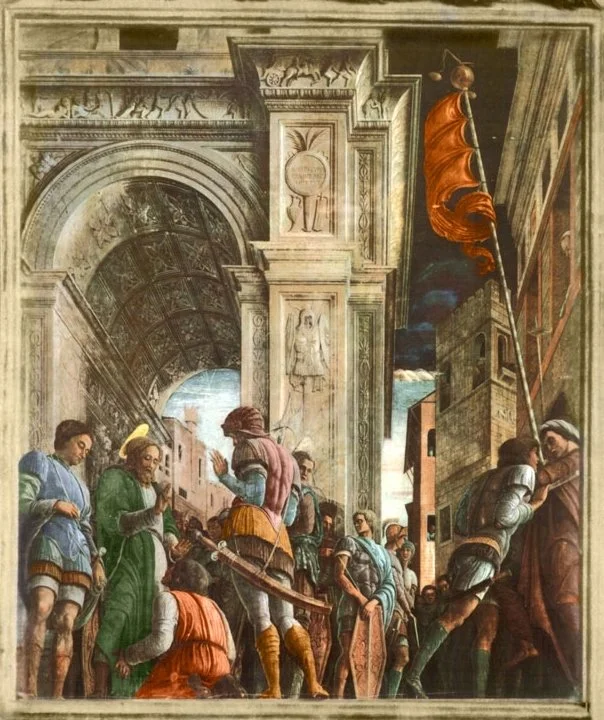
Andrea Mantegna, Saint James Led to His Execution, Ovetari Chapel, Church of the Eremitani, Padua (destroyed 1944; photograph).
One might think Squarcione had learned something from this experience. Apparently not. In 1454, a young Bolognese painter named Marco Zoppo arrived in Padua and began working for him. The following May, Squarcione adopted Zoppo "as a son and with love," promising to leave him his entire estate, including the workshop. In return, Zoppo surrendered his right to the proceeds from his own paintings. He also made plaster casts, using gypsum supplied by his father in Bologna. The records mention 3,500 pounds of it. Squarcione wasn't merely teaching students to draw from antiquities. He was manufacturing reproductions that he could use for instruction and sell to other artists.
The love lasted less than five months. Squarcione, who had recently remarried, suddenly demanded repayment for Zoppo's room and board. The dispute went to arbitration, and on October 9, 1455, Squarcione lost. He had to compensate Zoppo for the plaster and for paintings, drawings, and figures he had sold to "many and diverse persons." The settlement came to 20 gold ducats, which Squarcione could pay in pictures, casts, medals, and painting equipment. Zoppo left for Venice. The historian who published these documents in 1908 suspected that Squarcione had second thoughts about leaving his estate to Zoppo and manufactured a quarrel to get out of the arrangement. It certainly fits the pattern.
Other students had their troubles with him. Giorgio Schiavone, a Dalmatian painter who spent three and a half years in the workshop, returned home with money, goods, and a collection of drawings supplied by Squarcione. Squarcione subsequently demanded the drawings back, including a prized cartoon of nudes by the Florentine painter Pollaiuolo. He spent years trying to recover them. By 1474, when Squarcione was already dead, they still hadn't come back.
In 1465, a former pupil named Agnolo di Silvestro offered a particularly memorable assessment of his old master. Squarcione, he said, made a habit of attracting people with promises, "boasting of things he does not have and of knowing what he does not know." He kept promising until he had worn them down and "sucked the juice out of them," after which he picked a quarrel.
That sounds remarkably like what happened to Mantegna and Zoppo. Squarcione had created a successful teaching enterprise. Students sought him out, paid substantial sums for instruction, and had access to a collection that few other workshops could rival. He had everything he needed to prosper without cheating anyone. Yet he repeatedly tried to extract more from his students than their agreements entitled him to. In the process, he drove away some of the very painters whose work and reputations made his workshop valuable.
So how good a painter was Squarcione himself? We have remarkably little surviving evidence. The documents record commissions for gilding, decorative painting, designs for woodwork, and even a map of Padua. In 1463, he received a commission for two canvases for the Scuola Grande di San Marco in Venice, an institution for which Jacopo Bellini also worked. A fire in 1485 destroyed their paintings.
Only two surviving paintings generally enter discussions of Squarcione's work. The better documented is the De Lazara Polyptych, painted for a chapel in Padua between 1449 and 1452. Its arrangement closely follows an altarpiece completed a few years earlier by Antonio Vivarini and Giovanni d'Alemagna. The other is a small Madonna and Child in Berlin, signed Opus Squarcioni pictoris, although some scholars question its attribution. Neither suggests a painter of Mantegna's stature. Perhaps Squarcione's greatest talent really did lie in teaching other people to paint.
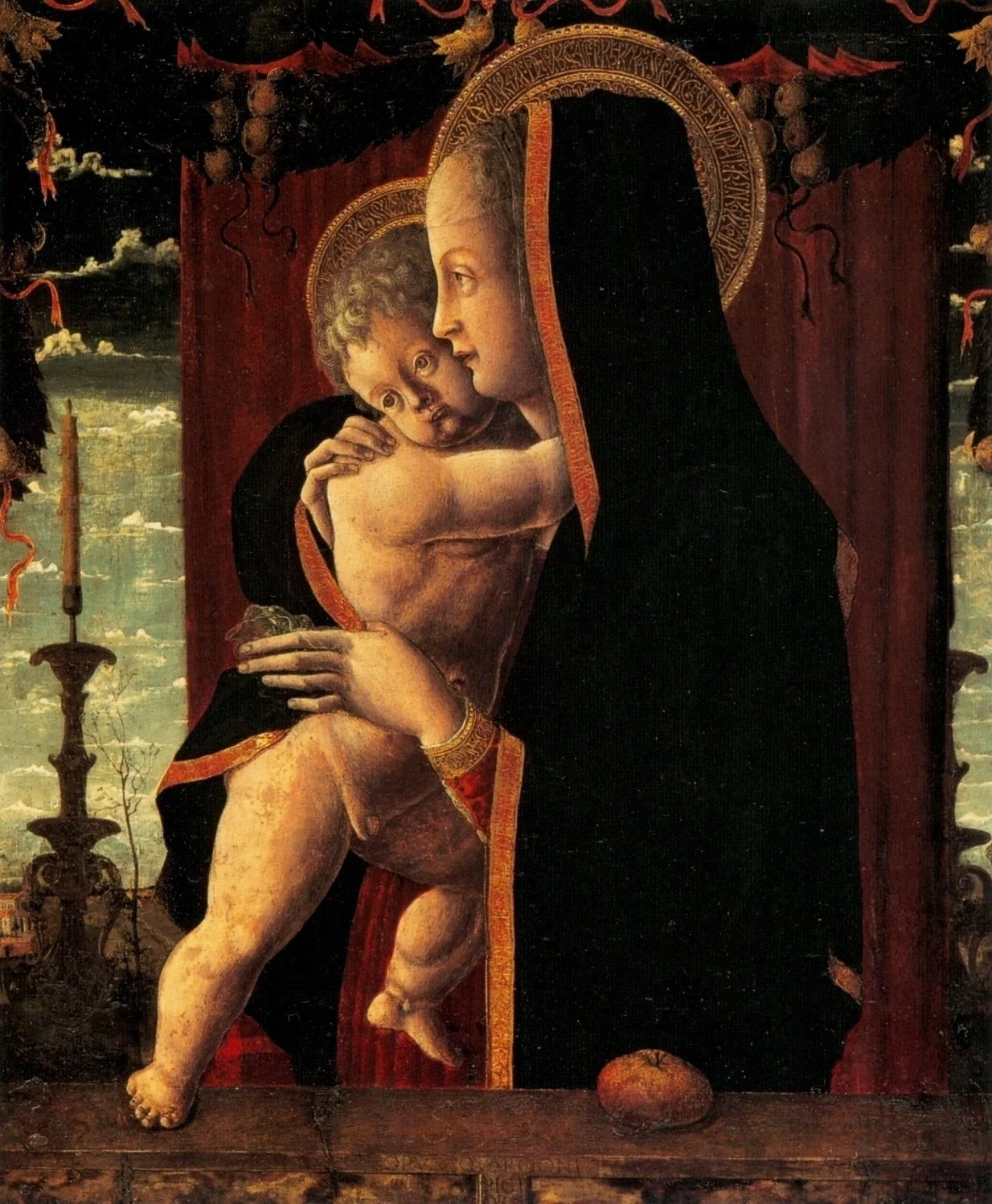
Francesco Squarcione, Madonna and Child, Gemäldegalerie, Berlin.
Vasari tells us that Squarcione criticized Mantegna's frescoes in the Ovetari Chapel, complaining that his figures looked like marble rather than living flesh. Considering how much Mantegna had learned from the antique sculptures in Squarcione's collection, the criticism has a certain irony. It also suggests that the resentment between the two men outlasted their legal disagreements.
For all his unpleasantness, Squarcione's workshop produced a remarkable group of painters: Mantegna, Marco Zoppo, Giorgio Schiavone, Nicolò Pizolo, and possibly Carlo Crivelli. He played an important part in making Padua a center for the new art of perspective and classical antiquity. His students carried what they learned into other workshops and other cities. Whatever we think of his character, we have to give him credit for that.
This is where Squarcione becomes particularly interesting to me in the story of the Bellini family. Jacopo Bellini was building a successful workshop of his own in Venice. He understood that an artist needed more than the ability to paint. A workshop required commissions, teaching materials, assistants, apprentices, and a means of passing knowledge from one generation to another. Squarcione had developed a remarkably effective system for doing all those things. Jacopo and Squarcione worked in overlapping artistic circles, and I think it's reasonable to speculate that Jacopo knew about his Paduan operation and recognized its success. Whether he admired Squarcione personally is another question.
Then there was Mantegna. By the time he married Jacopo's daughter Nicolosia in 1453, he had already broken with Squarcione and established himself as an independent artist. We have no evidence that Jacopo engineered his departure. But the marriage brought Squarcione's most celebrated pupil into the Bellini family. For Jacopo, whose sons Gentile and Giovanni were developing their own careers, it was an advantageous connection. Mantegna had received an extraordinary education in Padua, and he brought that knowledge, along with his exceptional talent, into the family.
And then there are the drawings. Squarcione had assembled an important collection, and the contracts and lawsuits tell us how carefully he guarded it. We also know that drawings moved between workshops, sometimes as gifts, sometimes through sales, and occasionally under circumstances that led to disputes. The art historian Norberto Gramaccini has proposed that the famous book of drawings in the Louvre, traditionally attributed to Jacopo Bellini, actually originated in Squarcione's workshop, possibly with Mantegna responsible for some of its contents. He even suggests that Mantegna may have acquired the book as compensation for his unpaid work and subsequently brought it into the Bellini family. It's an intriguing theory, although far from universally accepted.
The authorship of the Louvre book, its possible origins in Squarcione's workshop, and its subsequent journey through the Bellini family raise more questions than we can answer here. There is also Jacopo's other drawing book, now in the British Museum, which complicates the story considerably. We'll look at both books, the arguments about who actually made the drawings, and what we know about their travels in another post.
DEEP DIVE
Giacomo Alberto Calogero, "Squarcione, Francesco," Dizionario Biografico degli Italiani, vol. 93 (2018). Available free at Treccani, in Italian. This is an excellent documentary account of Squarcione's career, with particular attention to his contracts, adoptions, lawsuits, and business dealings. It provides the basis for much of the chronology here.
Norberto Gramaccini, Jacopo Bellini's Book of Drawings in the Louvre and the Paduan Academy of Francesco Squarcione (De Gruyter, 2021). Gramaccini takes Squarcione seriously as an innovator in art education and examines the evidence for his teaching methods. His larger argument about the Louvre drawing book is especially important for our investigation, although it remains contested.
Vittorio Lazzarini, Documenti relativi alla pittura padovana del secolo XV (Venice, 1908). The original documents concerning Squarcione's students, including Zoppo's adoption and arbitration, Schiavone's missing drawings, and Squarcione's will. Essential for understanding the business behind the workshop.
Francesco Squarcione: "pictorum gymnasiarcha singularis," edited by Alberta De Nicolò Salmazo (Il Poligrafo, 1999). Proceedings of a conference held in Padua in 1998. The essays examine Squarcione's artistic reputation, the workshop's organization, and its influence on Paduan painting.
Giorgio Vasari, Lives of the Artists, Life of Andrea Mantegna. Vasari provides accounts of Squarcione's collection and his criticism of Mantegna's frescoes. As always with Vasari, the stories are entertaining, but we need to distinguish what he reports from what contemporary documents establish.
Additional sources: Bernardino Scardeone, De antiquitate urbis Patavii (Basel, 1560), pp. 370–71, for the flattering early biography; and Deborah Lipton's 1974 New York University dissertation on Squarcione, which gathers much of the documentary evidence.
YOU MIGHT ALSO LIKE

THE FAMILY BUSINESS is my developing treatment for a television drama about the Bellini family, their workshop, and the world of Renaissance Venice.