
WHO REALLY RAN VENICE?

Gentile Bellini, Procession in the Piazza San Marco
The ruling class, the doge, and the machinery behind The Family Business
There is something misleading about the word republic.
When we hear it, we tend to imagine citizens choosing their leaders. Venice certainly had citizens, and it was fiercely proud of not having a king. But during the years of Jacopo, Gentile and Giovanni Bellini, political power belonged to a relatively small group of hereditary patrician families. If you were born into one of those families, you had a place in the government. If you were not, wealth, talent and fame might bring you very close to power, but they would not give you a vote.
The Bellinis came very close.
Gentile painted the doges. He worked in the Doge’s Palace and was sent to Constantinople as a representative of the Republic. Giovanni was eventually made an official painter to the state. Their paintings helped Venice describe itself to its own citizens and to the rest of the world.
But the Bellinis did not run Venice.
They painted the men who did.
A REPUBLIC FOR THE RULING CLASS
The central institution of Venetian government was the Great Council. By the fifteenth century, it was composed of the adult men of hereditary patrician families. Membership did not depend upon individual wealth, education or merit. A poor nobleman had the same formal right to sit in the council as one of the wealthiest merchants in the city, while a highly successful doctor, notary, shipbuilder or painter had no right to sit there at all.
The closing of the Great Council to outsiders had begun in 1297 and became increasingly rigid. By the time the Bellinis were working, Venice’s ruling class had largely become a caste. Political membership descended through the family. The Republic was republican within that group, but oligarchic to everyone outside it.
The Great Council was enormous. Depending upon the period and attendance, between roughly 1,200 and 2,000 noblemen might be entitled to sit in its chamber. Its room in the Doge’s Palace was one of the largest in Europe. Imagine the sound of that many men arriving, settling themselves, exchanging information, forming alliances and waiting to vote.
The council elected the doge and filled most of the important offices of the state. It also elected the smaller councils that performed much of the day-to-day work. In other words, it did not necessarily make every decision itself, but it decided which members of the ruling class would be allowed to make them.
Venice was governed through an elaborate web of councils, committees, magistrates and temporary offices. Responsibilities overlapped. Terms were often short. Some appointments involved voting, some involved drawing lots, and many involved both. The system was intentionally complicated.
This was not inefficiency by accident. It was inefficiency with a purpose.
Venice distrusted concentrated power.
THE DOGE WHO COULD NOT ACT LIKE A KING
The most visible person in Venice was the doge. He lived in the Doge’s Palace, wore magnificent robes and a distinctive cap, received foreign ambassadors and appeared at the center of public ceremonies. Laws and proclamations were issued in his name. When Venice needed a human face, it used his.
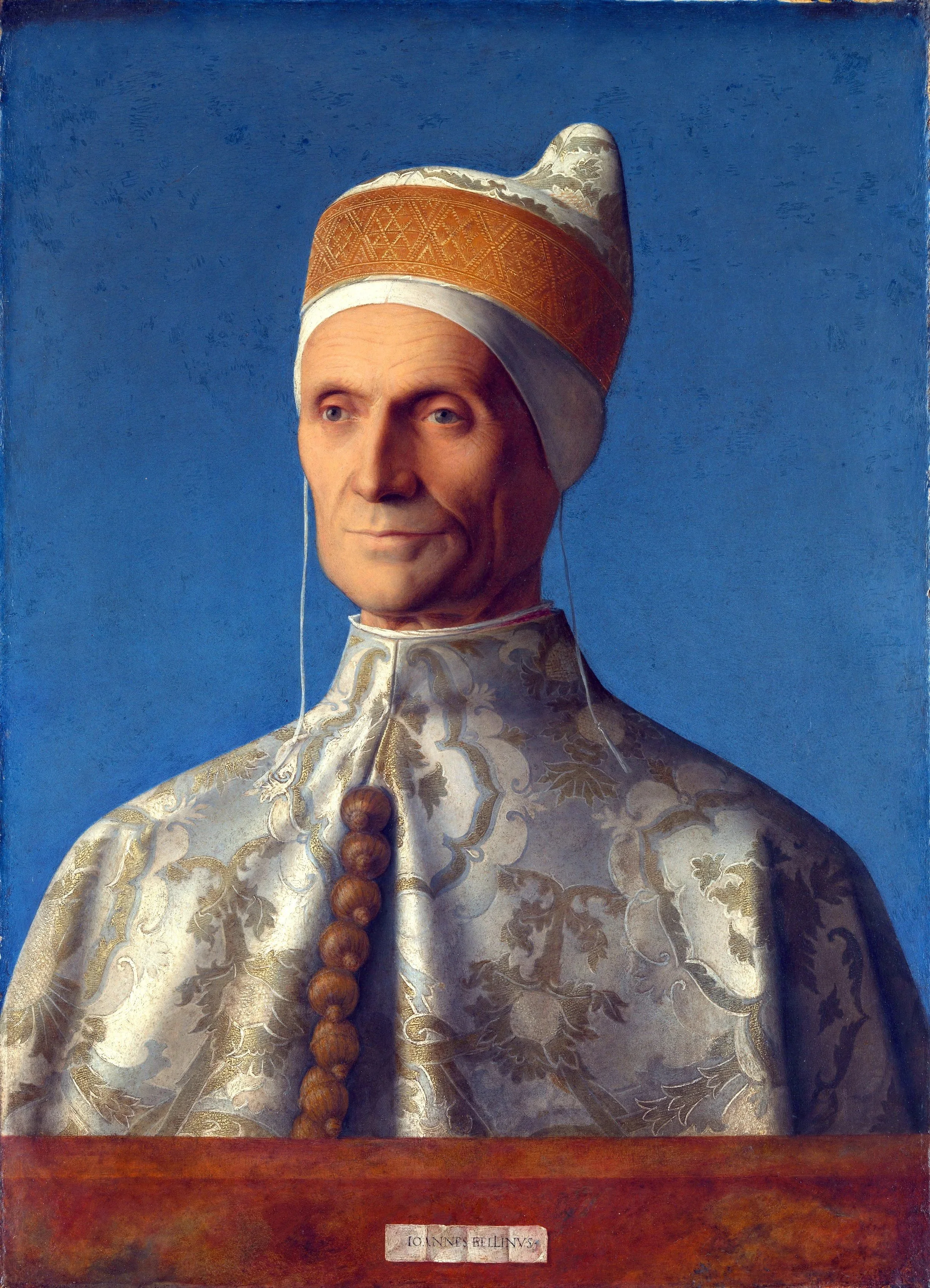
Giovanni Bellini, Doge Leonardo Loredan
He certainly looked like a king.
But Venice had spent centuries making sure that he could not become one.
The doge was elected for life, usually when he was already an older man. His election involved a famously complicated series of ballots and lotteries intended to make it difficult for one faction to control the result. Once chosen, he swore an oath called the promissione ducale, which set out what he could and could not do. The oath governed not only his public decisions but parts of his private life. He was surrounded by councillors, bound by ceremony and prevented from acting independently in foreign or domestic affairs.
The doge’s job was to embody power without personally owning it.
This distinction is important when we look at Giovanni Bellini’s portrait of Doge Leonardo Loredan. Loredan appears remote, intelligent and immovable. He wears white silk damask woven with gold and silver thread. His body has the solidity of a sculpted imperial bust. He seems to be the source of authority.
But the authority belongs to the office and to the Republic behind him.
Loredan had prestige. He had influence. He did not have freedom.
GOVERNMENT BY COMMITTEE
Beneath the grandeur of the doge was the machinery that actually governed Venice.
The Senate was a smaller and more active body than the Great Council. It dealt particularly with trade, manufacturing, finance, diplomacy, foreign policy and war—the subjects on which Venetian survival depended. Its members generally came from the wealthiest and most experienced patrician families. Unlike the Great Council, which often voted without debate, the Senate was a place where major policies were argued.
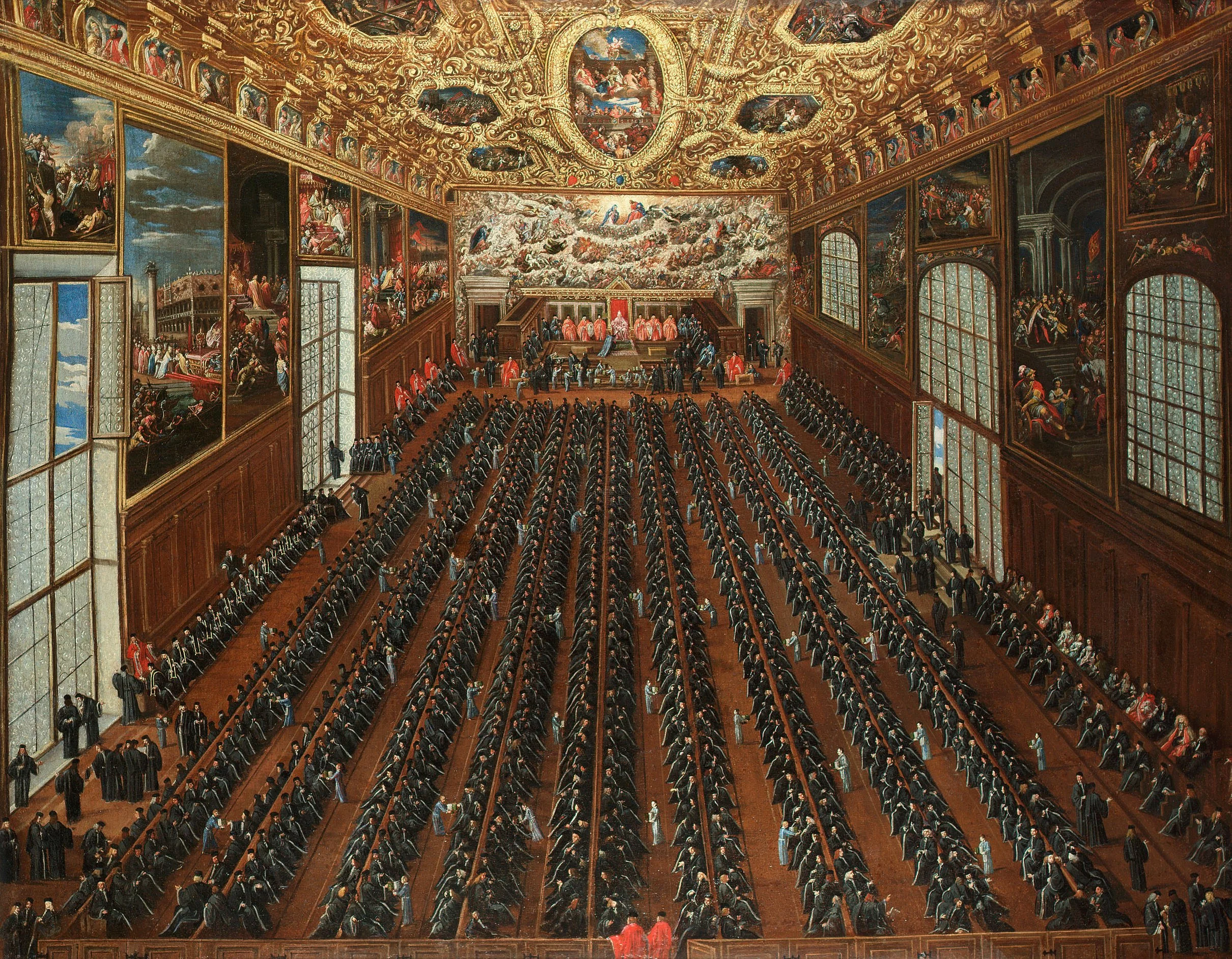
Joseph Heintz the Younger, The Great Council of Venice, about 1648–50. Although painted long after the Bellinis’ time, it conveys the extraordinary size of the assembly and the collective nature of Venetian rule.
The Collegio, or Full Council, prepared business for the Senate, dealt with ambassadors and helped manage foreign affairs. Representatives from other governments waited in its antechamber before being received. In a city whose fortunes depended upon negotiation, information and trade, the rooms where diplomats waited could be as important as some battlefields.
There were also courts, financial magistracies, maritime officials, grain officials, health officials and administrators responsible for Venice’s mainland and overseas territories. The Council of Ten, which we will look at separately, dealt with state security, conspiracy, political danger and a growing range of matters the government wished to control closely.
No single council was simply “the government.” Power moved among them.
This made Venice difficult to seize. A man might dominate one office, but his term would end. A family might be influential, but rival families surrounded it. A doge might be ambitious, but councilors watched him. A senator might speak forcefully, but hundreds of other patricians still possessed votes, relatives, clients and memories.
The system assumed that men wanted power and then arranged itself to prevent them from keeping too much of it.
A WARNING INSIDE THE PALACE
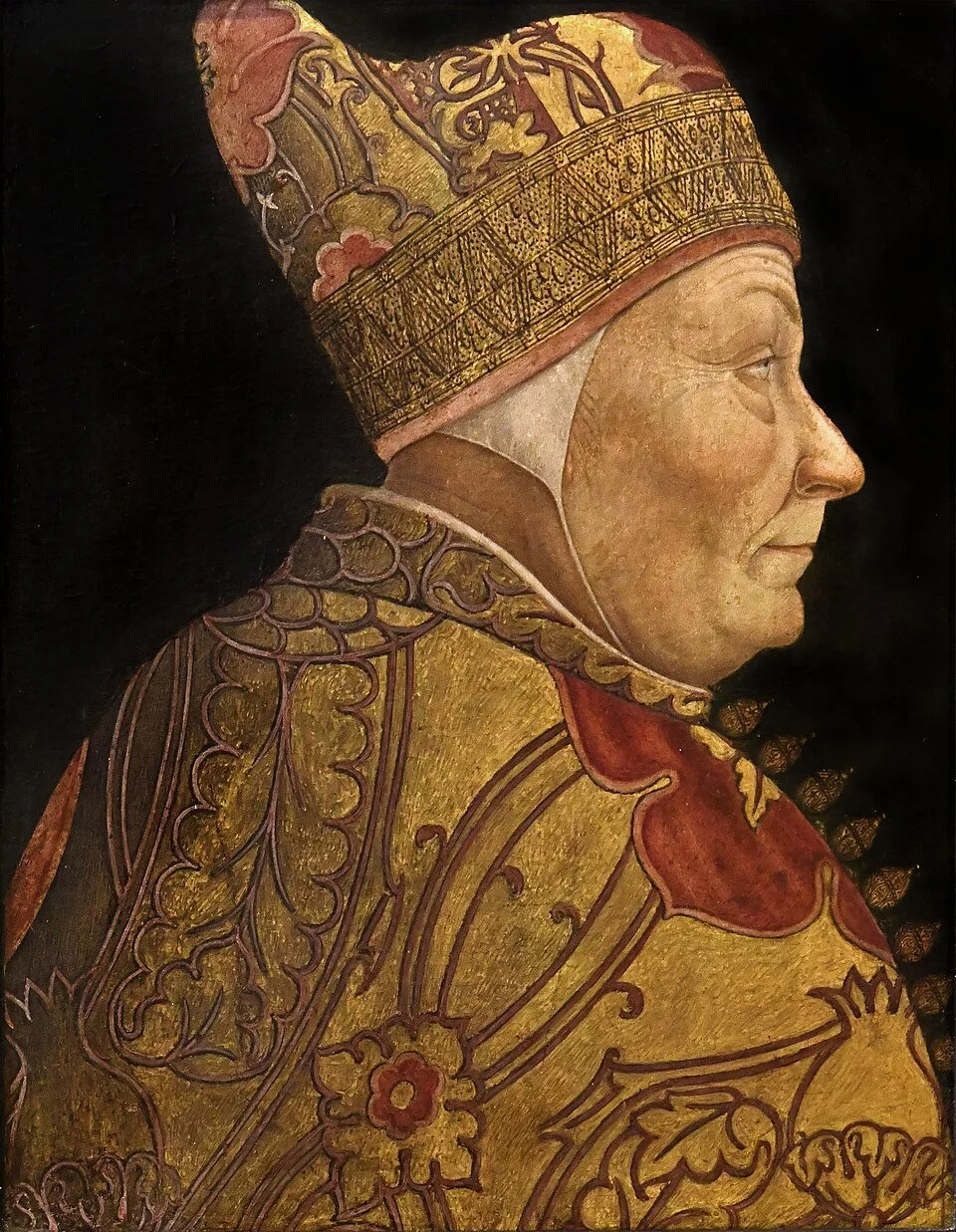
Lazzaro Bastiani (1429–1512), Francesco Foscari., oil on panel, ca 1460 - After more than three decades as doge, Foscari was forced from office in 1457. His fate demonstrated that even the most conspicuous man in Venice remained subordinate to the state.
The Bellinis lived through one of the clearest demonstrations of how little protection the doge’s robes could provide.
Francesco Foscari had been doge since 1423. His long reign coincided with Venice’s expansion onto the Italian mainland and its costly wars with Milan. He was one of the most powerful and visible men of Jacopo Bellini’s generation.
His only surviving son, Jacopo Foscari, was repeatedly investigated, tried, and exiled on charges that included corruption and illicit contact with Venice’s enemies. In 1457, after his son’s death in exile, the elderly doge was forced to leave office. He died days later.
Whatever the private motives and political rivalries behind the case, the public lesson was unmistakable: the office belonged to Venice, not to the man who occupied it.
A doge could not protect his son from the state.
He could not necessarily protect himself.
For The Family Business, this is worth remembering. The Bellinis were not operating in a benign world of enlightened patrons. They were working beside a government that rewarded service, watched reputations closely, and could destroy people it believed threatened the state.
WHO WAS EXCLUDED?
Outside the patriciate was a second recognized class, the cittadini, or citizens. These were not citizens in the modern political sense. They could not sit in the Great Council, but educated citizen families supplied Venice with notaries, lawyers, physicians, secretaries, and civil servants. Because patrician officeholders rotated frequently, experienced citizen administrators provided much of the institutional memory that allowed the government to continue functioning.
Below and around them was the much larger popolo: artisans, boatmen, sailors, laborers, shopkeepers, servants, vendors, craftspeople and workshop owners. They built the ships, made the glass, dyed the cloth, unloaded the cargo, carved the stone and painted the altarpieces. They produced the physical city but did not govern it.
This did not mean they were entirely without influence. They belonged to parishes, guilds, confraternities, neighborhoods and extended families. They could attach themselves to powerful patrons. Successful artisans could become wealthy, acquire property and place their children advantageously.
But there was a boundary they could not cross.
A painter might enter the Doge’s Palace carrying a commission. He might speak to senators. He might portray the doge with such conviction that the painting would outlive the sitter and the Republic itself.
When the council assembled, he remained outside.
THE BELLINIS ENTER THE PALACE
This makes the Bellinis’ rise particularly striking.
Jacopo established the workshop and positioned his family within the world of major religious, civic and private patronage. Gentile carried the family into the most public chambers of Venetian life. In 1474, he undertook the restoration and replacement of paintings in the Great Council chamber and became responsible for the official portraits of successive doges. Much of this work was destroyed in the fire that swept through the palace in 1577.
When Gentile was sent to Constantinople in 1479, Giovanni assumed greater responsibility for the decorations in the Great Council chamber. In 1483, he received an official appointment from the Republic. The family workshop had become useful to the state.
Useful is not the same thing as equal.
The government needed the Bellinis because Venice required images. The Republic needed to present its history as continuous, its victories as providential, its rulers as dignified and its citizens as harmoniously ordered. The walls of the Doge’s Palace did not merely need decoration. They needed an argument.
Venice was stable because Venice was virtuous.
Venice was wealthy because Venice was favored.
Venice was powerful because Venice was united.
This was the story the government told about itself, and painters helped make it visible.
IN THE FAMILY BUSINESS
Jacopo’s ambition for his sons was not simply that they become good painters. He wanted the family placed where decisions were made and prestigious commissions awarded.
Gentile was temperamentally suited to this world. He understood public ceremony, hierarchy, costume and the importance of getting every person into the correct position. His great crowd scenes show Venice not as a collection of individuals but as an ordered body.
Giovanni’s relationship to authority is more complicated. He eventually receives the state position and paints one of the most convincing images of political power ever made. Yet his strength lies in private feeling, inwardness and the life behind appearances.
The brothers are both painting Venice, but not the same Venice.
A BELLINI VIEW OF POWER
Giovanni’s Doge Leonardo Loredan was painted around 1501–2, near the end of the period we are considering. Loredan does not look toward us. To meet our gaze might suggest an exchange between equals. Instead, he looks slightly away, occupying a space we can see but cannot enter. The expensive white mantle, the gold buttons, the formal cap and the blue field behind him separate the office from ordinary life.
Yet Giovanni does not turn him into an emblem. The flesh is soft. The expression is alert and difficult to read. The mouth appears capable of changing. The man remains present inside the office.
That may be the most revealing thing about the painting.
Venice spent centuries constructing a system in which no individual was supposed to become larger than the Republic. Giovanni gives us both: the institution and the man trapped inside it.
WHO REALLY RAN VENICE?
The easiest answer is the patrician class.
A better answer is that Venice was run by patrician families acting through a dense system of councils, elections, magistracies, alliances and rivalries. The doge represented their collective power but could not independently command it. The Senate handled the decisions most essential to trade and foreign affairs. The Great Council controlled access to office. Smaller bodies watched for conspiracy, corruption, and disloyalty.
Behind all of them stood the idea of Venice itself.
La Serenissima—the Most Serene Republic—was treated almost as a living being. Doges died, but the Republic did not. Families rose and fell, but the Republic continued. Individual ambition was permitted, even expected, as long as it appeared to serve the state.
The Bellinis understood this. They may not have had seats in the Great Council, but they helped create the image the Great Council had of itself.
They did not run Venice.
They helped Venice believe in its own power.
WHERE THIS RELATES TO THE FAMILY BUSINESS
In The Family Business, the Venetian government is not a distant institution. It determines which workshops receive commissions, which artists gain access to the palace, and whose version of Venetian history appears on its walls. Jacopo understands that the family’s success depends upon learning how power moves through the patrician families, councils, magistracies, and confraternities without ever belonging to that world himself. Gentile learns to make himself useful to it. Giovanni becomes responsible for giving its authority a human face. Even the doge cannot simply grant a favor or protect someone on his own. Every promise passes through other men, other offices, and other obligations. For the Bellinis, artistic ambition is therefore inseparable from political calculation. They must serve the men who govern Venice while remaining alert to the rivalries and shifting alliances behind them.
THE DEEP DIVE
I agree that it does not need a rewrite. The writing is clear, vivid, and structurally sound. One useful confirmation: the National Gallery says Gentile became responsible for the official dogal portraits in 1474, but Giovanni’s portrait of Loredan was probably a private commission. Your post already preserves that distinction. National Gallery
Here is the section ready to paste:
FOR THE DEEP DIVE
Robert Finlay, Politics in Renaissance Venice. An excellent account of how political power actually operated among the patrician families, particularly through elections, alliances, rivalries, and the enormous Great Council.
Donald E. Queller, The Venetian Patriciate: Reality versus Myth. Queller looks behind Venice’s carefully cultivated image of civic unity and selfless government to examine the ambitions, interests, and behavior of the men who ruled it.
Edward Muir, Civic Ritual in Renaissance Venice. Particularly valuable for understanding the doge’s ceremonial role and the way Venice used processions, public rituals, architecture, and images to present the Republic as orderly, stable, and divinely favored.
Dennis Romano, The Likeness of Venice: A Life of Doge Francesco Foscari, 1373–1457. The essential source for Francesco Foscari, his son’s prosecution and exile, and the political forces that eventually removed the doge from office.
Frederic C. Lane, Venice: A Maritime Republic. A broad and highly readable history of Venice, with particularly useful discussions of the Great Council, the Senate, the doge, the patriciate, and the relationship between government and trade.
Peter Humfrey, Painting in Renaissance Venice. A clear account of how Venetian painters worked within the city’s religious and political institutions, including the Bellinis’ relationship with the Republic and the decoration of the Doge’s Palace.
The Doge’s Palace: Layout and Collections. The museum’s guide to the rooms in which the Great Council, Senate, Collegio, Council of Ten, and other governing bodies conducted their business.
https://palazzoducale.visitmuve.it/en/layout-and-collections/
Giovanni Bellini, Doge Leonardo Loredan, The National Gallery, London. The museum’s detailed account of the portrait, Loredan’s ceremonial clothing, Bellini’s presentation of political authority, and Gentile Bellini’s responsibility for the official portraits of the doges.
https://www.nationalgallery.org.uk/paintings/giovanni-bellini-doge-leonardo-loredan
THE FAMILY BUSINESS is my developing treatment for a television drama about the Bellini family, their workshop, and the world of Renaissance Venice.