
VENICE: AN IMPOSSIBLE CITY
VENICE: AN IMPOSSIBLE CITY
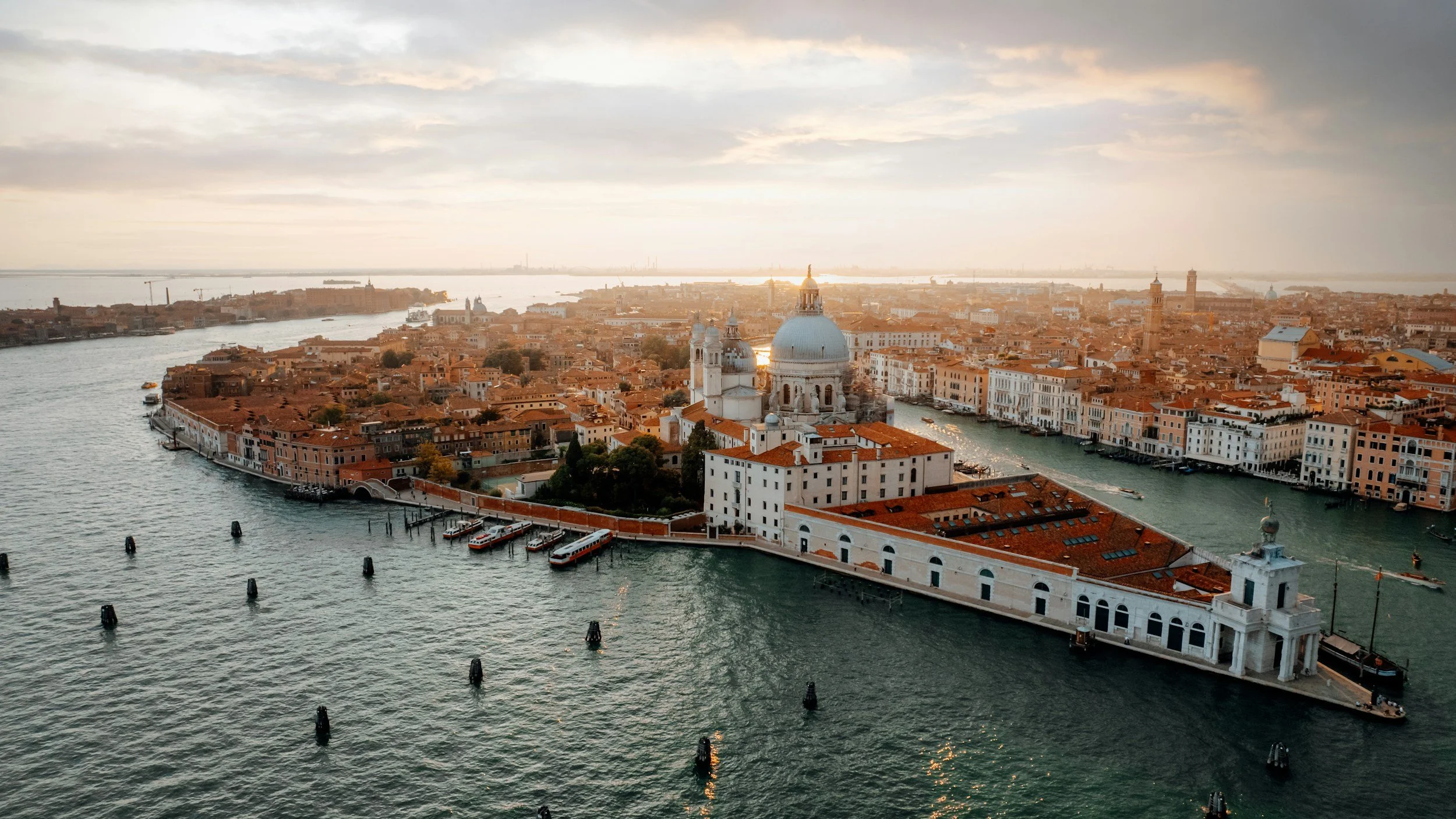
At first glance, Venice is an absurd place to build a city. There is almost no firm ground. The islands are low, muddy, and divided by tidal channels. The water is salt. Stone, timber, grain, fuel, and drinking water all have to come from somewhere else. A sensible person might have moved a few miles inland.
The people who became Venetians did the opposite.
By the time of the Bellinis, this unlikely settlement had become one of Europe's wealthiest and most powerful cities. It had spread across scores of small islands and commanded an extensive maritime empire. Venice prospered not despite the lagoon, but because of it. The same water that made the city difficult to build also made it difficult to attack. It connected Venice to the Adriatic and the eastern Mediterranean while keeping it just beyond the easy reach of mainland rulers.
WHY BUILD THERE AT ALL?
No single moment marks Venice's founding. The familiar story is that people from the mainland fled into the lagoon to escape successive invasions after the Roman Empire collapsed. Different versions mention the Huns, Goths, and Lombards. There is truth behind the story, but the neat account of whole cities emptying into the marshes is also part of the mythology Venice later created about itself.
People had already been using the lagoon for fishing, salt production, and transport. The mainland's instability changed that. Over several generations, clergy, military officials, merchants, and other inhabitants moved toward the islands. The settlements that survived remained connected to the Byzantine world even as much of northern Italy came under Lombard control. Venice did not suddenly spring from the water. It accumulated.
The lagoon offered an unusual combination of refuge and access. A land army found it hard to cross, but it was not remote. It opened directly onto the Adriatic, while rivers and overland routes connected it to the rich agricultural and manufacturing regions of northern Italy. The early Venetians could trade with the mainland without being entirely subject to it, and look east toward Byzantine ports without abandoning the West.
That position would become the basis of Venetian power.
MAKING GROUND
The settlers found no city waiting for them. They had to construct the ground beneath it.
They consolidated small islands, reinforced muddy banks, and gradually joined separate settlements into a single urban fabric. Some channels were preserved and enlarged; others were narrowed, redirected, or filled. The larger surviving waterways became the Grand Canal, the Giudecca Canal, and the basin of Saint Mark. The smaller channels became the rii, the narrow canals through which the city's daily life moved. Venice was not laid out on top of the lagoon. Its shape developed through a long negotiation with it.
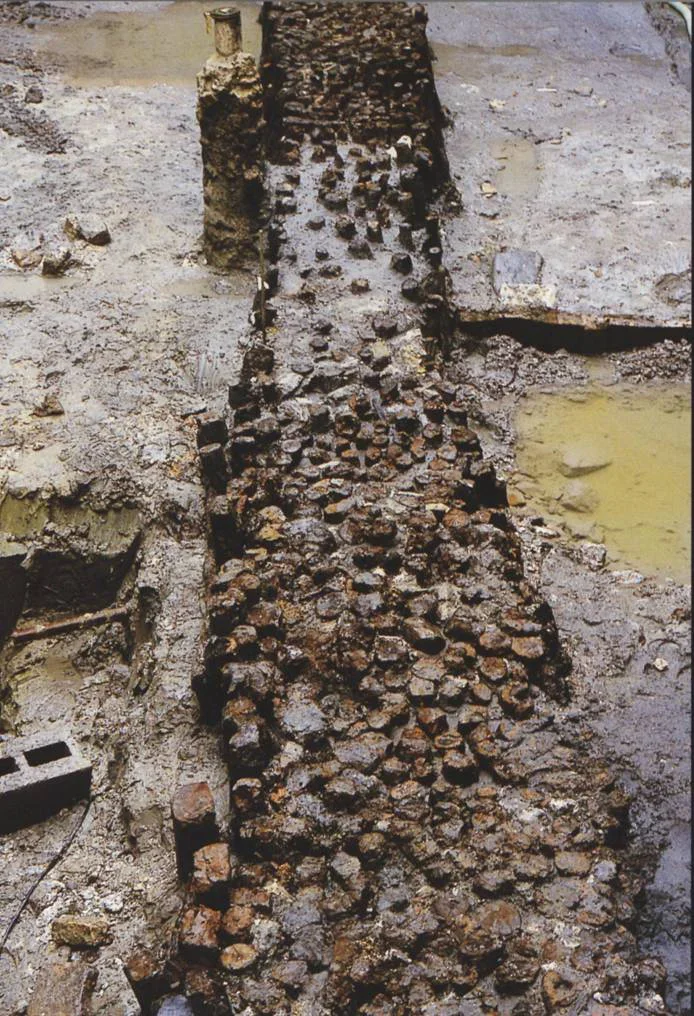
14 th century wooden piling found during archeological survey in 1999 in Venice at ex-Cinema San Marco. (by Graziano Arici)
Where the soil was too soft to support a substantial building, workers drove closely spaced wooden piles into the silt and clay. These were generally not enormous trunks reaching all the way to bedrock, as the more dramatic accounts sometimes suggest. Many were relatively short piles used to compress and strengthen the unstable upper layers of soil. Workers laid wooden planks across them, then water-resistant stone and the masonry above. The method varied by site and building weight. A palace or church required far more preparation than a modest house.
The submerged wood often survived because it was buried in wet mud with very little oxygen. It did not simply turn to stone, another appealing but misleading version of the story. The piles remained wood, protected by the surrounding conditions, although modern investigations have shown they can deteriorate. Venetian foundations have always required watching and repair.
Above the foundations, builders learned to distribute weight carefully. Brick was used extensively. Heavy stone tended to be concentrated where it was most necessary: at water level, in columns, around openings, and across façades meant to display wealth and permanence. The grand palaces along the canals may appear to rise effortlessly from the water, but beneath them is an elaborate system designed to keep them from settling unevenly into the mud.
The city had another obvious problem. It was surrounded by water that could not be drunk. Rainwater was gathered in paved courtyards and squares, filtered through layers of sand, and stored in underground cisterns beneath the structures that look like wells. They also had to carry additional fresh water in from the mainland. Venice was, as the diarist Marin Sanudo observed, a city in water without water.
THE WATER WAS THE WALL
Most medieval cities defended themselves with fortifications. Venice had the lagoon.
Its shallow water, mudflats, and shifting channels were treacherous to anyone who did not know them. Large ships could enter only through particular passages. Channel markers, pilots, and local knowledge mattered. An approaching army could not simply march up to the gates because there were no gates and, for much of Venice’s history, no continuous city wall.
This did not make Venice invulnerable. It made attacking the city unusually difficult. The lagoon offered distance from the mainland's political violence and helped Venice preserve a degree of independence while other northern Italian cities were absorbed, divided, or repeatedly conquered.
But the lagoon was useful only if it remained a lagoon. Rivers carried silt that could gradually turn shallow water into dry land. Tides and currents altered channels. Banks eroded. Canals filled with mud. The Venetians had to dredge, reinforce, and regulate the waterways continually. What appears to be a natural setting was, by the time of the Bellinis, already the result of centuries of human management. The survival of the buildings and the navigability of the canals were inseparable.
A CITY WITH A PURPOSE
Venice was more than a refuge. It became a place where goods could move between worlds.
Ships from the eastern Mediterranean brought spices, textiles, ceramics, metalwork, manuscripts, and luxury goods into the lagoon. Venetian merchants carried some of them farther into Europe and returned with timber, grain, metals, and manufactured goods from the mainland and the north. Trade continued across religious and political divisions. Venice fought the Ottoman Empire at various points, negotiated with it at others, and conducted business whenever circumstances allowed.
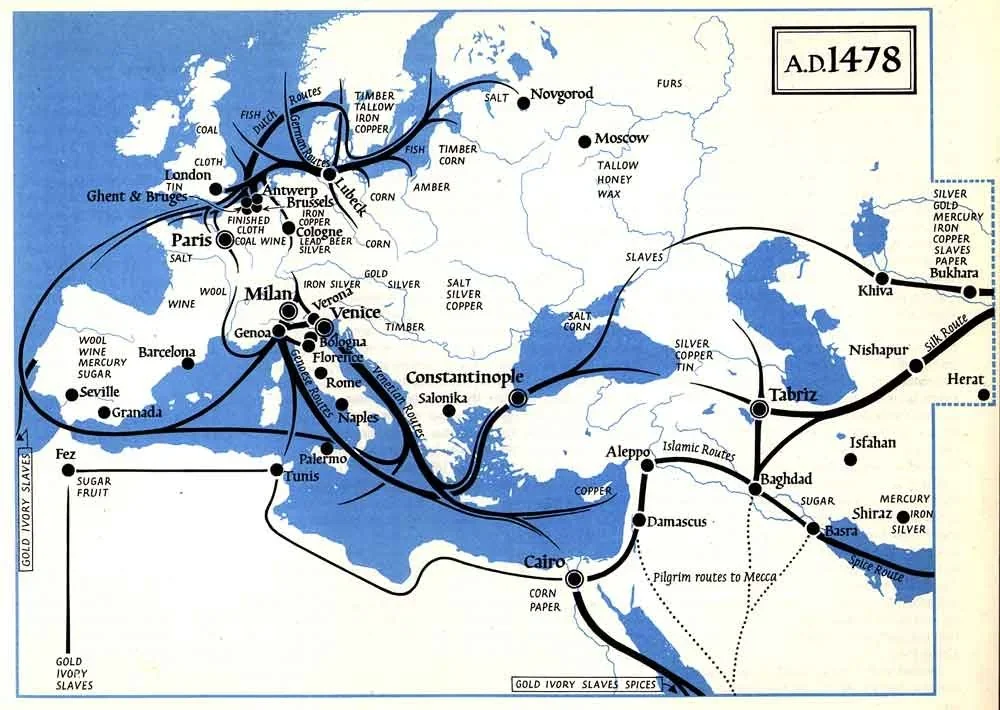
Old World Trade Routes 1478 C.E.
Its apparent disadvantages encouraged this development. Venice had little agricultural land. It could not survive by turning inward. Food, wood, stone, and fuel had to arrive by boat. The city’s dependence on trade forced it to become exceptionally skilled at shipping, contracts, diplomacy, warehousing, shipbuilding, and risk management.
The lagoon separated Venice from the mainland, but the sea connected it to an immense commercial world. What began as a place of refuge became a transfer point between East and West.
This purpose shaped the city physically. The canals were not decorative. They carried people, building materials, food, merchandise, refuse, news, and visiting dignitaries. A palace’s principal entrance commonly faced the water because that was where people of consequence arrived. The façade seen from the canal was the building's public face. The narrow land entrance at the rear may have been secondary.
Venice must be imagined from the water inward, not from the street outward.
VENICE IN THE TIME OF THE BELLINIS
By the fifteenth century, Venice was near the height of its wealth and confidence. It controlled territories on the Italian mainland as well as ports and islands along the Adriatic and in the eastern Mediterranean. Its markets were filled with foreign goods. Its churches, confraternities, and government buildings advertised civic order, religious devotion, and commercial success. The richness was real, though the city also defended its possessions, negotiated with powerful enemies, and watched the Ottoman Empire expand across territories essential to Venetian trade.
This is the Venice of the Bellinis. Jacopo, Gentile, and Giovanni were not working in a provincial art center. They were working in a maritime capital whose merchants, diplomats, and officials moved between cultures. Materials, objects, and visual ideas arrived from Byzantium, the Islamic world, northern Europe, and the Italian mainland. The Bellinis’ patrons had seen foreign textiles, metalwork, ceramics, and manuscripts. Some had lived abroad. Others had relatives or business partners stationed in Venetian colonies and trading centers.
The family workshop was part of this commercial system. Paintings were devotional objects, public declarations, memorials, and instruments of institutional prestige. A commission from a major confraternity or government body was not merely an artistic opportunity. It brought the workshop into a network of money, reputation, and political influence.
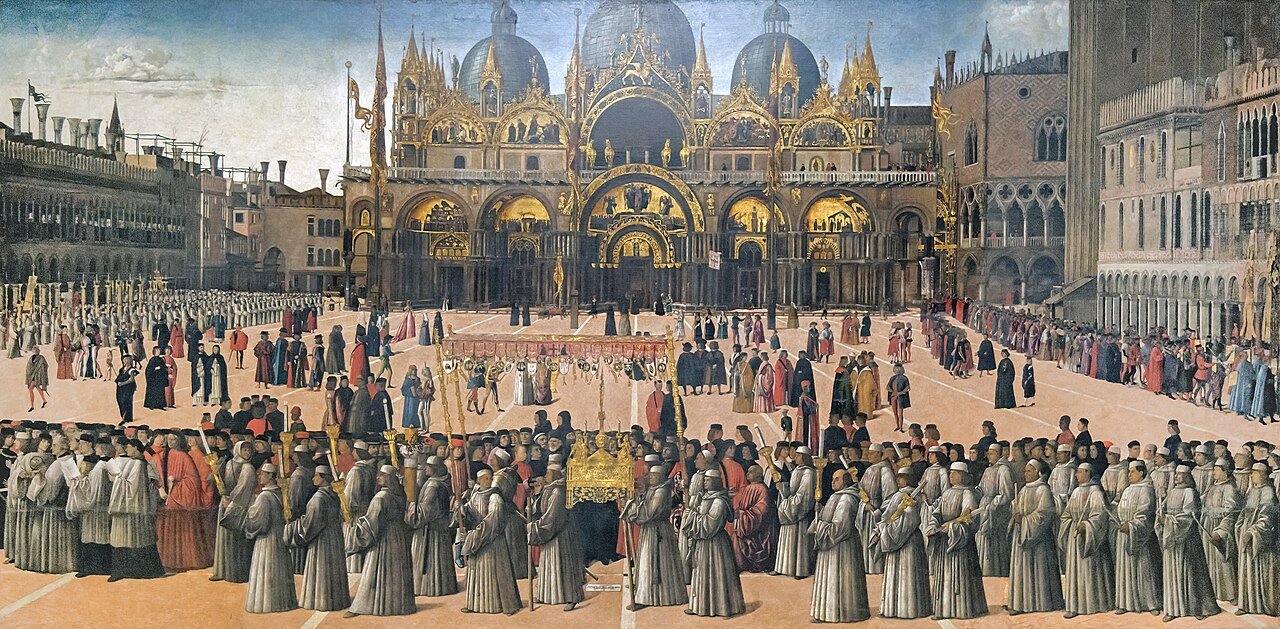
Gentile Bellini, Procession in Piazza San Marco,
Gentile Bellini’s Procession in Piazza San Marco, painted in 1496 for the Scuola Grande di San Giovanni Evangelista, shows what Venice wanted the world, and perhaps itself, to see. The immense square is ordered. The procession moves through it with ceremony. The confraternity, the church, and the citizens occupy their appointed places. It is an image of the city as a public performance, with architecture, religion, and social rank brought together on one enormous stage.
For The Family Business, Venice should never be merely the background behind the Bellinis. The water determines how people arrive, how materials enter the workshop, how news travels, and where chance meetings can occur. It determines which families grow rich and which institutions can afford enormous cycles of paintings. It also helps explain Jacopo’s particular intelligence. To run a successful workshop in Venice, he must understand not only painting but the movement of favors, contracts, reputations, and obligations through the city.
The Bellinis’ business exists because Venice exists. And Venice exists only because generations of people learned how to keep an impossible city functioning.
FROM ENGINEERING TO POWER
Maintaining Venice required more than skilled builders. Someone had to decide which canals to dredge, which banks to reinforce, where ships could anchor, how to supply fresh water, and how to divide the costs. The lagoon's freedom depended on an unusual amount of regulation.
The city’s physical survival required administration, cooperation, and control. Private wealth could build a palace, but it could not preserve the lagoon or keep the shipping channels open. For that, Venice needed magistrates, councils, laws, and public offices, many of them overlapping and nearly all of them designed to prevent too much authority from remaining in one pair of hands.
Having established how Venice was built, the next question is inevitable:
Who really ran it?
FOR THE DEEP DIVE
Frederic C. Lane, Venice: A Maritime Republic. The classic account of Venice’s development as a commercial and maritime power.
Deborah Howard, The Architectural History of Venice. Particularly useful for understanding how the city’s physical structure, buildings, and waterways developed together.
Joanne M. Ferraro, Venice: History of the Floating City. A broad and readable history of Venetian society, politics, trade, and daily life.
Venice and Its Lagoon, UNESCO World Heritage Centre. A concise overview of the relationship between the city and the lagoon that made it possible.
https://whc.unesco.org/en/list/394/
Gentile Bellini, Procession in Piazza San Marco, Gallerie dell’Accademia. The museum’s account of the painting and its commission for the Scuola Grande di San Giovanni Evangelista.
https://www.gallerieaccademia.it/opera/processione-in-piazza-san-marco/
Venice and the Islamic World, The Metropolitan Museum of Art. An introduction to the trade, diplomacy, and visual exchange that connected Venice to the eastern Mediterranean.
https://www.metmuseum.org/essays/venice-and-the-islamic-world-828-1797
THE FAMILY BUSINESS is my developing treatment for a television drama about the Bellini family, their workshop, and the world of Renaissance Venice.