
In the late 1420s, the humanist Guarino da Verona wrote a Latin poem praising the painter Pisanello, who would later become Jacopo Bellini’s rival at the court of Ferrara (see PISANELLO: THE OTHER HEIR TO GENTILE’S WORLD). Guarino admired Pisanello’s ability to reproduce the natural world so convincingly that a viewer could almost hear horses neighing, waves breaking, and birds singing. He marveled that Pisanello knew which birds appeared at night, how trees looked in winter, and what happened to the landscape with the arrival of spring.
Guarino had studied Greek in Constantinople and spent his career teaching classical literature. His praise of Pisanello was part of a growing exchange between scholars and artists, in which the humanists applied what they knew of ancient writing to the work of contemporary painters. They compared living artists with the great painters of antiquity and celebrated them in poems and letters. Painters, meanwhile, found new subjects in the literature the humanists were recovering.
This exchange interests me because it shows people developing a vocabulary for discussing art, at a time when recognizing artistic achievement was becoming one more sign of a good education.
The movement behind this was humanism. Beginning in the late thirteenth century, scholars in Padua and elsewhere turned to the surviving literature of ancient Greece and Rome. They hunted for manuscripts, corrected errors introduced by centuries of copying, and studied classical rhetoric, history, poetry, and moral philosophy, looking for lessons they could apply to their own lives.
Venice absorbed the movement through Padua, which it conquered in 1405. Young Venetian patricians attended the university there, and a humanist education became useful to men headed for government and diplomacy. A cultivated man was expected to know his classical authors and what they taught about civic virtue and public conduct. An educated patron might recognize the literary source of a painting, check the accuracy of an ancient inscription, or enjoy a clever twist on a familiar story.

Hieronymus Rodler’s version of Alberti’s Veil (1531).
In 1435, Leon Battista Alberti wrote On Painting, the first systematic account of what painting could do. He wanted painters to understand geometry, perspective, and composition, and he urged them to spend time with poets and orators, who could help them invent better subjects. His ideal was the istoria, a composition in which figures, gestures, and actions work together to tell a story. His example was Giotto’s mosaic of the ship of the apostles in Old St. Peter’s in Rome, the Navicella, where each disciple shows his own fear and agitation as Christ walks on the water. Alberti was giving painters a standard to aim at, and he was also giving educated viewers a way to judge them.
We can see this culture at work at the court of Leonello d’Este in Ferrara, where Guarino had been Leonello’s tutor since 1429. In 1441, Jacopo Bellini and Pisanello competed to paint Leonello’s portrait. A contemporary sonnet by the courtier Ulisse degli Aleotti credited Jacopo with the win.
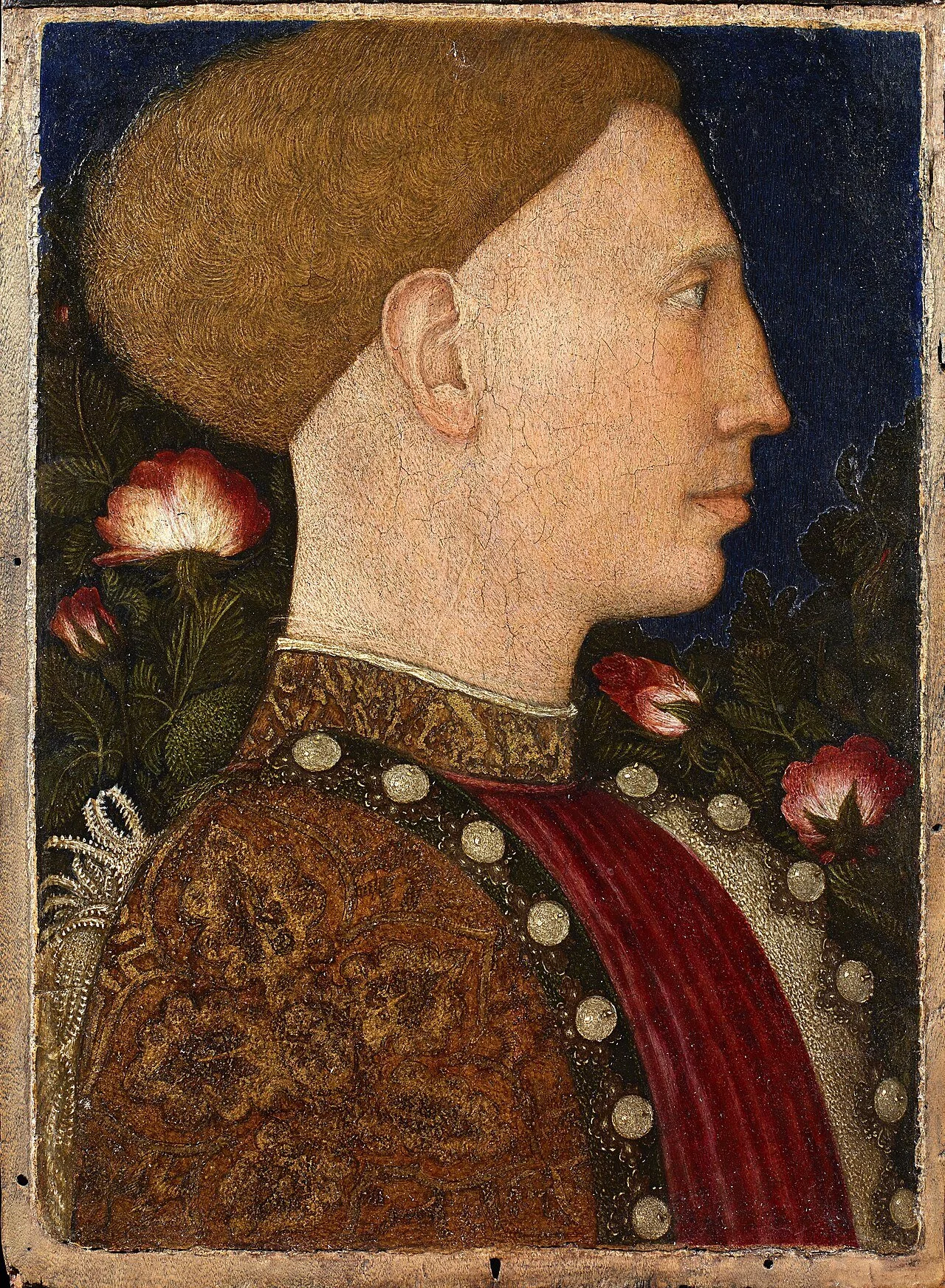
Pisanello, Portrait of Leonello d'Este (c. 1441)
Six years later, Leonello wrote to Guarino about a project to decorate his study at the villa of Belfiore with paintings of the Muses. Guarino’s reply, dated November 5, 1447, praised the idea as worthy of a prince, then went on to describe each of the nine Muses, what she presided over, and how she might be shown. Painters including Angelo Maccagnino and Cosmè Tura worked on the cycle over the following years, and several of the panels survive. A ruler and his old teacher had worked out what a painter should paint.
Pisanello’s portrait medals show the same culture in metal. They were modeled on ancient Roman coins, with the ruler’s profile on one side and a symbolic image on the other. In 1444 Pisanello made a medal for Leonello’s marriage to Maria of Aragon. On the reverse, Cupid holds a sheet of music and teaches a lion to sing. Leonello means “little lion.” A viewer who caught the pun and the allegory got the joke, and that was the point.
In Padua, Andrea Mantegna drew even closer to this world. His interest in Roman monuments and lettering brought him into the company of antiquarians such as Felice Feliciano and Giovanni Marcanova. In September 1464, Feliciano recorded an outing on Lake Garda with Mantegna and Samuele da Tradate, a Mantuan court official. They sailed in a boat hung with carpets and laurel, hunted for ancient inscriptions, and played at being Romans, with Samuele crowned in laurel and ivy as “emperor” and strumming a cithara. Squarcione had given Mantegna access to classical models, but Mantegna took them much further than the workshop.
The Bellinis came at this culture from different directions. Jacopo knew educated men, among them the Venetian physician and engineer Giovanni Fontana, who wrote a treatise on painting for him. The treatise is lost. We know of it only because Fontana mentions it in another of his books. Jacopo’s sons inherited a world in which a painter’s learning counted toward his reputation.
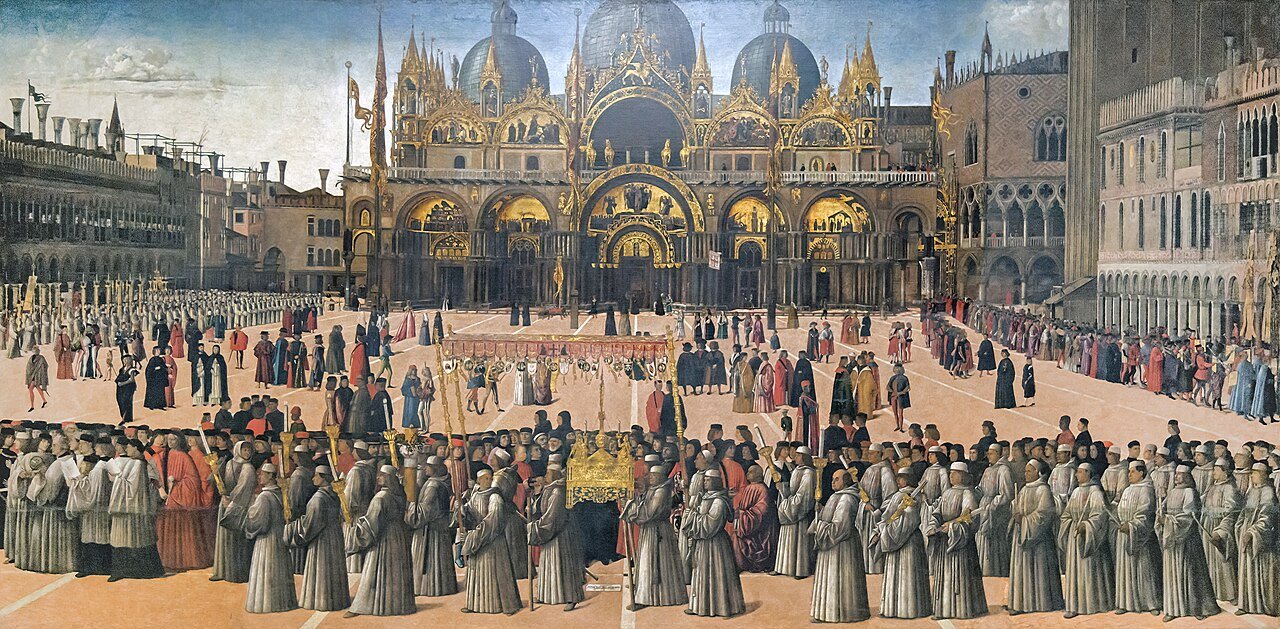
Gentile Bellini, Procession in Piazza San Marco of 1496.
In Venice, the humanist interest in civic history and reputation found a counterpart decades later in Gentile Bellini’s paintings of state ceremonies, such as his Procession in Piazza San Marco of 1496. These presented the Republic as it wished to be seen: prosperous, orderly, and devout. They weren’t humanist pictures, but they came out of the same deliberate cultivation of a public image.
Taste in this period developed through conversations among painters, scholars, and patrons, and they did not all agree. Pisanello’s close observation of nature, Mantegna’s reconstruction of antiquity, and Giovanni Bellini’s light and atmosphere produced very different pictures. What changed was that painting was increasingly discussed as intellectual work, and a painter’s inventions as worth the same attention as a writer’s.
For Jacopo Bellini, who began as an apprentice in a painter’s household, this must have been a striking change in the people he met and what they expected of him. His win in Ferrara shows he could satisfy a demanding court, though we have little evidence of what he made of its intellectual life. I wonder how much of it he carried home to Venice, and how much reached his workshop later through his sons and his son-in-law Mantegna.
DEEP DIVE
Michael Baxandall, Giotto and the Orators: Humanist Observers of Painting in Italy and the Discovery of Pictorial Composition (Oxford University Press, 1971). This book is the backbone of this post. Baxandall shows how men trained in Latin rhetoric looked at pictures, and why they praised the things they did. He also explains where Alberti’s idea of composition came from.
Michael Baxandall, “Guarino, Pisanello and Manuel Chrysoloras,” Journal of the Warburg and Courtauld Institutes 28 (1965). If you only have an afternoon, start here instead. It covers Guarino’s poem to Pisanello and includes the full letter about the Muses, in Latin and in English.
Leon Battista Alberti, On Painting (1435). It’s short, opinionated, and still readable. Look for the passage on Giotto’s Navicella and his advice that painters make friends with poets.
Luke Syson and Dillian Gordon, Pisanello: Painter to the Renaissance Court (National Gallery, 2001). The best guide to Pisanello, Guarino, and the Este court, with excellent pages on the medals. You’ll never look at a singing lion the same way.
Margaret L. King, Venetian Humanism in an Age of Patrician Dominance (Princeton University Press, 1986). King argues that Venetian humanism served the ruling aristocracy, which explains a lot about the city the Bellinis were working in. It’s heavy going in places, but the argument is worth the effort.
Patricia Fortini Brown, Venice and Antiquity: The Venetian Sense of the Past (Yale University Press, 1996). Venice had no Roman ruins, so it invented a past to suit itself. Brown tells how, and it’s a pleasure to read.
YOU MIGHT ALSO LIKE


THE FAMILY BUSINESS is my developing treatment for a television drama about the Bellini family, their workshop, and the world of Renaissance Venice.