AD REINHARDT: HIDDEN IN PLAIN SIGHT
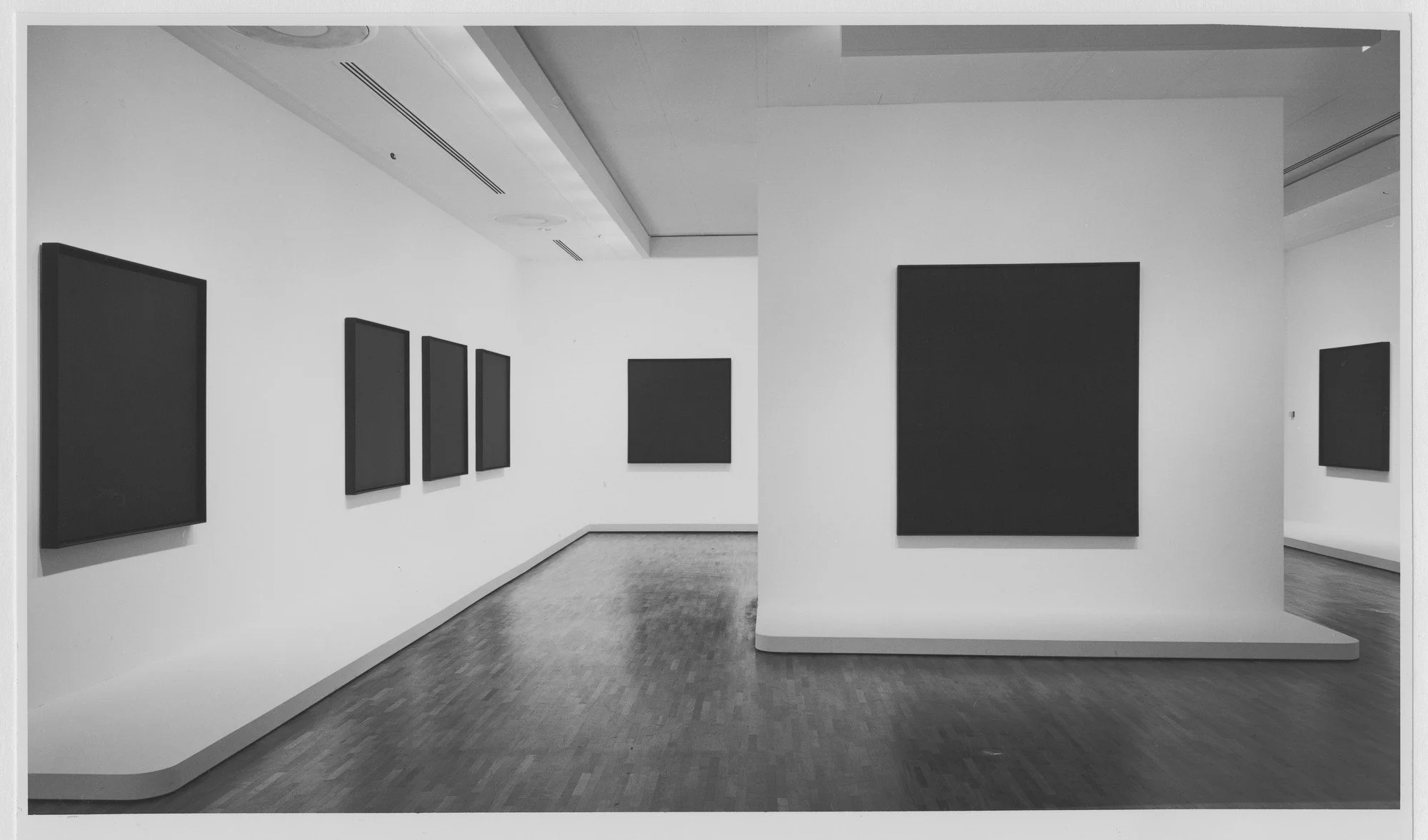
Ad Reinhardt, Exhibition at MOMA 1991
When I was a child, I took art lessons at the Museum of Modern Art. After class I would go through the collection. I did this every week, so certain paintings became almost like acquaintances. I remember the first time I came across one of Ad Reinhardt’s black paintings. My first reaction was more or less: WTF. I can’t remember now for sure, but there may have been a Larry Bell box nearby and possibly a white painting by Robert Ryman. I may be telescoping different visits. Bell’s glass box, which glistened like a gas leak, was a helpful comparison. It had already made me alert to the surface. Reinhardt’s painting seemed to be doing something entirely different. So what was it? I think looking with that question in mind allowed me to stay until the painting told me. Slowly, what had looked uniformly black began to separate into nine squares. One seemed slightly redder, another bluer, another greener. The differences were so slight that I had to wait for my eyes to adjust before I could see them. The painting wasn’t black at all.
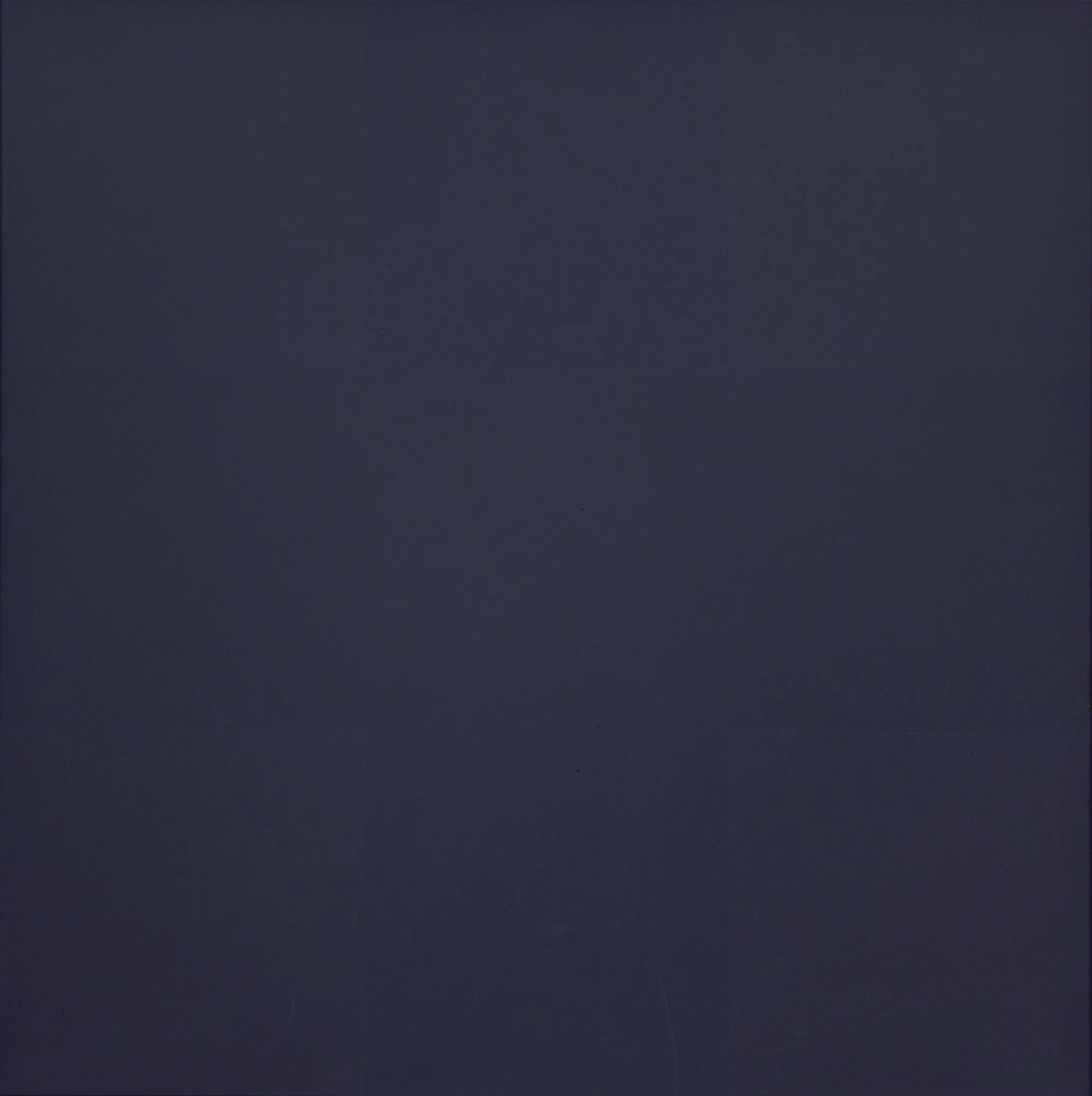
Ad Reinhardt, Abstract Painting, 1960–61, Museum of Modern Art.
I had no idea then how deliberately Reinhardt had constructed this experience. MoMA’s 1960–61 Abstract Painting is exactly as I remember it: a three-by-three grid. The four corner squares are reddish-black; the vertical part of the cross is bluish-black; the horizontal is greenish-black. The distinctions emerge with prolonged looking. What interests me now is that Reinhardt did not make it easy. He was not particularly interested in making anything easy. Reinhardt was a painter, but he was also a writer, teacher, polemicist, and very funny satirical cartoonist. His How to Look cartoons took on artists, critics, museums, and the art world in general. He could be merciless about his contemporaries and equally uncompromising about what painting should and should not be. The Archives of American Art preserves his cartoons and extensive papers, and the Whitney describes him as a relentless advocate of what he called “Art-as-Art.”
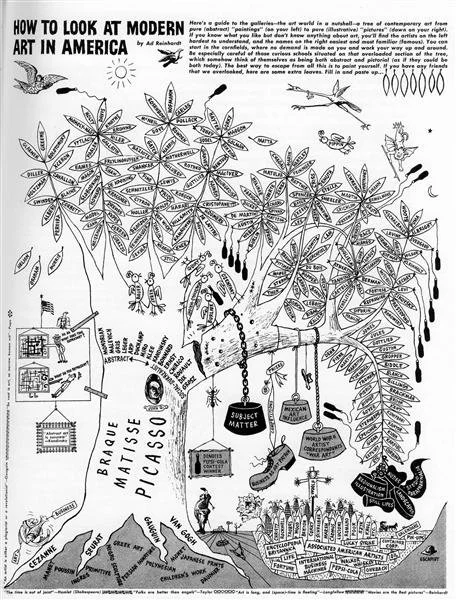
Ad Reinhardt, How to Look at Modern Art in America, 1946
In 1957, he published “Twelve Rules for a New Academy.” They are mostly prohibitions. No texture. No brushwork. No drawing. No forms. No design. No color. No light. No space. No time. No size or scale. No movement. No object, subject, or matter. He even managed to work in “no chess playing.” Not exactly a man afraid of making pronouncements. By the end of his life, he had reduced his own paintings to five-foot squares and was calling them his “ultimate paintings.” He said he wanted to make “the last paintings anyone can paint.” He described the ideal painting as pure, abstract, non-objective, timeless, spaceless, changeless, relationless, and disinterested. The surface should be matte, with the brushwork brushed out so completely that it did not reflect the room around it.
Reading all of that, I can understand my friend in Tokyo. Many decades after my childhood visits to MoMA, I visited a friend working in Tokyo. We were going through a museum when I came upon a large black Reinhardt. I was delighted. It felt like being reunited with someone I had known for most of my life. My friend was not delighted. “I hate this sort of thing,” she said. She seemed genuinely offended by the painting. I think she felt that the artist was playing a game with her, that he had put a black canvas on the wall and was waiting for the viewer either to pretend to understand it or feel like an idiot. Knowing a little more about Reinhardt now, I have to admit that she may have picked up on something real about the man. He was combative. He liked absolutes. He spent a fair amount of time telling other artists what they should not be doing. But I don’t think that is what the painting was doing. I pointed out the colors to her. I showed her how the black shifted, how the structure began to emerge when you stayed in front of it.I don’t think she was impressed.
FOR THOSE WHO LIKE TO WATCH PAINT DRY
When I first saw the Reinhardt at MoMA, I assumed that what I was seeing had something to do with glazes. I was wrong. Reinhardt made those almost imperceptibly colored blacks by mixing black oil paint with very small amounts of red, green, or blue. He let the mixtures sit for weeks so the pigment and liquid components separated, then poured away much of the liquid and painted with what remained. The result was an extraordinarily matte, concentrated surface with almost no visible trace of the brush. That matte surface matters. Soulages, whom I wrote about in the last post, worked the black paint into ridges and grooves so that light would catch on it. Anish Kapoor found a material that could absorb so much light that the surface of an object could almost disappear. Reinhardt wanted neither. He did not want the room reflected in the painting. He did not want a flash of light traveling across the surface. He did not want brushwork telling you what his hand had done. He took away as many distractions as he could and left you with differences in color so slight that you had to recalibrate your eyes to find them. He once said that there was an old black and a fresh black, a lustrous black and a dull black, black in sunlight and black in shadow. His blacks were never simply one black.
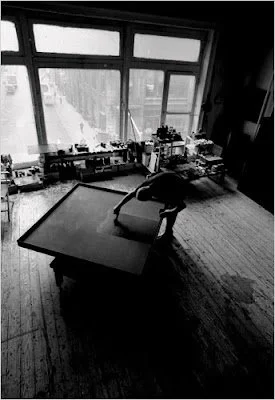
Ad Reinhardt in his New York Studio in the 1960s. The artist worked flat, brushing and rebrushing the surface to remove all traces of the stroke. Image courtesy of the Guggenheim Museum
This is where I part company slightly with Reinhardt’s rhetoric. If he really wanted to make the “ultimate painting,” the painting he arrived at was not one in which there was nothing left to see. Quite the opposite. By taking almost everything away, he made the act of seeing itself more apparent. The painting gives you very little at first. If you glance at it and walk away, you saw a black square. That is a perfectly accurate account of the first few seconds. But stay. Your eyes adjust. One black separates from another. The grid becomes visible. Colors that were there all along begin to emerge. Reinhardt rewards attention. I can’t say that he would have described the paintings as lessons in perception. He had his own very particular language for what he thought he was doing. But that is what the paintings taught me. And perhaps I learned it particularly well because I was a child. I had nowhere else I needed to be. I had a question, and I stood there waiting for an answer. Years later in Tokyo, I tried to point out the shifts in color to my friend. I don’t think I persuaded her. But by then I had known these paintings for most of my life. I already knew that the black was only the first thing you saw. Reinhardt had hidden the painting in plain sight.
IF YOU WANT TO KEEP LOOKING
MoMA’s entry for Abstract Painting is unusually useful because it describes both what happens perceptually when you stand in front of the painting and how Reinhardt prepared his colored blacks. It also includes his wonderfully severe description of the five-foot-square painting he was trying to make. The Whitney has another late Abstract Painting that Reinhardt worked on from 1960 until 1966. Their account emphasizes something that matters enormously here: the minute shifts of hue, value, and luster are largely lost in reproduction. Reinhardt believed that the real experience depended on standing in front of the actual painting and looking. And if Reinhardt’s paintings have not yet exhausted your patience, his How to Look cartoons and papers at the Smithsonian’s Archives of American Art reveal an entirely different Reinhardt: argumentative, political, scholarly, satirical, and very funny.
YOU MAY ALSO LIKE