ALLAN McCOLLUM: WHAT ARE WE LOOKING AT?

The first time I saw Allan McCollum’s Surrogate Paintings, I thought they were totally cynical. As I looked at them, what I thought I was seeing was a black painting, matted in white and put into a brown frame. The painting was nondescript other than its color. The mat was ordinary white, not what I would have thought of as museum quality, and the frames looked as though they might have been bought at a rummage sale. But what they actually were was something else. McCollum began making his Surrogate Paintings in 1978. The early ones were constructed from wood and museum board and painted with acrylic. What appeared to be a painting, a mat, and a frame had actually been fabricated together to create an object that looked like one.

Then, in 1982, he took the idea further. He began making Plaster Surrogates. These were cast in Hydrostone, a hard plaster. The frame, mat, and black “painting” were now all part of one object, which was painted to look like three separate things. So what was I looking at? Was it a painting? Was it an object pretending to be a painting? Was it trompe-l'œil? Usually trompe-l'œil is painting pretending to be something else. McCollum seemed to be doing almost the reverse. He had made an object that pretended to be a painting. That was interesting. But the more I thought about what he had made, the more troublesome it became. McCollum had not started with the familiar black centers and brown frames. Some of the early Surrogates were monochromatic. He found that people tended to see them as Minimalist objects rather than as stand-ins for paintings. So he began differentiating the parts. The center became black. The surrounding area became a white mat. The outside became a brown frame. In other words, he made them look more like what he thought people would recognize as a painting. But this is where I begin to have a problem. A black painting in 1980 was not a neutral image.

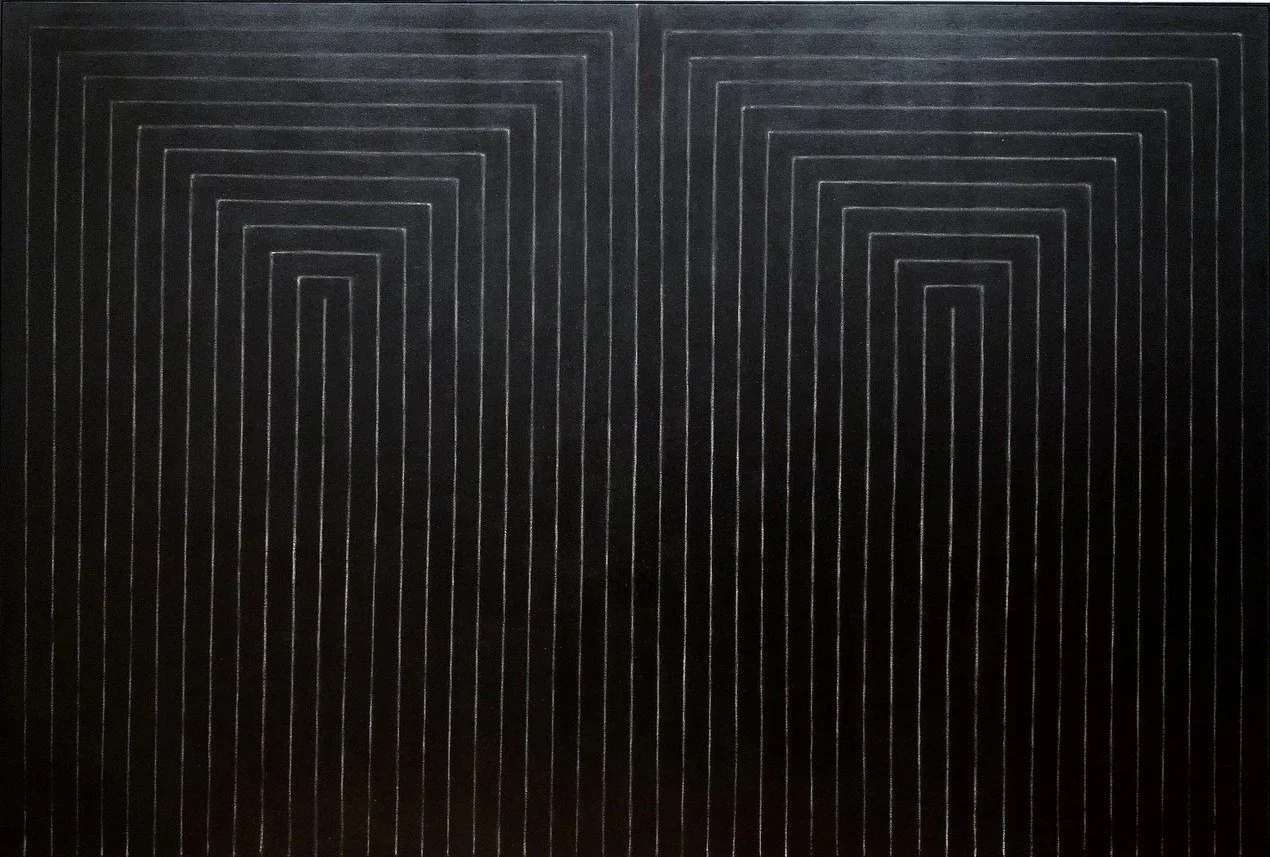
Malevich had made Black Square. Ad Reinhardt had spent years making black paintings. By then the black monochrome had acquired an entire history of its own. So if your purpose is to create a generic sign that means “painting,” why choose something that already has such a specific meaning? And then why put it in that frame? To me the frame looks cheap. Not necessarily literally cheap, but culturally cheap. It looks like the sort of frame that might turn up at a rummage sale around an undistinguished picture someone no longer wanted. Then there is the scale. McCollum made the Surrogates in many different sizes, but they are generally much smaller and less physically imposing than the Modernist paintings their black centers inevitably make me think about. And then he hung them together, crowded across the wall in something resembling a nineteenth-century salon.
Now I have a black Modernist painting, diminished in scale, put into a rummage-sale frame, and hung in a nineteenth-century arrangement. Each of those things has a cultural history. And I am not convinced McCollum consciously chose all of them for what they brought to the work. He has said that he wanted the Surrogates to function as signs for paintings, and that making the centers black and distinguishing the frame and mat helped people understand what they were supposed to represent.

But I think he may have believed he was simplifying the language when, in fact, he was piling several very specific languages on top of one another. It is a little like trying to drive to Detroit using a map of Long Island. You may get somewhere interesting, but I’m not sure it is where you thought you were going. What surprised me as I thought about the work again was that this was almost the opposite of my original objection.
When I first saw the Surrogates, I thought McCollum was being too clever. I thought he was making fun of painting, perhaps suggesting that if you put a black rectangle inside a mat and frame and hang it on a museum wall, everyone will solemnly agree that it is Art. I thought the work was cynical because it seemed too knowing. Now I am not sure it was knowing enough. The questions it raises are certainly interesting. Is the black center the painting? If the frame and mat are actually part of the same object, are they still a frame and mat? Is this sculpture? Is it trompe-l'œil? Is it a representation of a painting? Is it a representation of bad art? Is it high art reproducing something that looks like low art that was itself trying to look like high art? And what happens when there are forty of them? I enjoy all of those questions. They are a kind of Rubik’s cube. But eventually another question occurs to me.
Are the questions more interesting than the art?
I think, for me, they may be.
FOR THOSE WHO LIKE TO WATCH PAINT DRY
Of course, I am a material girl, so once I discovered that these things were not actually framed paintings, I wanted to know exactly how they were made. The first Surrogate Paintings were built from wood and museum board and painted. Later, McCollum began casting the entire object in Hydrostone. The different areas were then painted so that one read as a frame, another as a mat, and the center as a black painting. There is something clever about turning three things into one thing and then making the one thing look like three. But the materials also make me aware of what I wish the work did. An artist who once had a studio in my building made pieces in which framed paintings were cast in metal. I saw their relation to McCollum, but I am not sure he did. More things that look the same, but carry different meaning.
Then I imagined McCollum’s Surrogates carved from marble. Not a marble frame around a painting. The entire thing carved out of one block: frame, mat, and painting. And then the marble painted so convincingly that the frame looked like cheap brown wood, the mat looked like ordinary white cardboard, and the center looked like a little black painting. Now I would really have a problem. I would be looking at an expensive, permanent material pretending to be something cheap and disposable. Sculpture pretending to be painting. Enormous labor pretending to be mass production. A precious object pretending not to be precious. The material would be working against the appearance. That interests me.
McCollum was interested in repetition, molds, copies, and the idea of the artwork as one among many. Hydrostone certainly serves that purpose. You can make another one. But I think this is where my instincts as a painter get in the way of accepting the proposition on its own terms. I want the material to do more than carry the idea. I want it to complicate the idea. And in the Surrogates, I’m not sure it does.I understand what McCollum says he was trying to do. I understand why he changed the early versions when people weren’t reading them as paintings. I understand why he multiplied them and why he hung them together. But I am still left with this strange collection of cultural signals: Modernist black painting, ordinary mat, rummage-sale frame, diminished scale, nineteenth-century salon. Perhaps all of those collisions make the work richer. But I don’t think they were all the collisions he intended. At first I thought McCollum’s Surrogates were cynical because they seemed too knowing. The longer I have thought about them, the more I wonder if the problem is just the opposite. Maybe he didn’t think them through far enough.
IF YOU WANT TO KEEP LOOKING
If you want to hear McCollum explain the Surrogates himself, I would start with his interviews on his own website. They are particularly useful because he talks about the early monochromatic versions and why he began giving them black centers, white mats, and more recognizable frames. Reading his explanation is actually what made me question some of his decisions more, rather than less.
MoMA has a Collection of Forty Plaster Surrogatesthat makes it easy to see what happens when the objects multiply. It is also a good place to look closely at the different sizes and frame colors and at how something that seems so simple changes when it becomes a group.
Art21 has a short piece on the Surrogate Paintings and Plaster Surrogates. I always like hearing an artist describe what he thinks he is doing. Whether I agree with him afterward is another matter.
YOU MAY ALSO LIKE