THE FIRST BLACK PAINTING WAS A JOKE
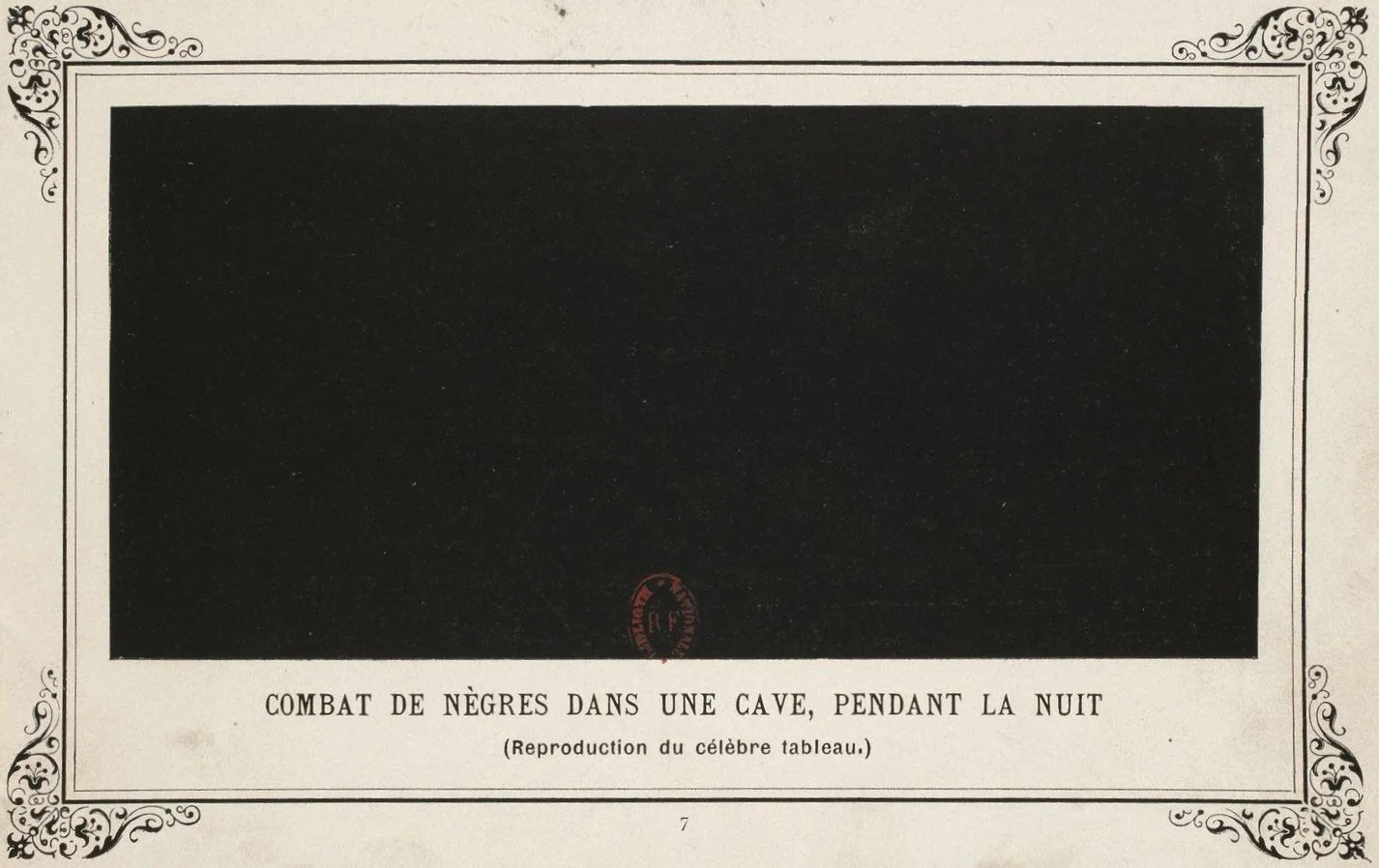
Alphonse Allais, reproduction of Paul Bilhaud’s black monochrome, from Album primo-avrilesque, 1897. The original French title, which uses a racist term, imagines Black men fighting in a cellar at night.
When we think of a black painting, we tend to think of something serious. Malevich. Ad Reinhardt. Rothko. Soulages. Black as emptiness, infinity, death, light, transcendence. But one of the earliest black monochromes was a joke.
In 1882, the French playwright and poet Paul Bilhaud exhibited a small canvas painted entirely black in the first exhibition of the Arts Incohérents, a wonderfully irreverent group organized by the writer and publisher Jules Lévy. The Incohérents had no interest in behaving themselves. Their exhibitions were conceived partly as a parody of the official Salon, and included visual puns, altered objects, parodies of famous works and pictures made by people who supposedly did not know how to draw. As the Musée d’Orsay rather nicely puts it, for the Incohérents, “seriousness” was the enemy.
Bilhaud’s painting was simply a rectangle of black oil paint on canvas. Its original French title uses a racial term we would not use now; the joke was that it represented Black men fighting at night. There was nothing to see because everything in the imaginary scene was black. That was the whole thing. Except, of course, it wasn't. The painting was listed as number 15 in the catalog of the 1882 exhibition. For many years, it was believed lost and known mainly through contemporary references. Then, in 2018, it turned up in a trunk belonging to a family outside Paris, along with a group of other works from the Arts Incohérents. The exhibition label and number remained on the back. In 2021, the French Ministry of Culture declared the group a national treasure, describing Bilhaud’s canvas as, according to specialists, the first true monochrome in the history of painting, thirty-three years before Malevich’s Black Square.
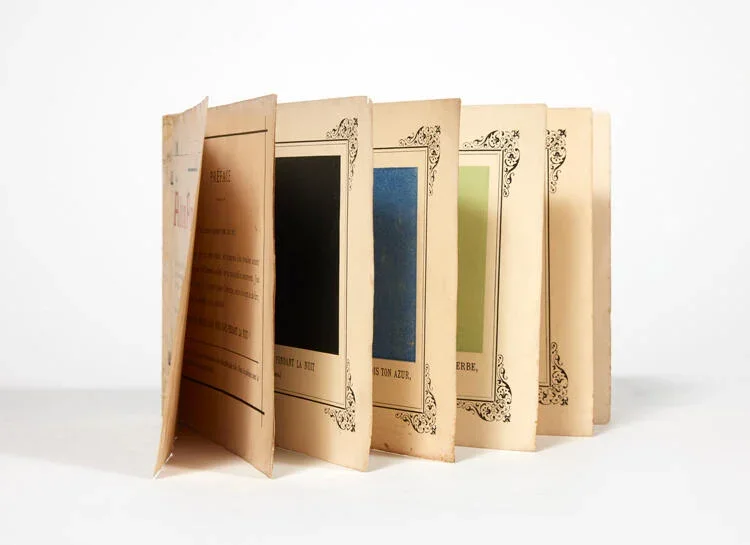
Alphonse Allais’s Album primo-avrilesque, 1897. Seven monochromes, each turned into a picture by its title.
THEN ALPHONSE ALLAIS GOT HOLD OF THE IDEA
Bilhaud’s friend Alphonse Allais, a writer and humorist, saw immediately that one monochrome joke could become an entire system. He began making his own. A white work depicted pale young girls taking their First Communion in a snowstorm. A red one became apoplectic cardinals harvesting tomatoes beside the Red Sea. Color supplied the picture; the title supplied everything that was supposedly happening inside it. In 1897 Allais gathered the idea into a wonderfully strange little book, the Album primo-avrilesque, published, appropriately enough, on April 1. It contained seven monochromes: black, blue, green, yellow or brown, red, gray and white. At the end came another piece of conceptual mischief: a funeral march written for a deaf man. The musical staves were blank. Allais included Bilhaud’s black painting as well, changing the imaginary setting slightly to a dark cellar and calling it a reproduction of the “celebrated painting.” In other words, he acknowledged that the joke was Bilhaud’s before it was his.
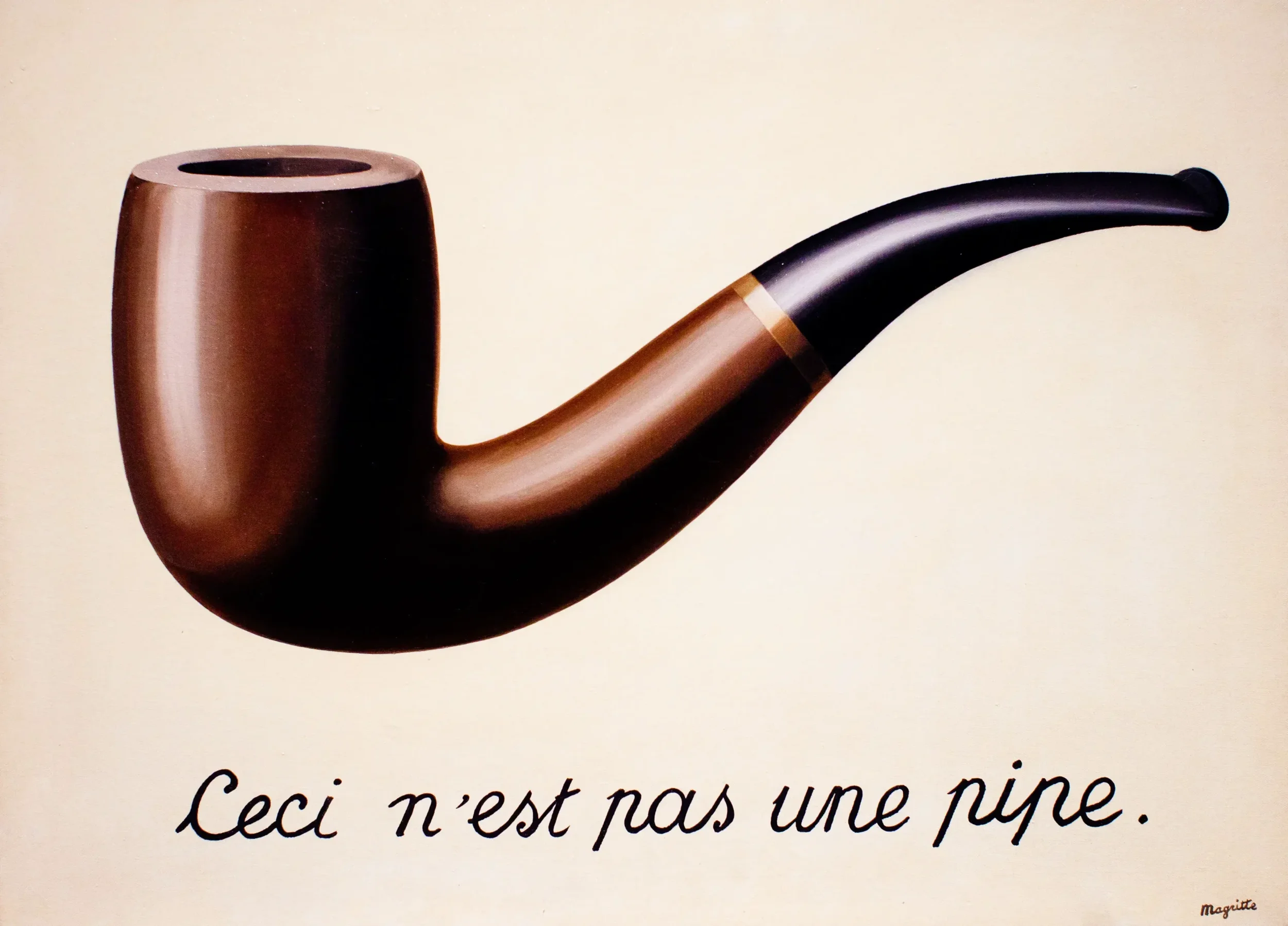
René Magritte – The Treachery of Images (This is Not a Pipe), 1929, photo: CC BY-NC 2.0 by Thomas Hawk
And this is where it gets interesting. Bilhaud and Allais were not trying to liberate color from representation. They were doing almost the opposite. Their monochromes depended entirely on representation. The black rectangle was funny because you were being asked to imagine a scene that the painting refused to show you. The painting and the title completed one another. That idea will return much later in twentieth-century art. Magritte will make titles destabilize what we think we see. Duchamp will discover how profoundly a title can alter an ordinary object. Conceptual artists will make the thought behind the work at least as important as the object itself. The Incohérents were doing some of this in the 1880s, while insisting they were having a laugh.

Kazimir Malevich, Black Square, 1915, oil on canvas, 79.5 cm × 79.5 cm (31.3 in × 31.3 in), Tretyakov Gallery, Moscow
AND THEN COMES MALEVICH
Thirty-three years after Bilhaud exhibited his black canvas, Kazimir Malevich hung Black Square in Petrograd. Visually, the leap from one to the other can look almost absurdly small. A black surface surrounded by a lighter one. But the intention could hardly be more different. Bilhaud’s black tells us that something is happening that we cannot see. Malevich’s black tells us that perhaps there does not have to be anything depicted at all. And there is one more peculiar connection. Scientific examination of Malevich’s Black Square has revealed a partly obscured inscription beneath its surface that appears to refer to the black monochrome joke later published by Allais. We cannot know exactly what Malevich meant by it, but it raises the intriguing possibility that the painting we have treated as the great beginning of the modern monochrome knew perfectly well that someone had already made the joke. That deserves its own post.
FOR THOSE WHO LIKE TO WATCH PAINT DRY
Bilhaud’s work really was a painting: oil paint on canvas. The French national-heritage commission notes underlying black motifs that merge into the apparently uniform surface, making the object a little more complicated than the reproduction suggests.
Allais’s Album, however, turns the monochrome into something closer to an artist’s book. The Bibliothèque nationale de France notes that the colored rectangles were produced using papers of differing textures and thicknesses pasted into the volume. So even these apparently flat fields were materially different from one another.
Which is perhaps the first lesson of black painting: a black rectangle is never just a black rectangle.
YOU MAY ALSO LIKE