GERHARDT RICHTER’S STRIPED “PAINTINGS”
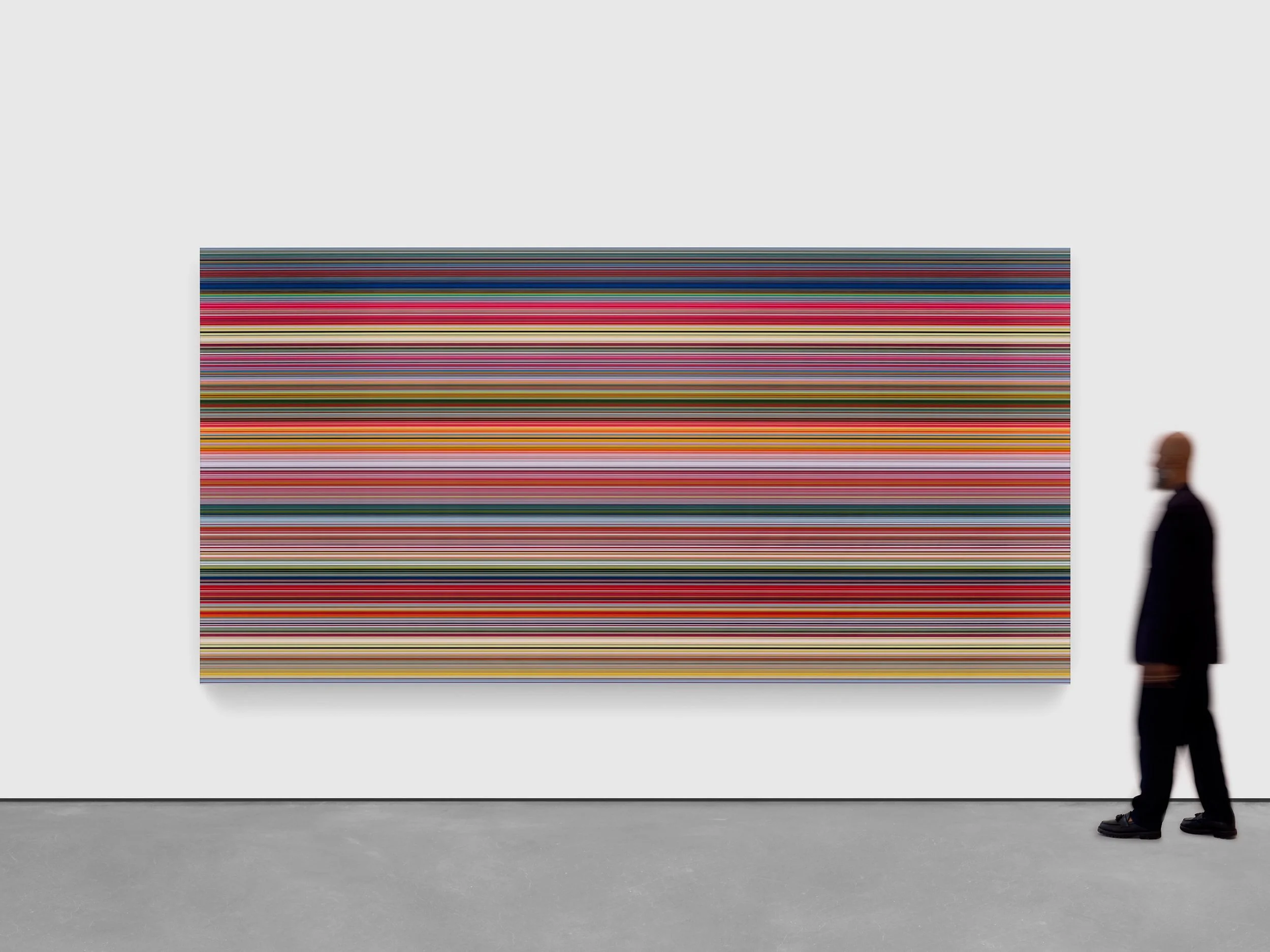
Gerhard Richter: Strip (Strip), 2024 | David Zwirner
"I don't believe in the reality of painting, so I use different styles like clothes: it's a way to disguise myself." Gerhard Richter
In the late 1970s I visited Berlin often with my then partner, Michael Marton, a German documentary filmmaker. On one trip we crossed into East Berlin with his friend Norbert. West Berlin, walled and surrounded, still felt vibrant, a dot of democracy that argued with its own precariousness. East Berlin felt like the opposite argument. The smell hit first, oily and heavy, some mix of diesel and cheap exhaust. The stores had almost nothing in them. The buildings were flat, gray versions of the International Style, stripped of any reason to like them. At Checkpoint Charlie the guards searched under the car with mirrors, then asked our German friends to turn sideways so they could match their ears to their passport photos. Nobody laughed. Back in West Berlin, the first thing I wanted was a Coke. I don't even drink Coke.
I don't want to overstate what one day in a foreign city tells you about an artist's whole life. But it's the closest I've come to the world Richter was made by.
Richter was born in Dresden in 1932, Nazi childhood, then an art education in East Germany, where painting was expected to serve the state. His aunt Marianne, who appears as a young woman holding the infant Richter in one of his early paintings, was diagnosed with schizophrenia, sterilized under Nazi law, and later killed in the euthanasia program. Decades afterward it came out that Richter's first father-in-law had been an SS doctor involved in that same sterilization system. In 1959 he saw Documenta II in Kassel and encountered Pollock and the Abstract Expressionists for the first time; in 1961, just before the Wall went up, he left for the West.
None of this shows up in his work as confession. Richter doesn't give us the image as proof of anything. He gives us an image that's been interfered with: photographs blurred so we can't mistake them for truth, abstractions dragged across the canvas with a squeegee so the hand is present and also, partly, not in control. He's said he wants chance, but chance that's been set up, chance that's better than he is.
That idea is the key to the Strip works.
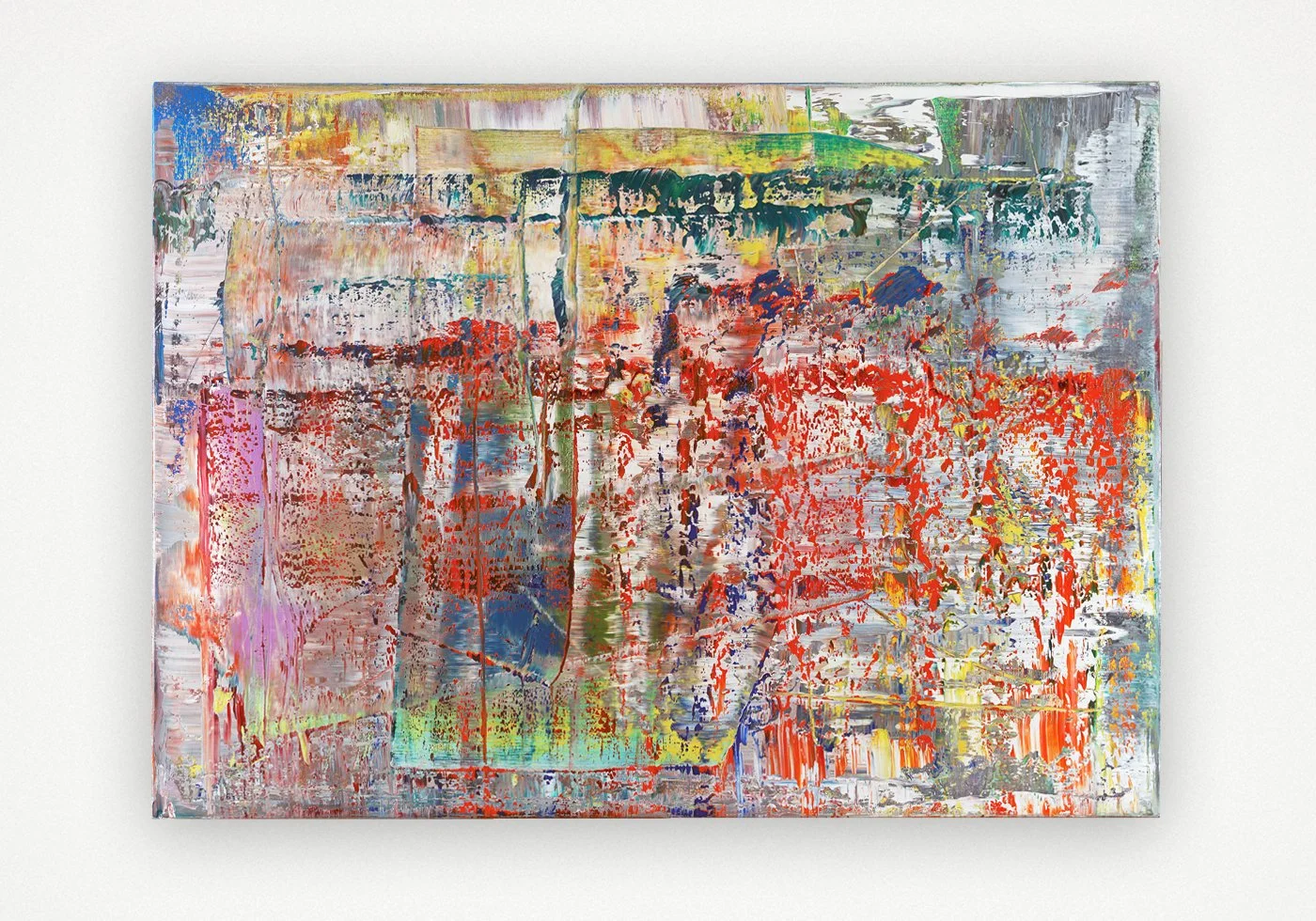
Gerhard Richter Abstraktes Bild 724-4
They don't start with a stripe. They start with one of Richter's own 1990 squeegee paintings, Abstraktes Bild 724-4, thick, layered, full of the physical residue of paint dragged over paint. Richter had that painting photographed, then ran the image through a digital process: split down the middle, mirrored, split again, mirrored again, two bands become four, four become eight, on and on, until the whole dense surface had been reduced to thousands of thin lines of color, then stretched horizontally. Paint became data. Gesture became a line. A surface became a sequence.
The results aren't paint on canvas at all. They're digital prints mounted between aluminum and Perspex using the high-gloss Diasec process: no weave, no brushmark, no place where pigment caught on a ridge. Just a smooth, glowing, mirror-hard surface.
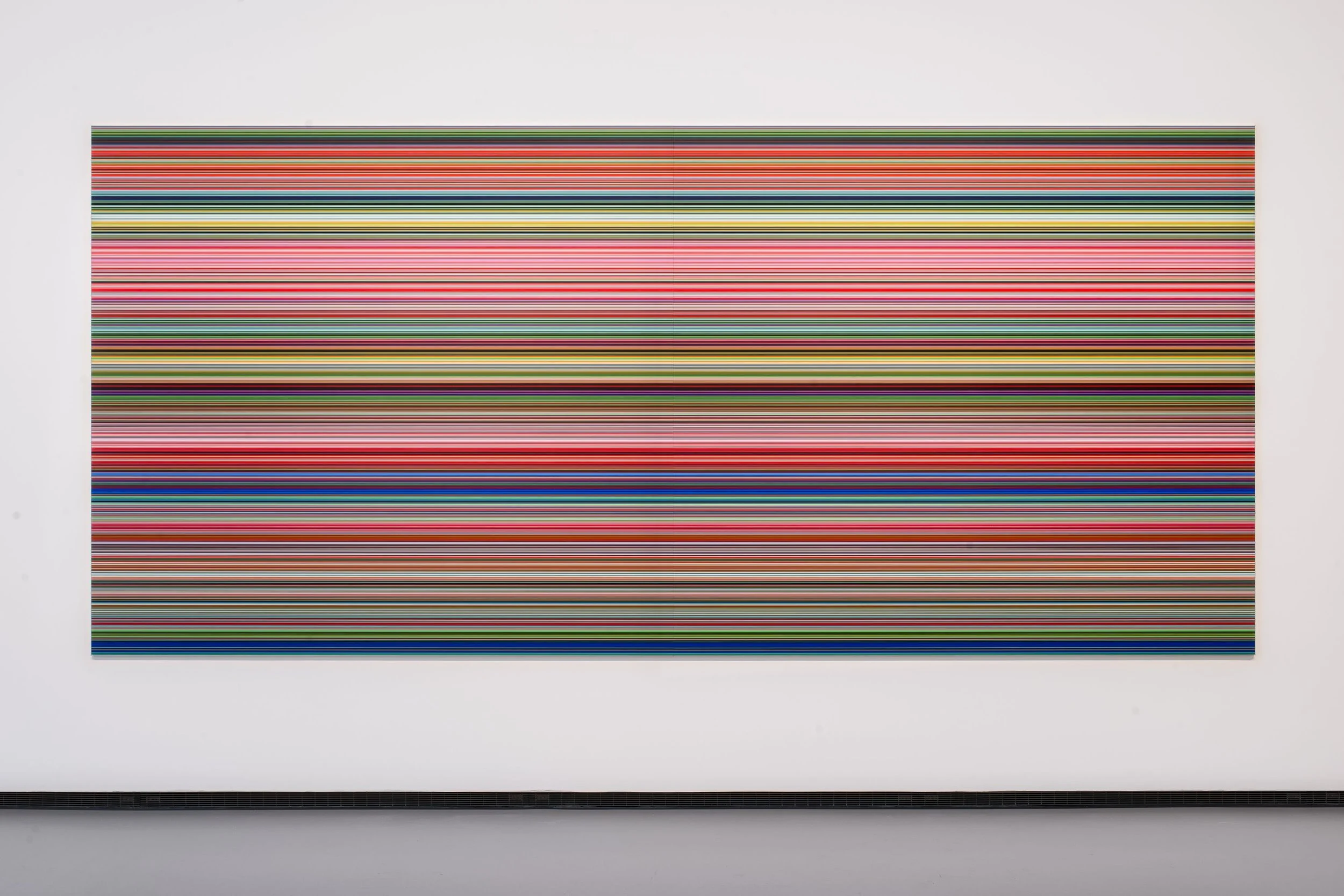
Gerhard Richter | Strip Series | 2011
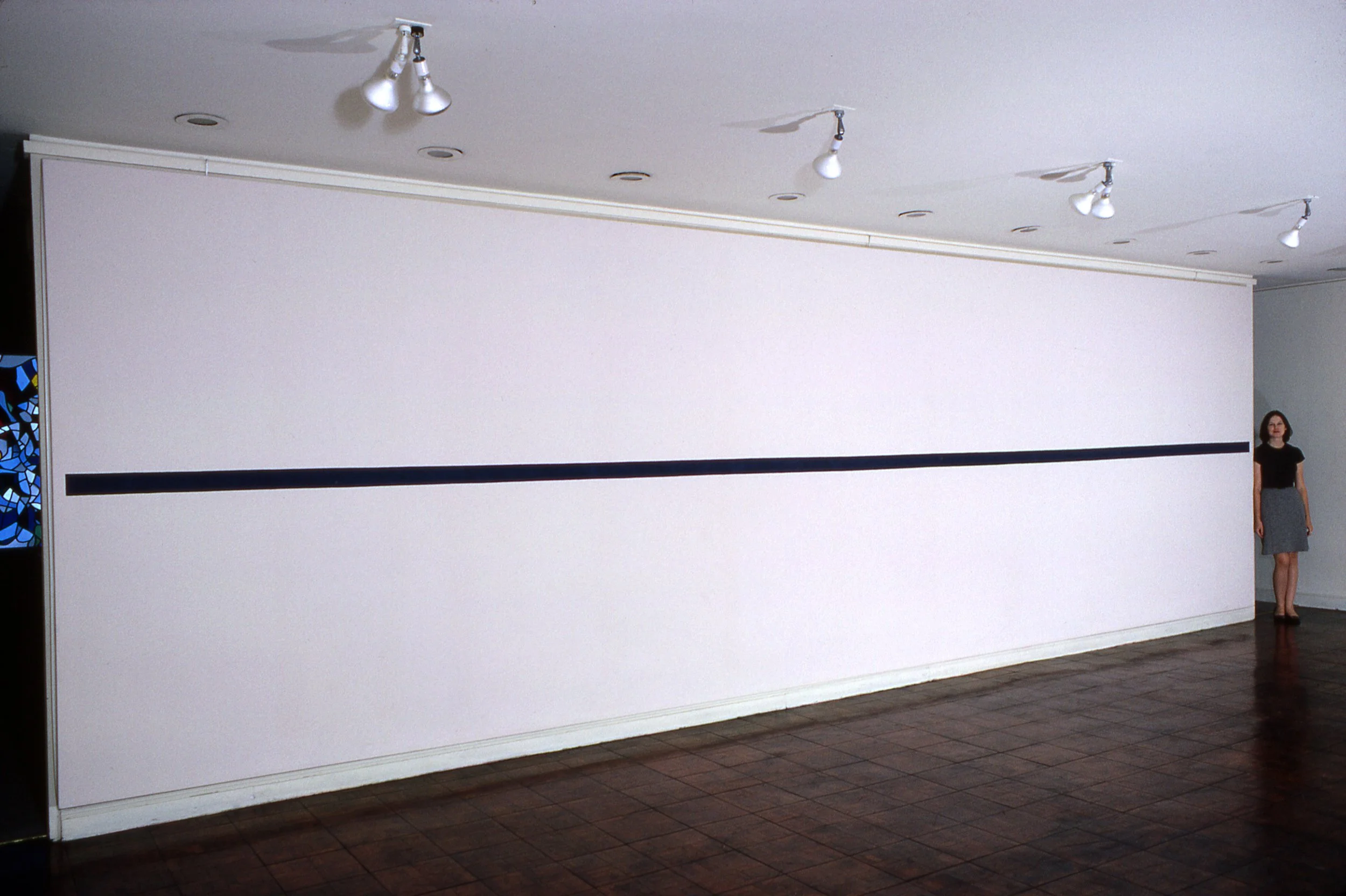
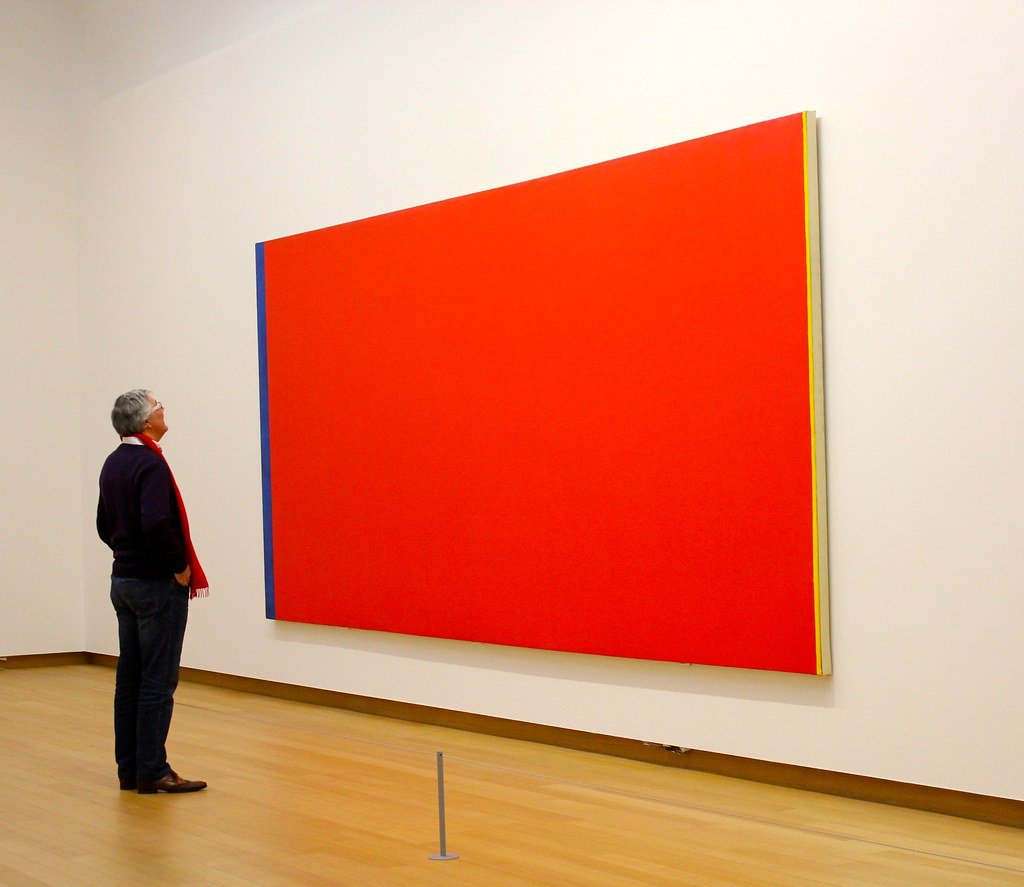
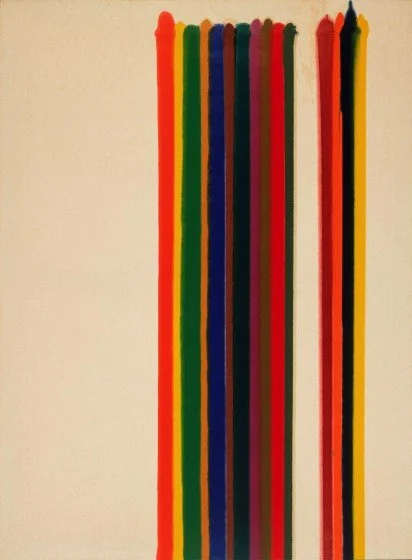
That's what separates them from every other stripe in this series. Newman's zips are placements. Martin's lines are acts of attention. Riley's stripes are built by eye and hand to vibrate on the retina. Noland's bands are about color soaking into raw canvas. Richter's stripes aren't built at all, they're extracted. The English title is exact: not Stripes, but Strips. To strip something is to take it away, reduce it, expose it. These are paintings stripped of painting.
And they're still beautiful, that's the uncomfortable part. At scale they flicker and vibrate almost like Riley's work, but by the opposite route: hers is constructed toward instability, his arrives at it by feeding a painting into a system. Somewhere behind every band is still that 1990 canvas, dragged and layered by hand. The body hasn't disappeared. It's been translated into a code so total it no longer reads as a body at all.
That's very Richter: he doesn't trust images, but can't leave them alone. He doesn't trust painting, but keeps going back to whatever's left of it once it's been put under enough pressure.
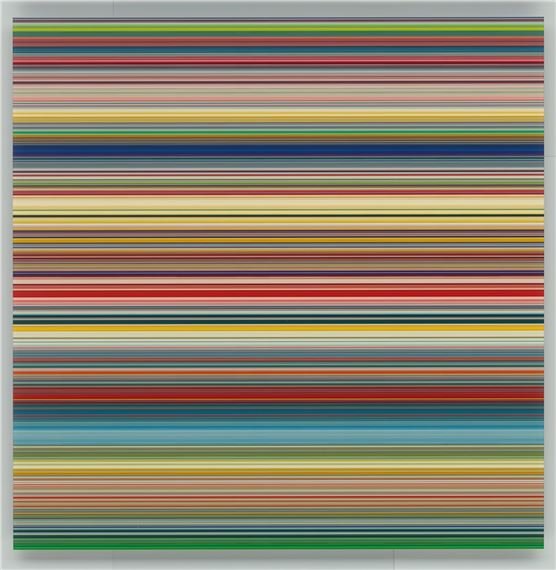
Gerhard Richter | STRIP (2025) | MutualArt
I think of the guards checking ears against passport photos, of shops with almost nothing on the shelves. Richter's Strip works have nothing to do with that day, directly. But they come from an artist who spent his early life inside a system that examined and distrusted appearances, and in the Strips, even painting doesn't get to remain itself. It's split, mirrored, reduced, sealed behind glass.
What comes out the other side is gorgeous. It just doesn't smell like paint.
YOU MAY ALSO LIKE: