MORRIS LOUIS: COLOR, GRAVITY, AND THE RADICAL STRIPE PAINTING
Morris Louis
Some artists use stripes as a way to measure space. Some use them as rhythm, structure, pattern, discipline, refusal, or optical vibration. With Morris Louis, the stripe begins somewhere else. It begins with liquid paint, raw canvas, gravity, and a room too small for the scale of what he wanted to make.
Louis is usually placed within the Washington Color School, along with Kenneth Noland and Gene Davis. That phrase makes it sound as if a movement gathered itself deliberately in Washington, D.C., as if the city had called these painters into being. But part of what interests me is how accidental it seems. Gene Davis was born there and had been a journalist before he became a painter. Kenneth Noland came to Washington after Black Mountain and Paris, and began teaching there. Louis moved first to Silver Spring, then to Washington, because of marriage and circumstance. In 1952, he and his wife, Marcella, bought a house on Legation Street, where he converted the dining room into his studio.
It was a small room, twelve feet two inches by fourteen feet, the opposite of the heroic New York loft. From that room came some of the largest and most open paintings of the period.

Morris Louis, Gamma
Washington was not New York. It did not have the same pressure, glamour, or density of ambition. But it had the Phillips Collection. It had the Washington Workshop Center for the Arts. It had Jacob Kainen, Leon and Ida Berkowitz, and a small community of artists who were looking hard at modern painting from a slight distance. That distance may have mattered. The artists in Washington were close enough to New York to know what was happening, but far enough away to make their own experiments without being swallowed by the scene.
Louis met Noland at the Washington Workshop Center, where both were teaching. Noland became his closest artist friend at that moment. They shared an interest in Pollock, in what painting could become after Abstract Expressionism, and in the possibility of color that was no longer bound to drawing in the traditional sense.
Then came the famous visit.
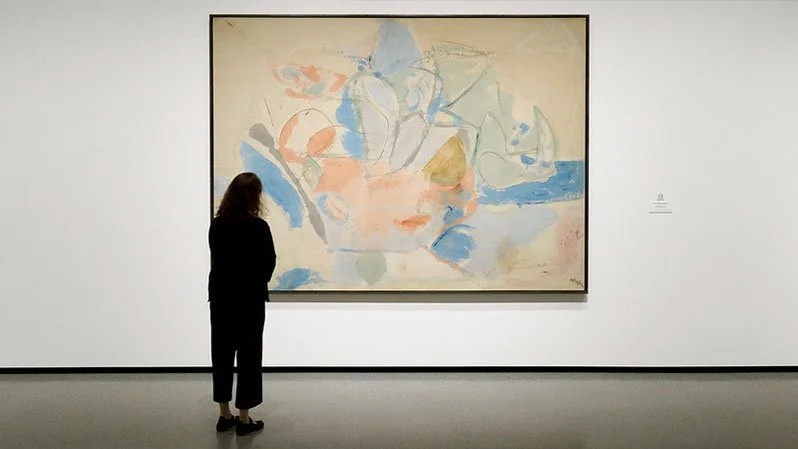
On the weekend of April 3–5, 1953, Noland brought Louis to New York. During that weekend, Noland introduced him to Clement Greenberg. They looked at galleries. They saw paintings by Franz Kline and Jackson Pollock. On Saturday evening, Louis and Noland went with Greenberg, Charles Egan, Kline, Margaret Marshall, and Leon and Ida Berkowitz to Helen Frankenthaler’s studio. There they saw Mountains and Sea, painted only six months earlier.
That painting has become one of those origin stories art history likes to fix in place. But origin stories are useful when they remain alive. Frankenthaler had poured thinned paint into raw canvas. She had found a way to take something from Pollock without imitating Pollock’s hand. The paint was not sitting on top of the canvas as an applied layer. It was entering the fabric. Stain replaced stroke. Color and support became inseparable.
Helen Frankenthaler, Mountains and Sea
Louis was later quoted as saying that Frankenthaler’s art was “a bridge between Pollock and what was possible.” The sentence has followed Frankenthaler, Louis, and Noland through art history because it names the hinge. Pollock had opened painting by putting the canvas on the floor and letting gesture, movement, and chance enter the work. Frankenthaler changed the temperature of that discovery. In Mountains and Sea, the surface did not record a muscular attack. It held color as if the canvas itself had become sensitized.
Louis understood the implications immediately.
After that visit, he and Noland returned to Washington and began experimenting with staining and pouring. From that shared beginning, their work diverged. Noland moved toward circles, chevrons, and later stripes, where color, interval, proportion, and edge became the central problems. Louis kept pursuing the behavior of poured paint itself. His mature work moves through the Veils, the Unfurleds, and finally the Stripe paintings of 1961–62.
The Veils are made of descending washes of color, layered and transparent, like color passing through color. The Unfurleds open the canvas from the sides, with streams of paint entering from the edges and leaving a great untouched field in the center. Then, near the end of his life, Louis arrived at the Stripes.
Morris Louis
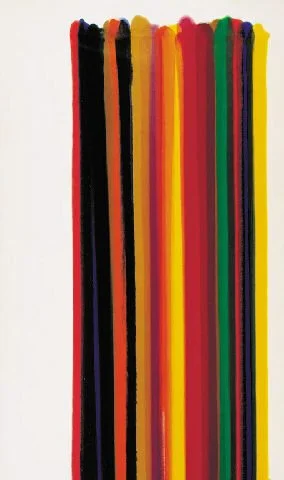
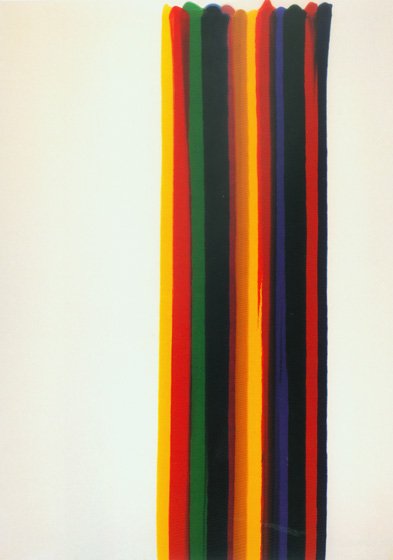
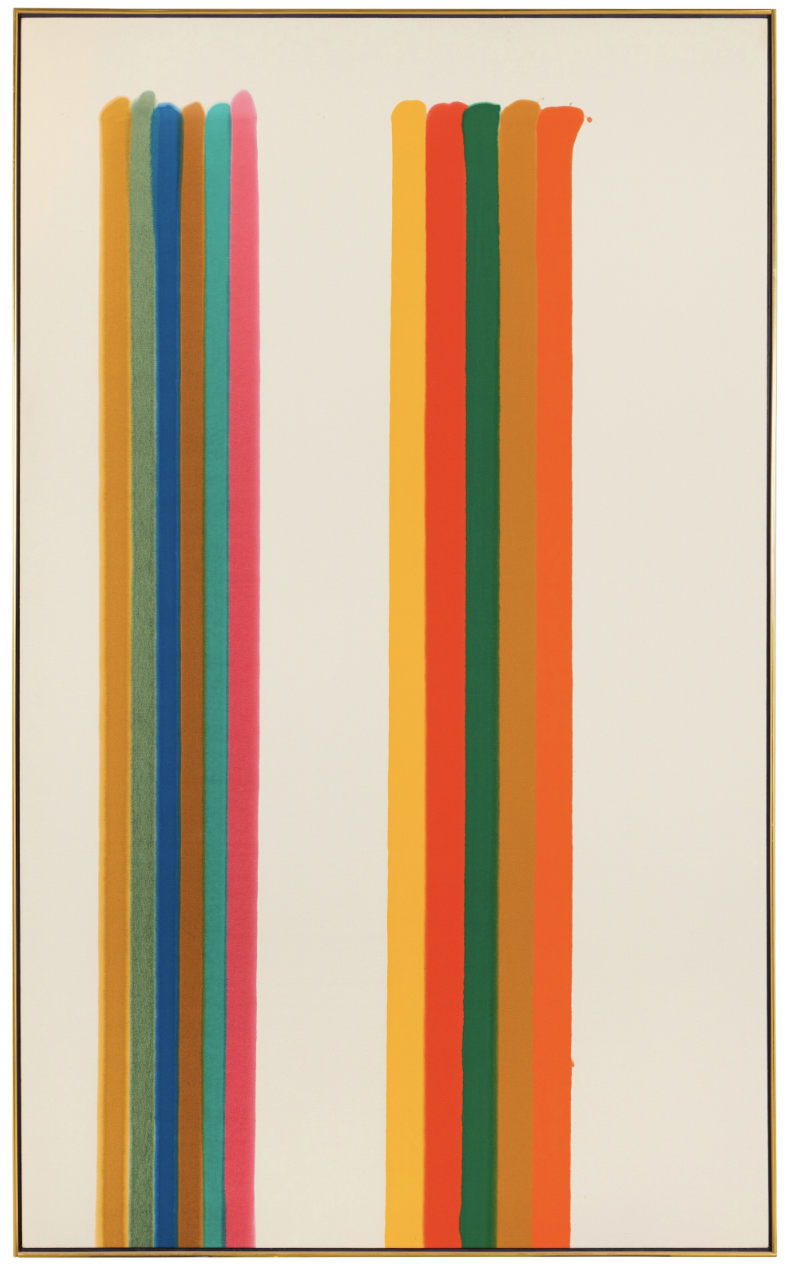
The Stripes look simple from a distance: vertical bands of color set against raw canvas. But the simplicity is deceptive. These paintings are not striped in the way a canvas might be striped with a brush, a ruler, or tape. They are poured. Louis used Magna, an acrylic resin paint made by Leonard Bocour, thinned with turpentine. The paint soaked into unprimed cotton duck. It did not sit on top of the canvas; it became part of it.
By this point, Louis had developed extraordinary control over an unstable process. He could pour a band of color over a long distance and maintain its intensity. He could keep adjacent colors close without letting them collapse into each other. He could let certain edges bleed or overlap, and in other places bring them into clean abutment. In the later Stripe paintings, the bands are not only records of flow. They are decisions about where flow will stop.
This is what makes them different from so many other stripe paintings. A stripe by Barnett Newman can be a division, a declaration, a vertical presence. A stripe by Gene Davis can be rhythm, tempo, beat. A stripe by Noland can be an interval and color pressure. In Louis, a stripe is paint under conditions. It is what liquid color does when the artist has arranged the canvas, the viscosity, the angle, the absorbency, and the timing so precisely that gravity seems to draw.
The word “draw” matters here. There is no brush mark in the usual sense. But there is still drawing. Louis shifted the angle of the canvas, the tautness of the fabric, and the viscosity of the paint. He worked on unstretched canvas attached to a working support. Some of the largest works could not be seen whole in the studio. He often evaluated the paintings only when they were stretched and prepared for exhibition.
Morris Louis, Polaris
That fact changes how I think about them. We tend to imagine the artist standing back, looking, adjusting, commanding the whole field. Louis often could not do that. The room was too small. The canvas was too large. He had to trust a procedure, and then later confront the result. His paintings were not improvised in the casual sense. They were exacting. But the exactness depended on not seeing everything at once.
Critics loved the way this work seemed to answer the problems of modernist painting. Greenberg and Michael Fried saw in Louis a way forward after Abstract Expressionism: a painting that held onto scale, color, and ambition while removing the loaded brushstroke, the theatrical gesture, the heavy hand. The poured stain joined color to the flatness of the canvas. The painting no longer had to pretend to open into another world. It could remain a surface and still feel immense.
That interpretation is important. It shaped how Louis was seen. It also makes sense. The paintings do test flatness, color, edge, interval, and the relation between mark and support.
But when I look at the Stripes, I keep coming back to the physical facts. A small room. Raw canvas. Paint thinned to the point where it could travel. A painter working largely alone, secretive about his process, almost never explaining himself. The work feels less like a theory of flatness than an encounter with material under pressure.
Louis was unusually closed-mouthed about intention. Diane Upright describes him as a loner who rarely discussed his art, not even with his wife. That reticence feels central to the paintings. He did not leave behind the kind of statements that allow us to say, cleanly, “This is what he meant.” We have the paintings. We have the studio facts. We have the testimony of others. We have the materials.
Leonard Bocour, who made Magna, later recalled seeing Louis’s Stripe paintings in 1961 and being astonished by the evenness and saturation of the bands, an effect Bocour himself could not duplicate when testing the paint. When he asked Louis how he had achieved it, Louis reportedly replied, “You got something to say, you say it.”
It is not an artist’s statement, exactly. But it has the density of one. Louis answered a technical question as if technique and meaning could not be separated. The effect was not a trick. It was the thought of the painting arriving through the behavior of the paint.
I first became interested in Magna because Louis used it. That was exactly why I wanted to try it. I wanted to know what kind of paint could make those paintings possible. That story belongs somewhere else, perhaps in one of these “Watching Paint Dry” posts, because Magna is its own subject: Bocour, acrylic resin, turpentine, saturation, luminosity, fumes, and the physical cost of working with a material that seemed to offer freedom and danger at the same time.
Louis was diagnosed with lung cancer in 1962 and died that September, at forty-nine. His illness has often been attributed to prolonged exposure to paint vapors. Knowing this changes the atmosphere around the work. It would be wrong to turn the paintings into a simple cautionary tale. But it would also be wrong to ignore the body in the room. The painter bent over the canvas. The fumes in an unventilated domestic space. The daily labor of pouring, thinning, lifting, looking, waiting.
The paintings are luminous, but they were not made out of light alone.
The Stripe paintings were Louis’s last series. They can look serene, almost inevitable, as if the colors simply arrived in order. But nothing about them was inevitable. They came out of years of looking, failure, destruction, experiment, and refinement. They came out of Pollock, Frankenthaler, Noland, Washington, Bocour’s paint, raw cotton duck, and a dining room that could barely hold the ambition of the work.
A stripe, in Louis’s hands, is not a motif laid on top of painting.
It is painting reduced to a set of conditions and pushed until those conditions begin to speak.
YOU MAY ALSO LIKE: