BLACK IS BLACK—UNTIL IT’S NOT: Malevich’s “Black Square”

Kazimir Malevich, “Black Square,” 1915, oil on linen, State Tretyakov Gallery, Moscow. The cracked surface now reveals traces of the paintings beneath it.
Years ago, I took my “steppish” daughter to the Guggenheim. I never married her father, hence the qualification, but she has been in my life since she was a child. We wandered into a side gallery that held several paintings by Kazimir Malevich. I don’t think I had taken twenty steps before she began peppering me with questions. Did Malevich know Picasso’s work? What other artists did he know about? Had he seen Duchamp? Was this before or after the Russian Revolution?
I don’t remember her exact questions anymore, only the velocity of them. What she wanted to know was not simply when Malevich made a particular painting. She wanted to know what he knew. What had he seen? What was available for him to see? What was happening around him? How much came from Europe and how much came out of Russia itself? If I could invent a child, this is the one I’d invent: relentlessly curious. So let’s see if I can answer some of her questions.
PICASSO WAS ALREADY IN MOSCOW
Malevich did not arrive at Black Square out of nowhere. Before Suprematism he moved through Realism and Impressionism, and then through increasingly fractured paintings influenced by Cubism and Italian Futurism. You can actually watch him dismantling the recognizable world. And Malevich did not have to go to Paris to encounter what was happening there. The great Russian collectors Sergei Shchukin and Ivan Morozov were bringing French modern painting to Moscow in extraordinary quantities. Shchukin opened his house to artists and students. By 1914 he owned fifty-one Picassos and had devoted an entire room to them. He also owned major works by Matisse, Cézanne, Gauguin, Monet and others. Picasso, in other words, was already in Moscow.
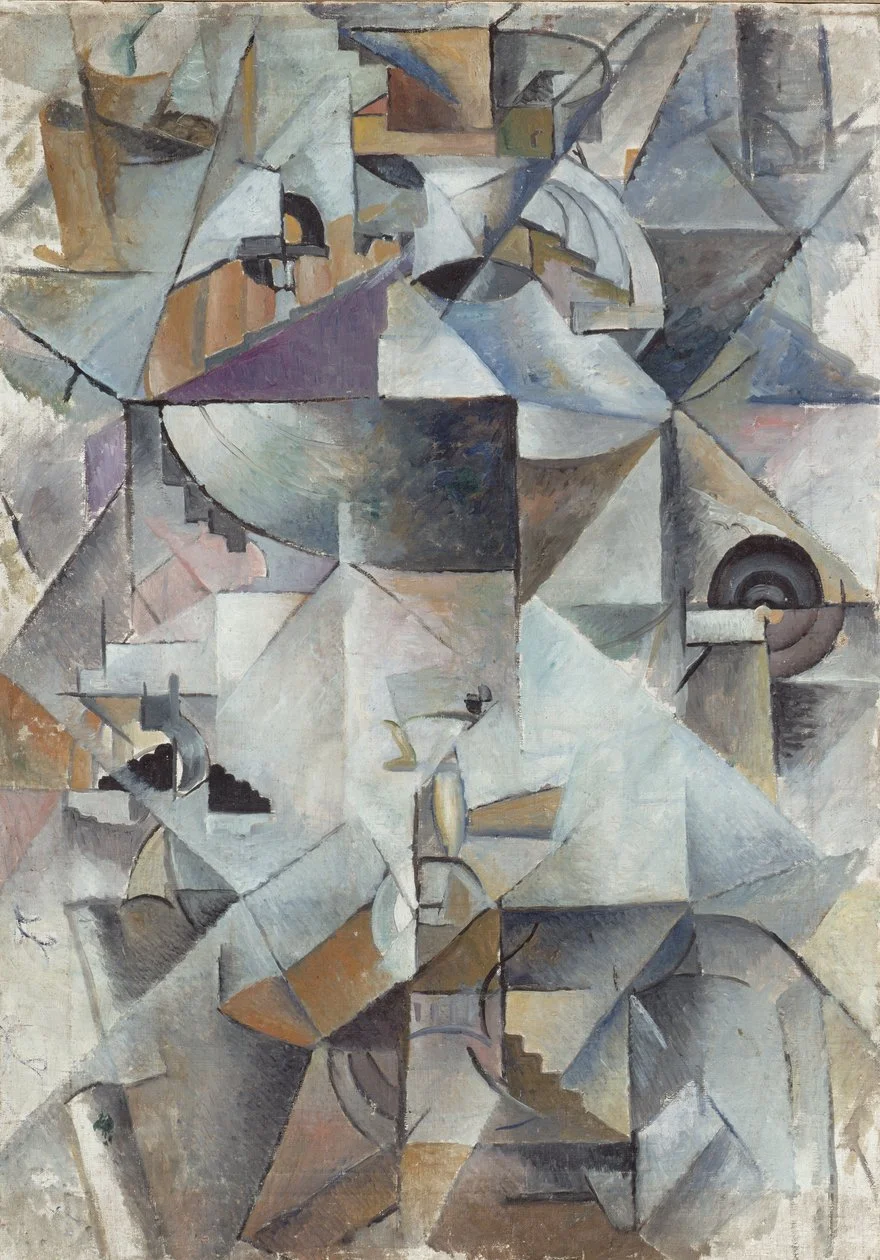
Kazimir Malevich, Samovar, 1913. The familiar object is still there, but Cubism has already begun to fracture it into planes and shifting points of view.
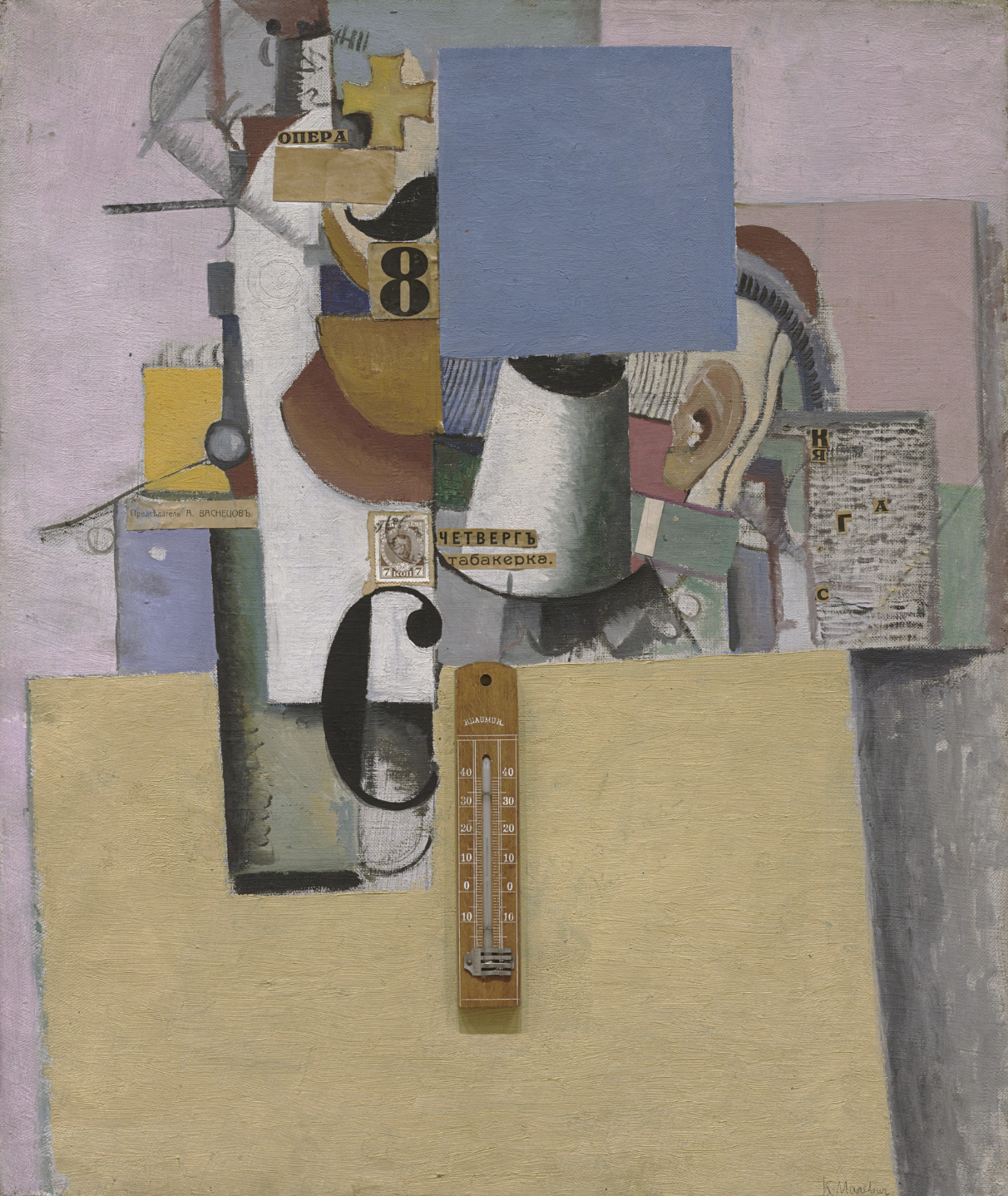
Kazimir Malevich, Reservist of the First Division, fall-winter 1914
Look at Malevich’s Samovar of 1913 or Reservist of the First Division of 1914 and the connection to Cubism is not hard to see. Things have been broken apart and reassembled. Bits of lettering and recognizable objects remain, but they no longer obey ordinary pictorial space. What interests me is how quickly Malevich kept moving. Cubism had given him a way to take the world apart. He seems to have decided that he didn’t need to put it back together. But Europe was only half the story. Malevich was also looking at Russian folk images, the inexpensive popular prints called lubki, and Russian icons. MoMA identifies all of these as important sources in his early work. That becomes important later.
DID MALEVICH KNOW DUCHAMP?
I haven’t found evidence that Malevich knew Duchamp personally, or that Duchamp was an important source for him at this point. But I find it hard not to think about the two of them together. In 1913 Duchamp had made Bicycle Wheel. In 1915, the same year Malevich exhibited Black Square, Duchamp bought a snow shovel, hung it from the ceiling, and called it In Advance of the Broken Arm. The readymade shifted an enormous amount of the work of art away from the making of the object and toward the artist’s decision about it. Malevich was doing something quite different. He was still very much a painter. But he too was beginning to make paintings in which the idea and the object could not easily be separated. A black square is, after all, not terribly difficult to paint. What mattered was the proposition behind it.
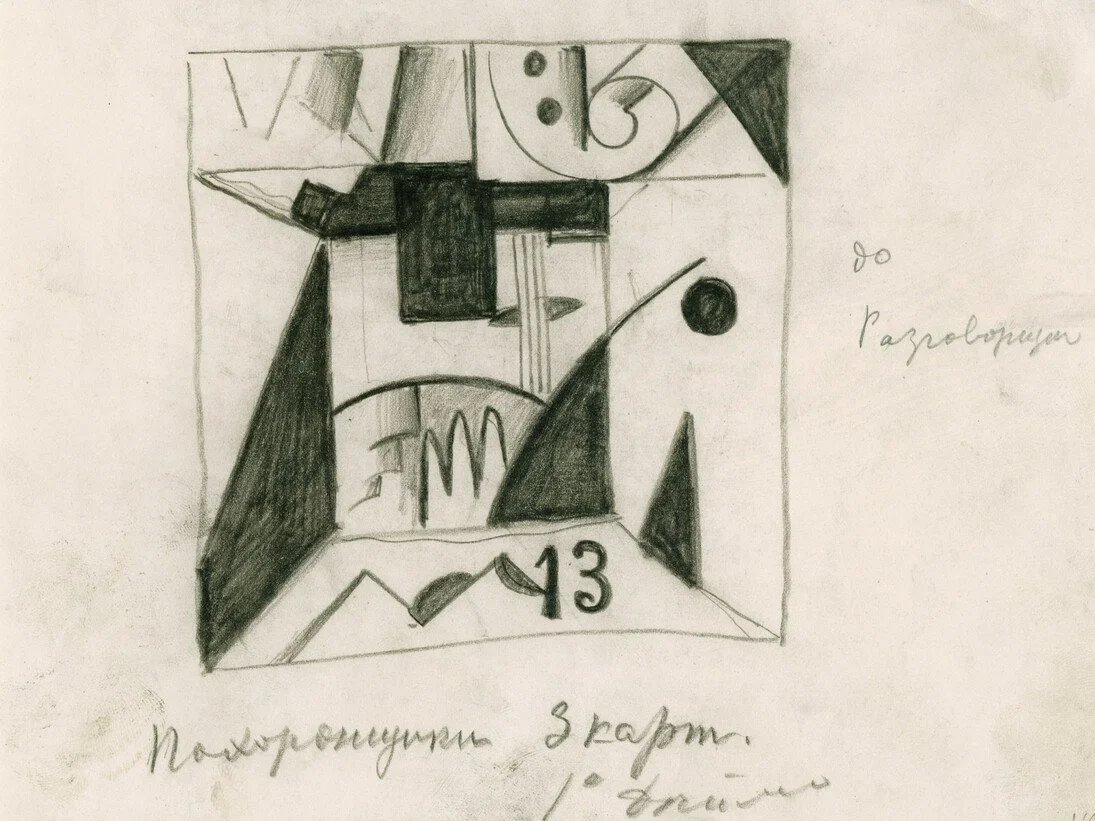
Kazimir Malevich, stage design for the Futurist opera Victory Over the Sun, 1913. The stark geometry of these sets helped lead him toward the forms of Suprematism.
SO WHERE DID THE BLACK SQUARE COME FROM?
It first appeared in 1913, when Malevich designed the sets and costumes for the Russian Futurist opera Victory Over the Sun. The production imagined humanity capturing the sun and replacing the old order with a new technological world. In Malevich’s stage design, a black square appeared on the curtain. The simplified geometry of those designs is now generally seen as one of the routes toward Suprematism. Two years later, the square became a painting. In December 1915, Malevich unveiled his new Suprematist paintings at 0.10: The Last Futurist Exhibition of Paintings in Petrograd. Colored rectangles, crosses, and planes floated against white. He wanted painting freed from the obligation to depict things. He described himself as having arrived at the “zero of form.” And then he did something extraordinary with Black Square. He hung it high in the corner of the room.
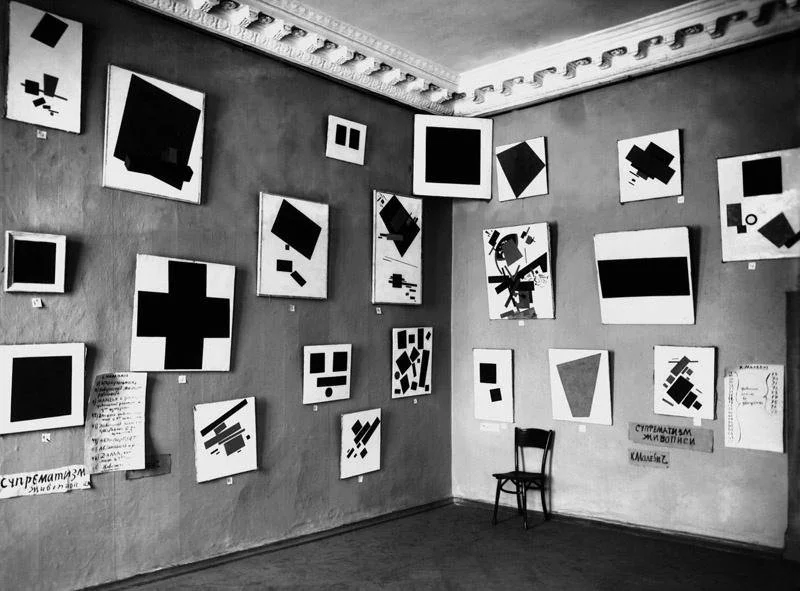
Black-and-white installation photograph of Malevich’s Suprematist paintings at the 1915 0.10 exhibition in Petrograd, with Black Square hung high in the corner of the room.
For a Russian viewer, that location would have been immediately recognizable. It was the place of honor in a traditional Russian home where the family’s religious icon might be hung. Malevich took that familiar place and put a black square in it.
I don’t think you have to decide that Black Square is therefore a religious painting. I am more interested in the fact that Malevich understood exactly what that placement would mean to the people who saw it.
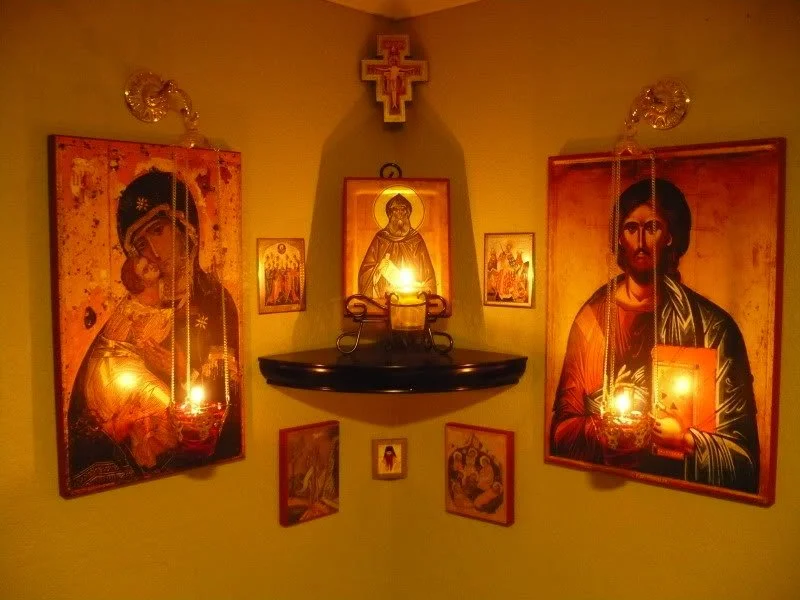
Traditional prayer corner.
He had removed the saint, the face, the story, the landscape and the gold. The place remained. This was also before the Russian Revolution, not after it. Black Square was shown in 1915; the revolutions came in 1917. Malevich later supported the Revolution and tried to bring Suprematist ideas into teaching, design and public life, but the revolution in his painting had already happened.
FOR THOSE WHO LIKE TO WATCH PAINT DRY
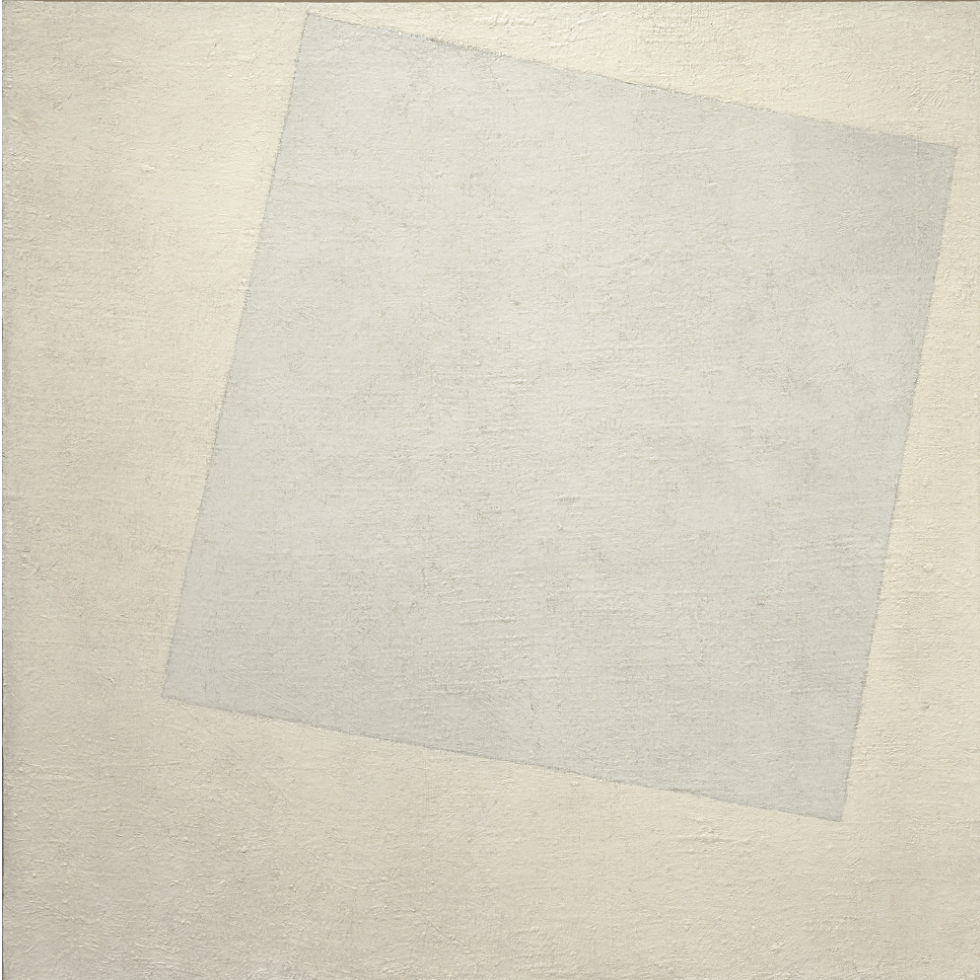
Here is where Black Square becomes much less pure. The painting we know from reproduction as an almost diagrammatic black square on white is, in person, a battered, complicated object. Its surface is heavily cracked. The square isn’t quite square. The white isn’t simply white. And underneath it are two earlier paintings. Technical examination at the Tretyakov Gallery revealed two successive compositions beneath the visible surface. Researchers also found that Malevich used two different black paint mixtures and left fingerprints in the white surrounding area. That may be my favorite fact about the painting. Malevich wanted to arrive at zero, but he got there by painting over what was already there. Through the cracks, bits of color from the buried paintings can still be seen. There is also the faint inscription discovered on the surface that Tretyakov researchers believe refers to the earlier black-monochrome joke associated with Alphonse Allais, whom I wrote about in the previous post. The reading of that inscription and its authorship have been disputed, so I wouldn’t make too much of it. But the possibility is tantalizing: even the painting that has come to represent a radical beginning may have known something about the joke that preceded it. And Malevich kept going. The black square was followed by circles, crosses, rectangles and colored planes, and eventually by White on White, where even the contrast between figure and ground has almost disappeared. The square did not end painting for him. It gave him somewhere else to go.
There is one more Malevich connection for me. David Diao was my teacher in 1973 when I was in the Whitney Museum Independent Study Program, the summer Robert Smithson died.
Years later, Diao found himself looking at that same photograph of Malevich’s 1915 exhibition. He had stopped painting for several years. When he returned to it in 1984, he was thinking about the arguments then going on around appropriation, originality and the use of existing images. He went back to the famous photograph of 0.10, an image he described as so ubiquitous in books on abstract art that it had almost become invisible.
In Glissement (1984), Diao took the twenty-one Malevich paintings visible in the photograph and released them from the photographed walls. Their shapes slide across and through one another on his canvas. He went on to use that photograph repeatedly, flipping it, doubling it and reorganizing it.
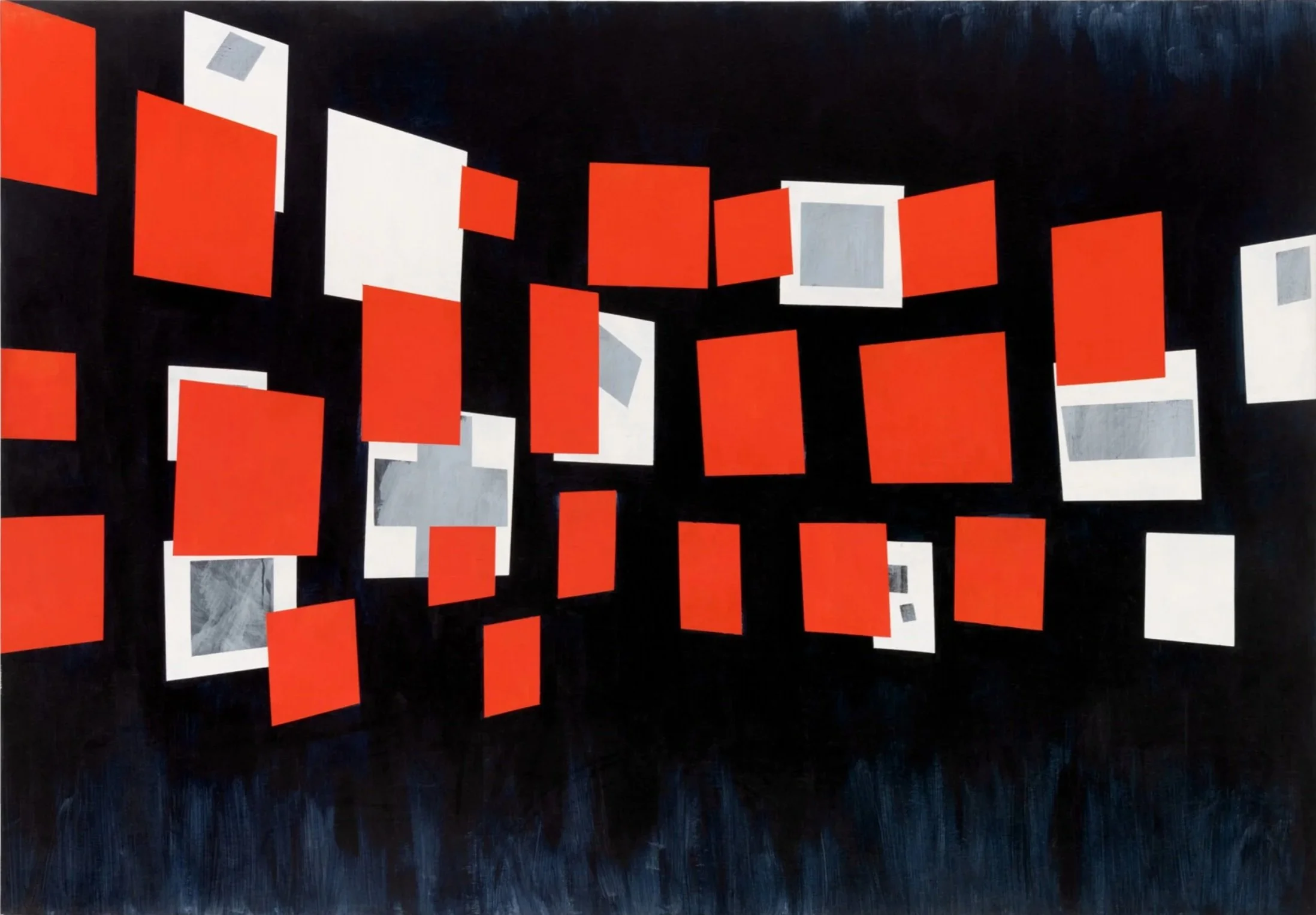
David Diao, Glissement, 1984, Acrylic on canvas, 70 x 100 1/4 inches (178 x 255 cm)
I didn’t know any of that when I was standing in the Guggenheim answering my steppish-daughter’s questions. She wanted to know what Malevich had looked at before he made Black Square. Diao, decades later, was looking at how the rest of us had learned to look at Malevich.
MY FAVORITE REFERENCES
The Guggenheim’s material on Malevich is particularly useful because you can follow the paintings as he moves from Cubism and Futurism into Suprematism. Kazimir Malevich: Suprematism at the Guggenheim
For the wonderful story of how fifty-one Picassos ended up in one Moscow house before the First World War, the Metropolitan Museum’s account of Sergei Shchukin is worth reading. The Met on Sergei Shchukin
If watching paint dry hasn’t frozen your brain, the technical research on Black Square is fascinating. The Art Newspaper’s account of the Tretyakov investigation is a good place to begin. The Art Newspaper on what lies beneath Black Square
And for Diao, I would go directly to his own conversation with Matthew Deleget in BOMB. He explains why the 0.10 photograph became so important to him and what happened when he began using it. David Diao in BOMB. There are also many books on Diao.