AGNES MARTIN: PAYING ATTENTION
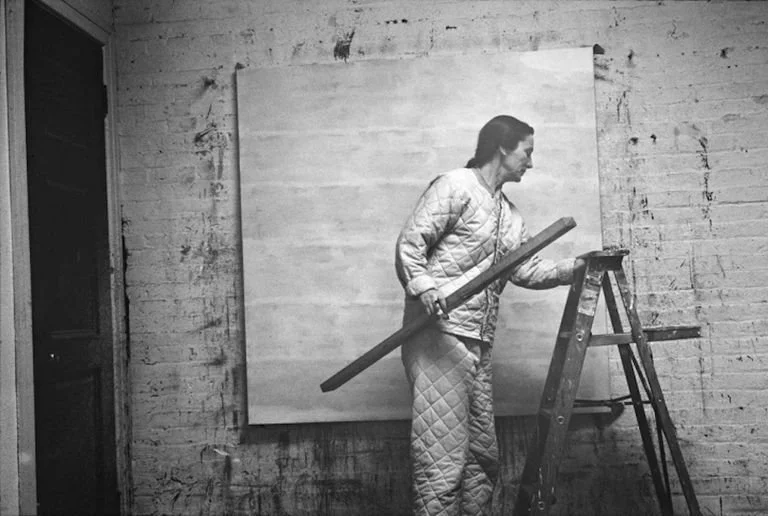
Agnes Martin with level and ladder
A million years ago, when I was in the Whitney Museum Independent Study Program, the program left New York City for what I believe was the only time and spent the summer in New Mexico. David Diao, Ron Clark, and a few others visited Agnes Martin.
What they may have thought would be a studio visit became something else.
Instead of taking them into the studio and showing them paintings, Martin took them on a long hike on a very hot day to see a remote tree she insisted they had to see.
I have thought about that story for years.
It was not, or not only, eccentricity. It was an exercise in attention. Before talking about paintings, she made them look. Not at a painting. Not at a work of art. Not at something framed, signed, and understood to be important. A tree. Far away. Reached slowly. Under a hot New Mexico sun. By the time they got there, the tree could not have been just a tree. It had become the thing they had walked toward. The thing she had asked them to notice.
That seems to me the right way to enter Agnes Martin’s work.
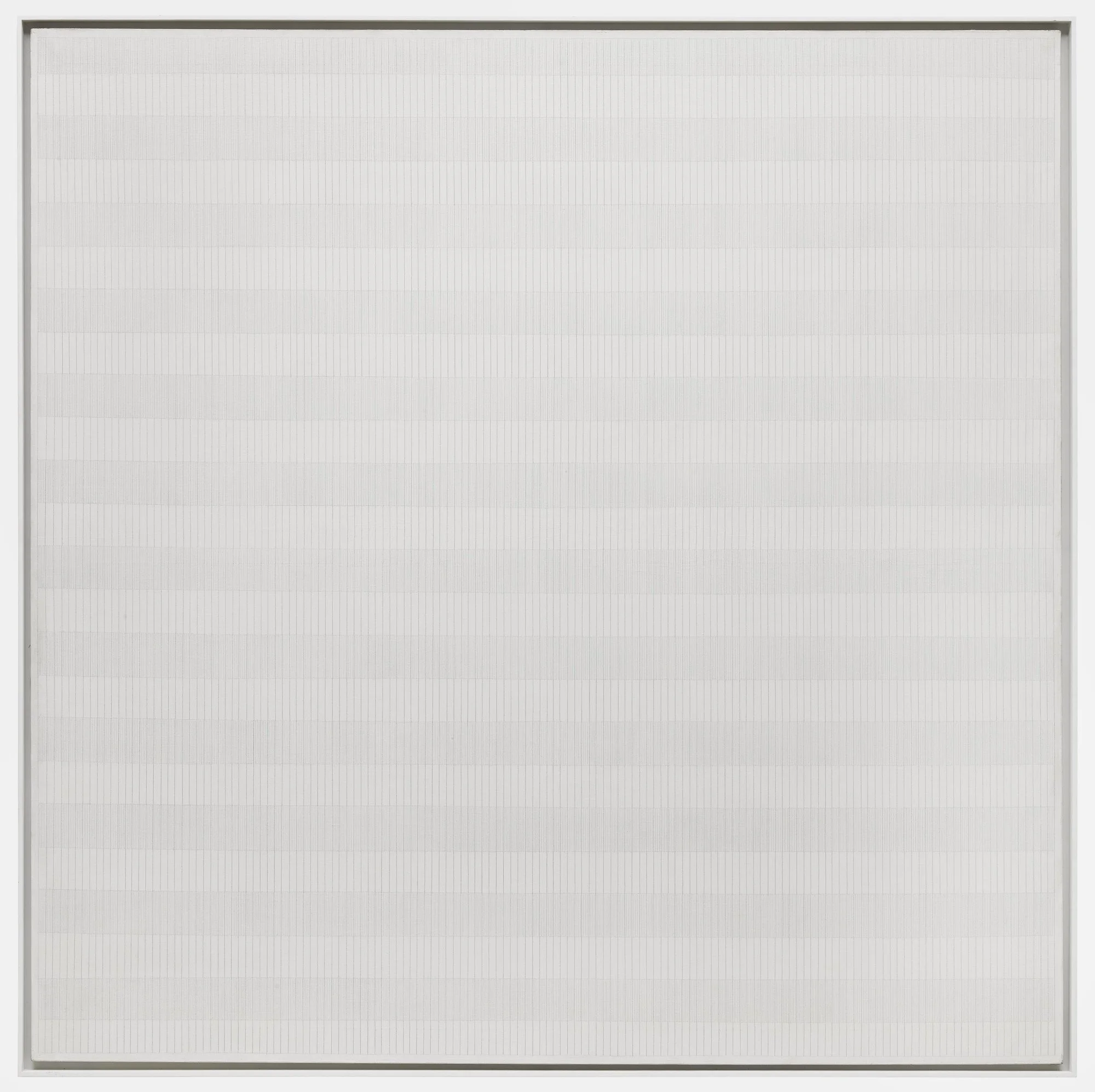
Agnes Martin, The Tree, 1964
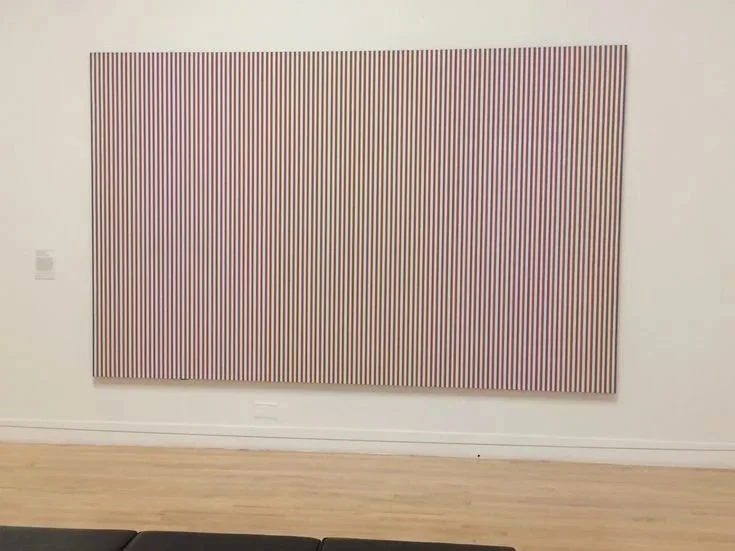
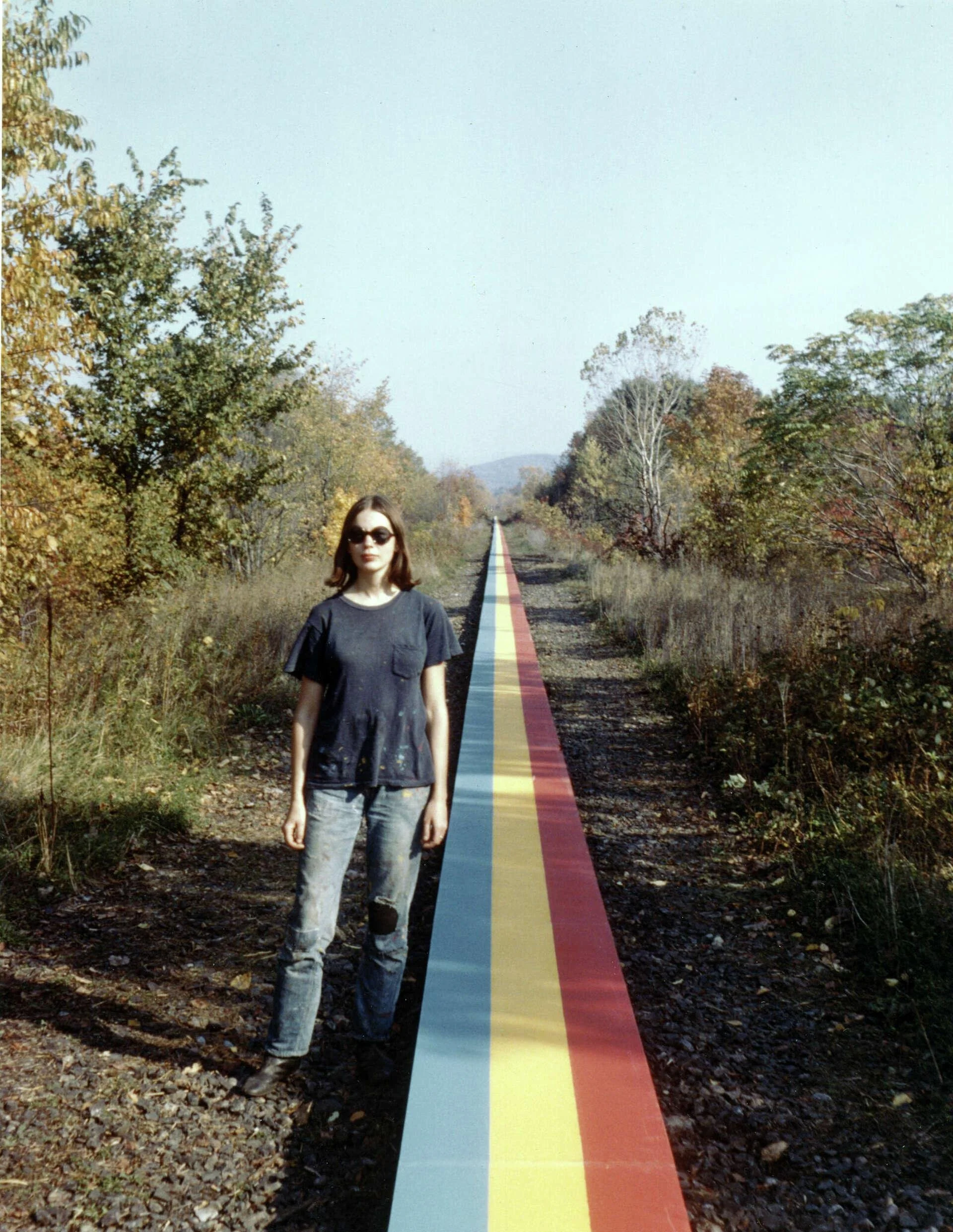
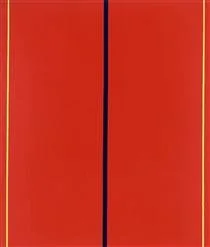
Martin’s lines are quiet. They do not split the canvas open, as Barnett Newman’s zips do. They do not vibrate or flicker like Bridget Riley’s optical bands. They do not behave like architectural stripes, decorative stripes, or stripes used to signal speed, energy, or force. They ask for a different kind of looking. They withhold just enough to make the eye work.
Agnes Martin is usually discussed in relation to the grid, and of course, that is right. The grid is central to her work. But grids are made of lines, and lines make intervals. Repeated closely enough, they become stripes, bars, bands, fields. The question is not whether Martin used stripes. The question is what kind of stripe this is.
In Martin, the stripe is not a declaration. It is not a graphic device. It is not there to organize a composition in the ordinary sense. It is a measure of attention.
It is easy to mistake this quiet for emptiness. From a distance, many of the paintings appear almost bare. Pale fields. Thin pencil lines. Subtle washes of color. Horizontal bands so quiet they seem to hover rather than sit on the surface. But the longer one looks, the less empty they become. The surface begins to register. The line is not mechanical. The pressure changes. The pencil meets the weave of the canvas. A hand has passed across it. A person has made this nearly impersonal thing.
Martin has often been grouped with Minimalism, but she did not think of herself that way. The connection makes sense formally: the reduced means, the repetition, the grid, the refusal of traditional composition. But her allegiance was not to cool objecthood or industrial facture. She felt closer to Abstract Expressionism.
This is the counterintuitive part.
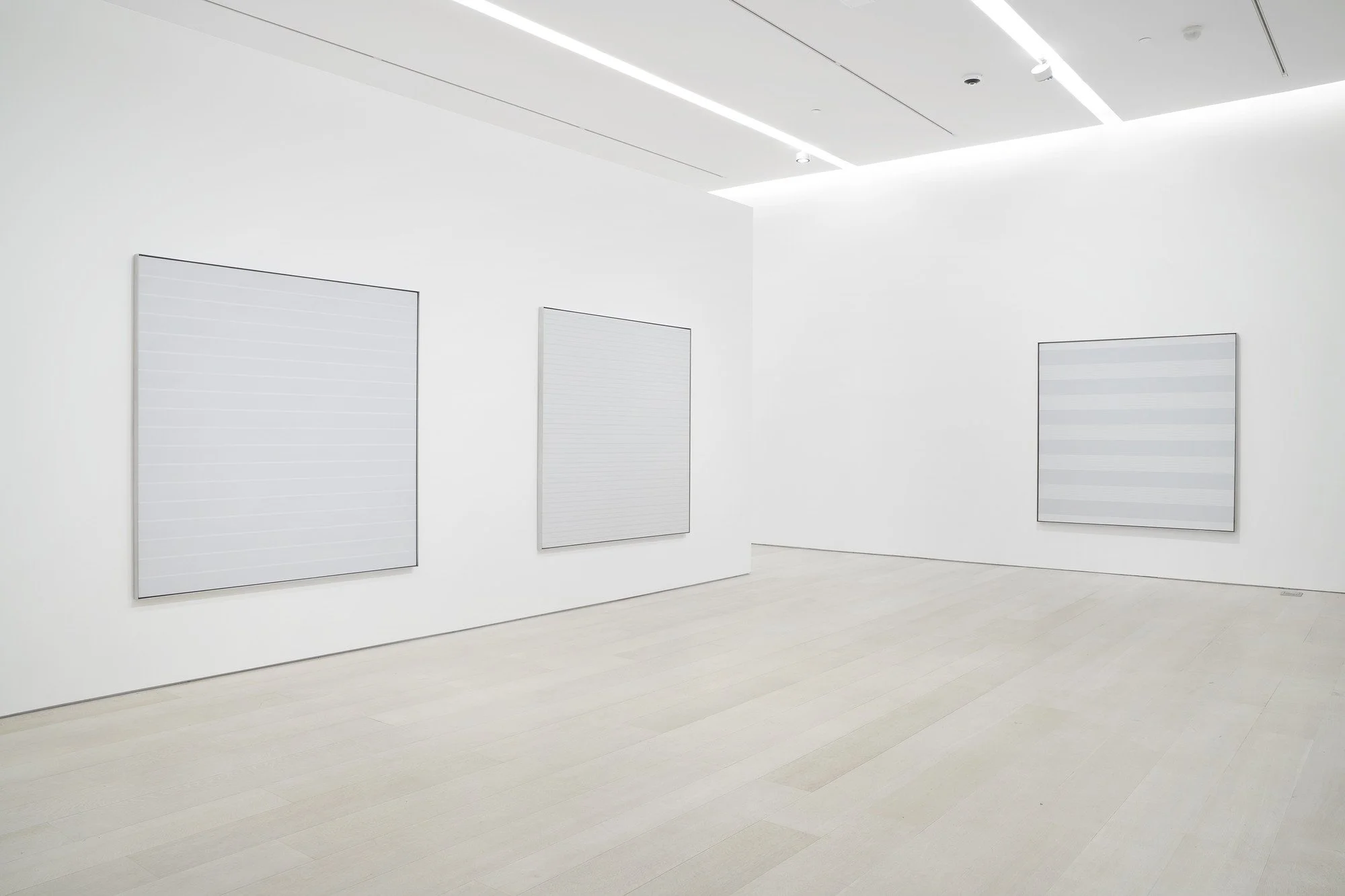
Agnes Martin exhibition at Pace Gallery
There is no visible drama in the work. No sweeping gesture. No theatrical encounter between painter and canvas. No evidence of struggle in the old heroic sense. But the emotional ambition is there. She wanted to make paintings that carried feeling without performance. If Abstract Expressionism often located feeling in the gesture, Martin located it in restraint. She removed the dramatic evidence and asked what feeling could survive without display.
That is one of the reasons her practice is so interesting.
The paintings did not emerge from a vague spiritual atmosphere. They came out of a disciplined way of preparing the mind, and then an equally disciplined way of preparing the painting.
Martin read the Tao Te Ching and was deeply interested in Taoism, Zen Buddhism, and Christianity, but I would not call her simply a Zen painter. That makes her smaller than she was. She was a painter who turned attention into a practice. The spiritual ideas mattered because they gave her a way to think about emptiness, receptivity, humility, and non-forcing. But she was not making illustrations of belief. She was trying to clear away the noise that interferes with perception.
She spoke of needing a quiet and empty mind before inspiration could come. This was not sentiment. It was work.
There is something severe in that.
To clear the mind is not to become vague. It is to remove the unnecessary. To stop imposing. To stop rushing toward interpretation. To wait long enough for something to appear that has not been forced into being.
Then, once the image appeared, Martin did not simply let it float into paint. She calculated it.
This is the part I love.
The paintings may seem ethereal, but their making was practical, measured, physical. She often worked out the structure in advance on paper, calculating each band, bar, or line before moving to the canvas. The image came first as an interior fact, but then the arithmetic followed. The intervals. The divisions. The scale. The surface.
For many years, she worked on large square canvases, often six feet by six feet. The size is important. It gives the grid room to become a field rather than a pattern. A small grid can become decorative. A six-foot grid meets the body. It is large enough to stand before, but not so large that it overwhelms you theatrically. It does not engulf you the way some Abstract Expressionist paintings do. It holds you at a distance where your own attention becomes part of the experience.
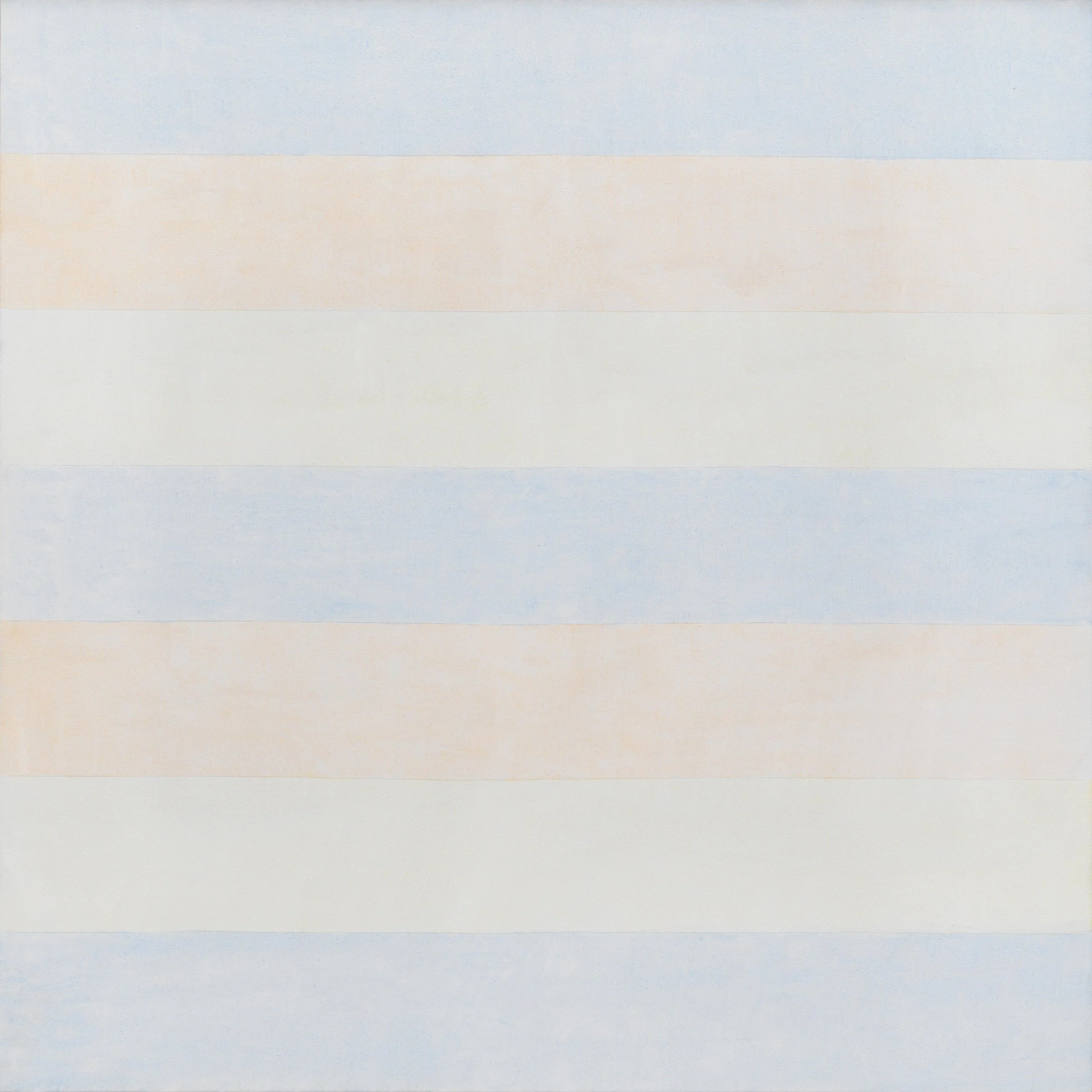
Agnes Martin, Untitled #5, 1998
The square also mattered to her. She once said that her formats were square, but the grids were never absolutely square. They were made of rectangles, slightly off the square. Covering the square with rectangles, she said, lightened the weight of the square and destroyed its power. That is a remarkable thing to say. The grid was not simply placed inside the square. It changed the authority of the square. It weakened its dominance. It made the surface breathe.
The making of the paintings followed from that discipline.
She prepared the canvas with pale paint, using oil in earlier works and later primarily acrylic. She used acrylic gesso, thin washes, graphite pencil. She drew lines with the help of straightedges, a short T-square, string, and sometimes tape. But the tools did not make the paintings mechanical. They made the structure possible. The hand still had to move across the surface. The pencil still had to travel over the tooth of the canvas. When she lifted the pencil to move the T-square, tiny breaks and imperfections entered the line.
That is where the painting lives.
Not in perfection, but in the distance between perfection and the hand.
The lines were not made in one grand gesture. They were not calligraphic acts, where one stroke either succeeded or failed. They were measured, marked, interrupted, continued. The risk was not in the drama of a single movement. The risk was in whether all those small acts of control could disappear into a surface with no false emphasis.
The paint itself was equally restrained. In some works, an opaque white acrylic gesso remained partly visible beneath the color, giving the surface a spareness and luminosity that would have been lost if the paint were thicker. Thin acrylic washes allowed light to move through the surface rather than simply bounce off it. The color could stray slightly beyond the pencil lines or stop just short of the canvas edge, which made the bands seem to float against the white ground.
That floating is not an effect added afterward. It is built into the making.
White ground. Thin paint. Graphite line. The tooth of the canvas. The small irregularities of the hand. The light in the room. The eye trying to hold all of it at once.
Martin was ruthless about failure. If a painting introduced the wrong kind of incident, she did not save it as evidence of process. She cut it with a mat knife. A pool of color, a blot, a drip, a place where the brushstroke became discontinuous, could make the painting too aggressive. It gave the eye somewhere to land too heavily. It became a focus.
This clarifies what attention meant in her work. It was not simply patience or quietness. It was a refusal of false emphasis. The painting had to remain open across the whole surface. Nothing could become the important part. The grid, the bands, the pale washes, the wavering graphite line, the white gesso beneath the color, all had to hold together without collapsing into composition.
A failed Agnes Martin painting was not necessarily failed because it was careless. It may have failed because something in it became too insistent.
This is very different from a manufactured stripe. It is also different from a stripe used as a dramatic gesture. Newman’s zip has the force of an event. Riley’s stripe activates the eye, setting off vibration, afterimage, instability. Martin’s stripe slows everything down. It is a stripe as interval, as breath, as restraint. It does not push forward. It asks you to stay.
And staying is not passive.
To look at an Agnes Martin painting is to become aware of how impatient the eye can be. At first, there may seem to be too little happening. The painting does not reward a quick glance. Nothing in it hurries toward you. But if one remains with it, the surface opens in significant ways. The bands become slightly different from one another. The grid softens. The color is not one color. The line is not one line. What seemed almost blank becomes specific.
Her paintings ask for sustained attention.
They are not empty. They are not cold. They are not diagrams. They are paintings made through waiting, measuring, drawing, repeating, correcting, accepting. The surface is quiet because the noise has been removed. But the quiet is active. It has been made, line by line.
Almost nothing has to happen.
And then, if you stay with it long enough, almost nothing becomes something.
FROM THE LIBRARY: AGNES MARTIN: Her Life and Art
“Over the course of a career that spanned fifty years, Agnes Martin’s austere, serene work anticipated and helped to define Minimalism, even as she battled psychological crises and carved out a solitary existence in the American Southwest. Martin identified with the Abstract Expressionists but her commitment to linear geometry caused her to be associated in turn with Minimalist, feminist, and even outsider artists. She moved through some of the liveliest art communities of her time while maintaining a legendary reserve. “I paint with my back to the world,” she says both at the beginning and at the conclusion of a documentary filmed when she was in her late eighties. When she died at ninety-two, in Taos, New Mexico, it is said she had not read a newspaper in half a century.” Thames and Hudson Press
ON SCREEN: AGNES MARTIN With My Back to the World
A moving documentary on the internationally renowned painter, shot over a period of four years, from 1998 through 2002, Agnes Martin's ninetieth year. Interviews with Martin are inter-cut with shots at work in her studio in Taos, New Mexico, with photographs and archival footage, and with images of her work from over five decades. The film is a venue for Martin to speak about her work, her working methods, her life as an artist, and her views about the creative process. Produced & Directed by Mary Lance
YOU MAY ALSO LIKE: