

Jacobello del Fiore, Justice Enthroned between the Archangels Gabriel and Michael, 1421. Before Jacopo Bellini established himself, Jacobello was one of Venice’s leading painters and a favorite of the state.
Jacopo Bellini came home to Venice with the best reference a painter could have: his apprenticeship with Gentile da Fabriano. There was just one problem. Venice was already full of Gentile. He had painted the walls of the Great Council Hall and run a workshop in town, and for twenty years Venetian painters had been helping themselves to his gold, his brocades and his sweet-faced Madonnas. The market was saturated with Gentile-like decoration. There was no room for another imitator, even a superior one.
Venetian patrons were also loyal. If you ran a church, a confraternity or a government office, you already had a painter, and you weren’t shopping for a new one.
At the top sat Jacobello del Fiore. Before 1412 the state was paying him 100 ducats a year, the kind of steady salary most painters only dream about. In 1421 he painted Justice for one of the courts in the Doge’s Palace. She sits enthroned between two lions, with the archangels Michael and Gabriel on either side, and the whole thing is crusted with gilded relief. If you want to know what official Venice liked to look at, that’s it. Next in line was Michele Giambono, who could slip a new idea into a Gothic picture without frightening anybody.

Jacopo Bellini, Annunciation, Sant’Alessandro, Brescia. Gentile da Fabriano’s love of gold and patterned surfaces remains, but Jacopo is already working through the new Florentine problem of measurable space.
So Jacopo did what newcomers do and led with his reference. In 1430 he painted a Saint Michael for the high altar of San Michele in Padua and signed it as Gentile’s pupil. The painting is lost, but we know who set its price: three painters, and one of them was Giambono. Imagine your competitor helping decide what you get paid.
Meanwhile, in his drawing books, Jacopo was teaching himself something nobody in Venice had asked for: Florentine space. Page after page, all through the 1430s, he worked out how to send a street back to a vanishing point and make a floor look like something you could walk on. He got a lot of it wrong at first and kept at it anyway.
You can see both sides of him in the Annunciation he painted for the church of Sant’Alessandro in Brescia. The angel and the Virgin wear brocades Gentile would have been proud of, and gold stars cover the ceiling. But the floor tiles and ceiling beams pull you back into a real room. Nobody agrees on when he painted it. Colin Eisler thought around 1430. Daniel Wallace Maze points to an old account book showing that the friars picked it up in January 1444, so he puts it in late 1443, and he thinks the little scenes along the bottom were painted by the teenage Giovanni. If Maze is right, Giovanni’s career starts here.
Jacopo’s business life, meanwhile, was a mess. In September 1440 he and Giovanni dissolved their family partnership. One of the witnesses was Ercole, the adopted son of Jacobello del Fiore, who had died the year before. Eleven days later Jacopo drew up a five-year partnership with another painter, Donato Bragadin, and then the notary crossed it out. We don’t know what went wrong. We do know that at about forty, Jacopo still hadn’t found an arrangement that worked.
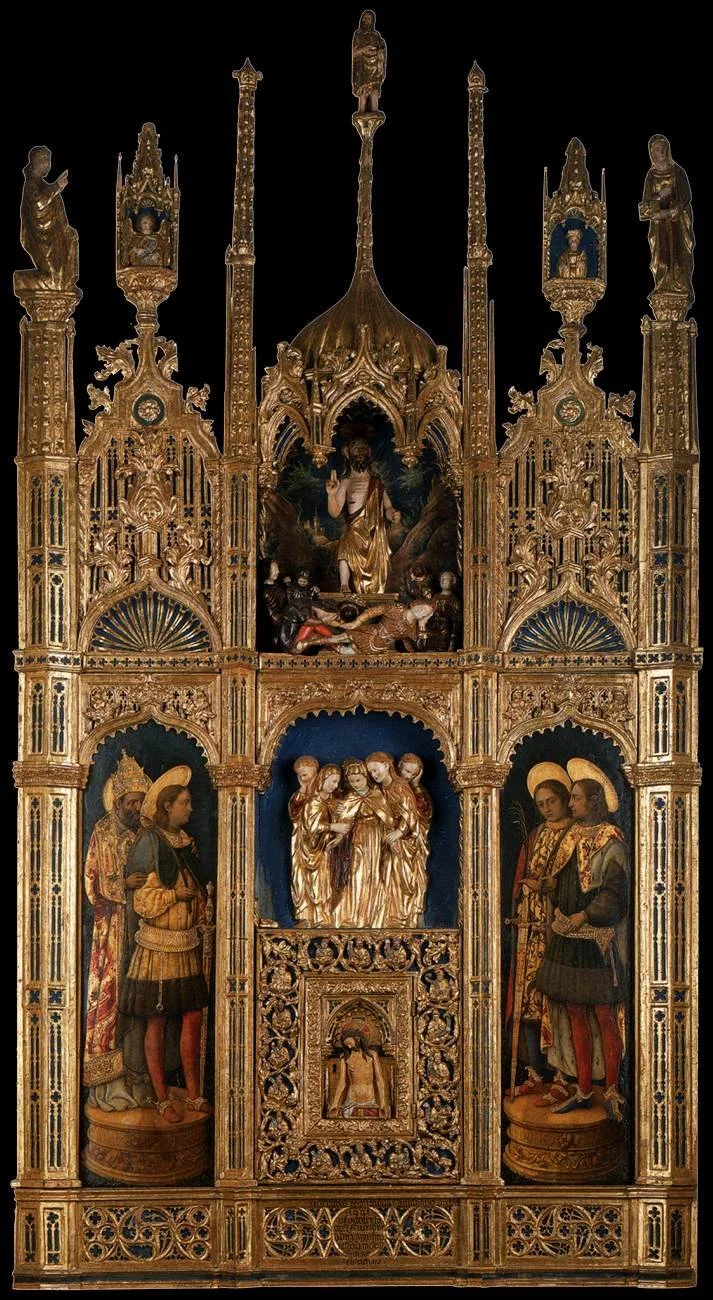
Antonio Vivarini and Giovanni d’Alemagna, polyptych for the Chapel of San Tarasio, San Zaccaria, Venice, 1443. Their workshop specialized in large, elaborate altarpieces that required painters, carvers, gilders, and a well-organized business behind them.
His real rivals were another family. Antonio Vivarini, from the glassmaking island of Murano, and his brother-in-law Giovanni d’Alemagna probably ran the top workshop in Venice in the 1440s. They made big Gothic altarpieces, panel stacked on panel inside towering carved and gilded frames. That meant carvers, gilders and painters all working to one deadline, and the Vivarini were very good at it. Around 1443 they made three of them for the chapel of San Tarasio at San Zaccaria, where they remain today. If you go, look up. A year earlier the Florentine Andrea del Castagno had painted the vault with God the Father, the Evangelists and saints, hard-edged and heavy as statues. Venice is on the altars and Florence is on the ceiling.
Jacopo found his opening in storytelling. Venice’s big confraternities, the scuole grandi, had started wanting large narrative paintings for their meeting halls, and Jacopo had the résumé for it. He had worked with Gentile in Venice, maybe even on the history paintings in the Great Council Hall. On October 4, 1444, the Scuola Grande di San Marco voted to decorate the room where its officers met, and Jacopo got the job. It kept the shop busy for years. When Giovanni d’Alemagna died in 1450, the Bellinis moved to the top of the Venetian market and stayed there for the next half century.
Giovanni was about nineteen when the San Marco job came in, and he was learning the trade from the inside. A painting was never just a painting. It was a patron, a price, a deadline and, every so often, a rival with a say in the fee.
YOU MAY ALSO LIKE


DEEP DIVE
Daniel Wallace Maze, Young Bellini (Yale University Press, 2021). Chapter 5, “Flashes of Brilliance,” makes the case that the teenage Giovanni painted the Brescia predella, an argument that, when Maze published it, hadn’t yet been taken up by other scholars. Chapter 6, “Lessons for Jacopo’s Assistant,” covers the San Marco commission and the Venetian market Jacopo was up against. Appendix A has the 1440 division, Ercole as witness, and the Bragadin contract.
Colin Eisler, The Genius of Jacopo Bellini (Abrams, 1989). For the lost Saint Michael in Padua and the case for an early date for the Brescia Annunciation. Eisler is also very good on what made Jacopo’s color Venetian.
Peter Humfrey, The Altarpiece in Renaissance Venice (Yale University Press, 1993). The standard book on how Venetian altarpieces were commissioned, built, and framed, from the Vivarini’s Gothic extravaganzas to the Bellinis’ later revolution.
THE FAMILY BUSINESS is my developing treatment for a television drama about the Bellini family, their workshop, and the world of Renaissance Venice.