
THE KING AND I: HOW THE VIEWER COMPLETES THE PAINTING
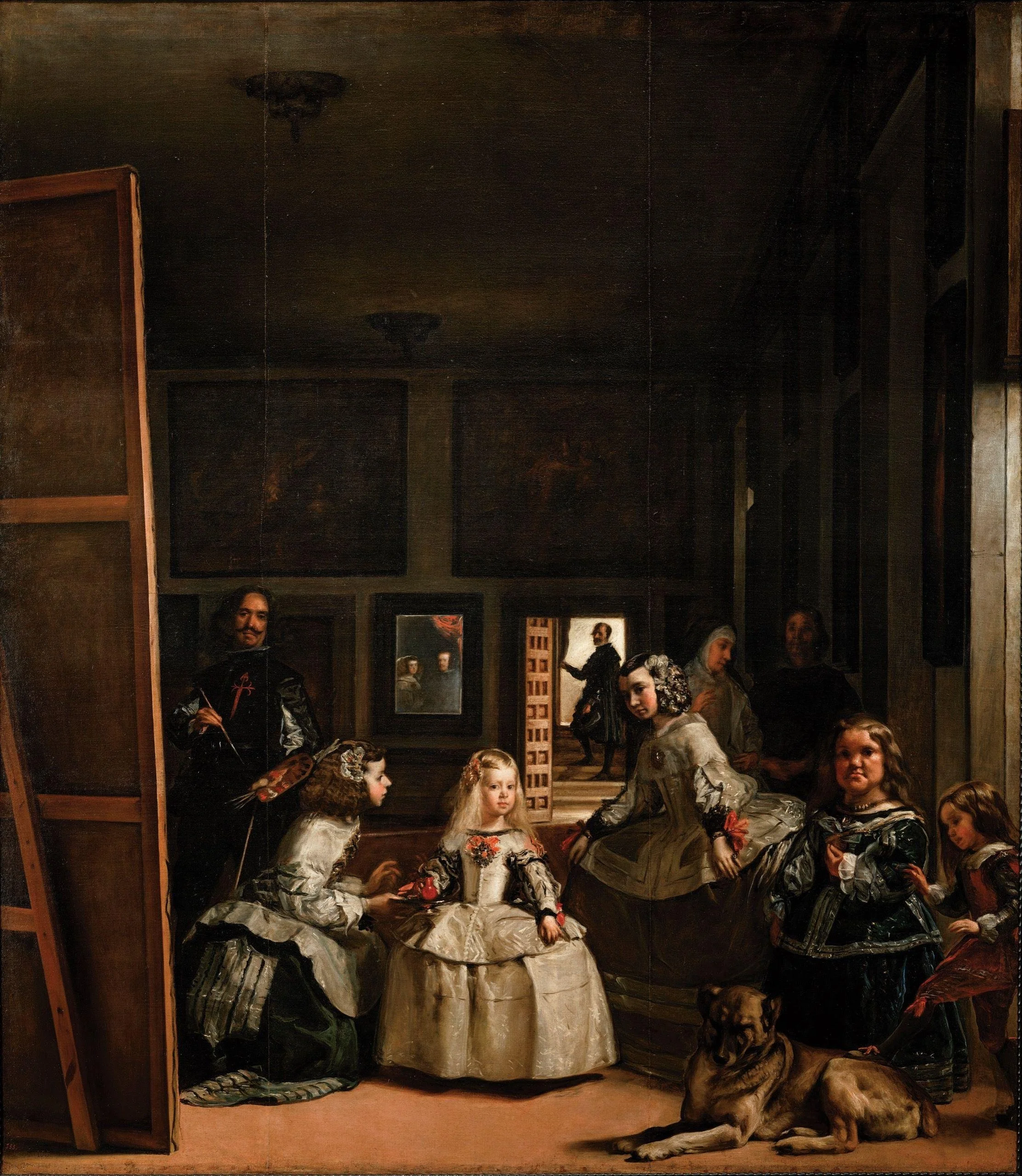
Diego Velázquez, Las Meninas
It wasn’t until I stood in front of Diego Velázquez’s Las Meninas that I understood that I, as the viewer, was the subject.
I had seen the painting countless times in reproduction. I knew the arguments, the diagrams, the mirror at the back of the room reflecting the king and queen. Intellectually, it all made sense. But none of that prepared me for the quiet, almost disorienting recognition that occurs when you are actually there, standing where the king and queen stood.
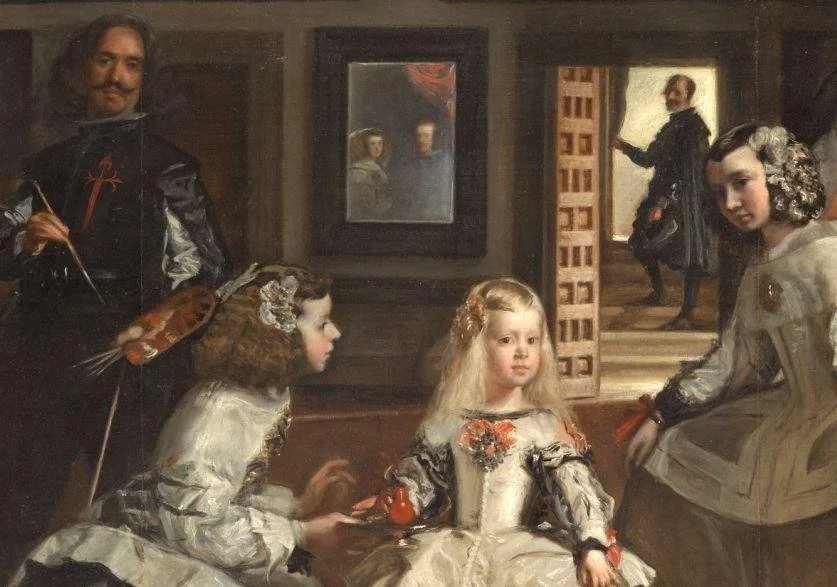
Detail of Las Meninas
The painting does not announce it. It simply re-organizes itself around you. The figures look outward. Velázquez pauses at his canvas. The space opens, but it opens toward a point that is not depicted. You occupy it. You complete it. And with that, the painting shifts from a scene in a room to something far less stable. It becomes a structure of looking in which you are implicated—quietly, but completely. And with this visual sleight of hand, the subject and meaning of the picture change. Valesques has not only implied your presence in the painting, he is also implying that you are the king and queen.
That realization depends on standing there. No reproduction places you in that position. On the page, you remain outside the painting. In the room, you are inside its logic.
I had a similar, but more physical, experience with Masaccio’s Holy Trinity in Santa Maria Novella in Florence.
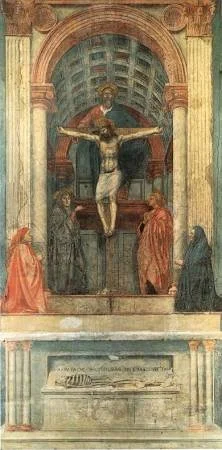
Masaccio's Holy Trinity (c. 1425–1427). Source: Wikipedia
In reproduction, Christ always looked slightly off to me. The proportions felt strained, the space compressed in a way that didn’t quite resolve. I assumed it was either the limitations of photography or an early experiment in perspective that hadn’t fully settled.
Standing in front of it, the problem disappeared. Or rather, it became clear that the problem had been mine.
The fresco is calibrated to a specific height. You have to stand at that height and look straight in. When you do, the architecture locks into place, and the figure of Christ resolves with it. If you shift—step to the side, look from too low or too high—the distortion returns immediately. It is not a flaw. It is a condition. Masaccio is not depicting a space so much as constructing one that only exists if you occupy the correct position.
The painting tells you where to stand.
With Hans Holbein the Younger’s The Ambassadors, the experience is less about finding the right place and more about moving through the wrong ones.
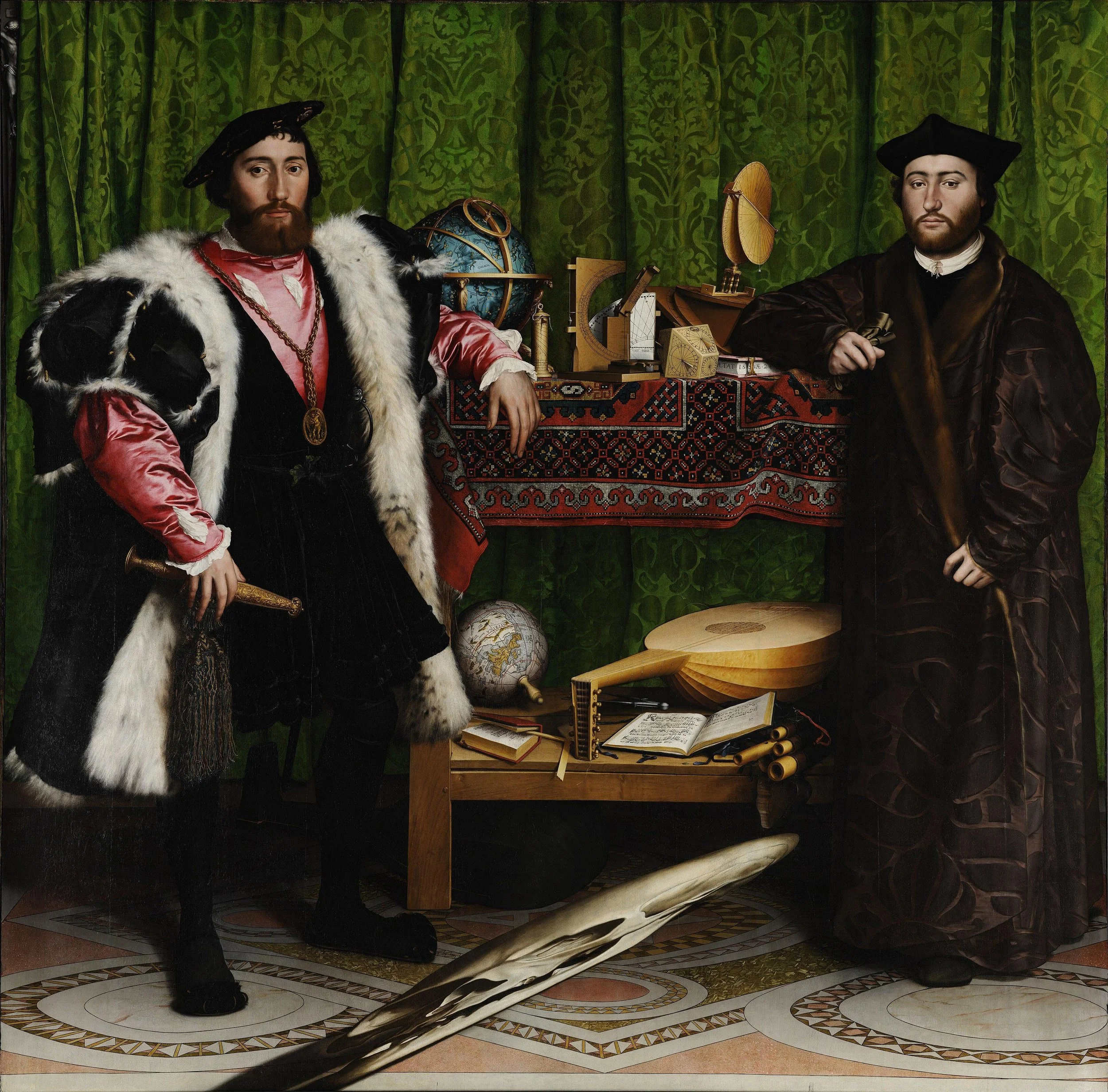
Hans Holbein the Younger, The Ambassadors
Head-on, it reads as a portrait of wealth, knowledge, and order. Instruments, fabrics, surfaces, everything rendered with an almost excessive clarity. And then there is that strange, elongated form cutting across the bottom of the painting, which makes no sense at all.
You begin to move. Almost involuntarily. And as you shift to the side, the distortion gathers itself and snaps into a skull.
It feels, at first, like a trick. A demonstration of skill. But the longer you stay with it, the more it becomes clear that the meaning of the painting is structured around that movement. Death is not simply included; it is withheld until you alter your position. The painting requires you to move to understand it. It stages that understanding in time.
I have not seen the great Baroque ceilings in person—those by Andrea Pozzo or Correggio, and I have never been particularly interested in them on the page. If anything resists reproduction, it is those.
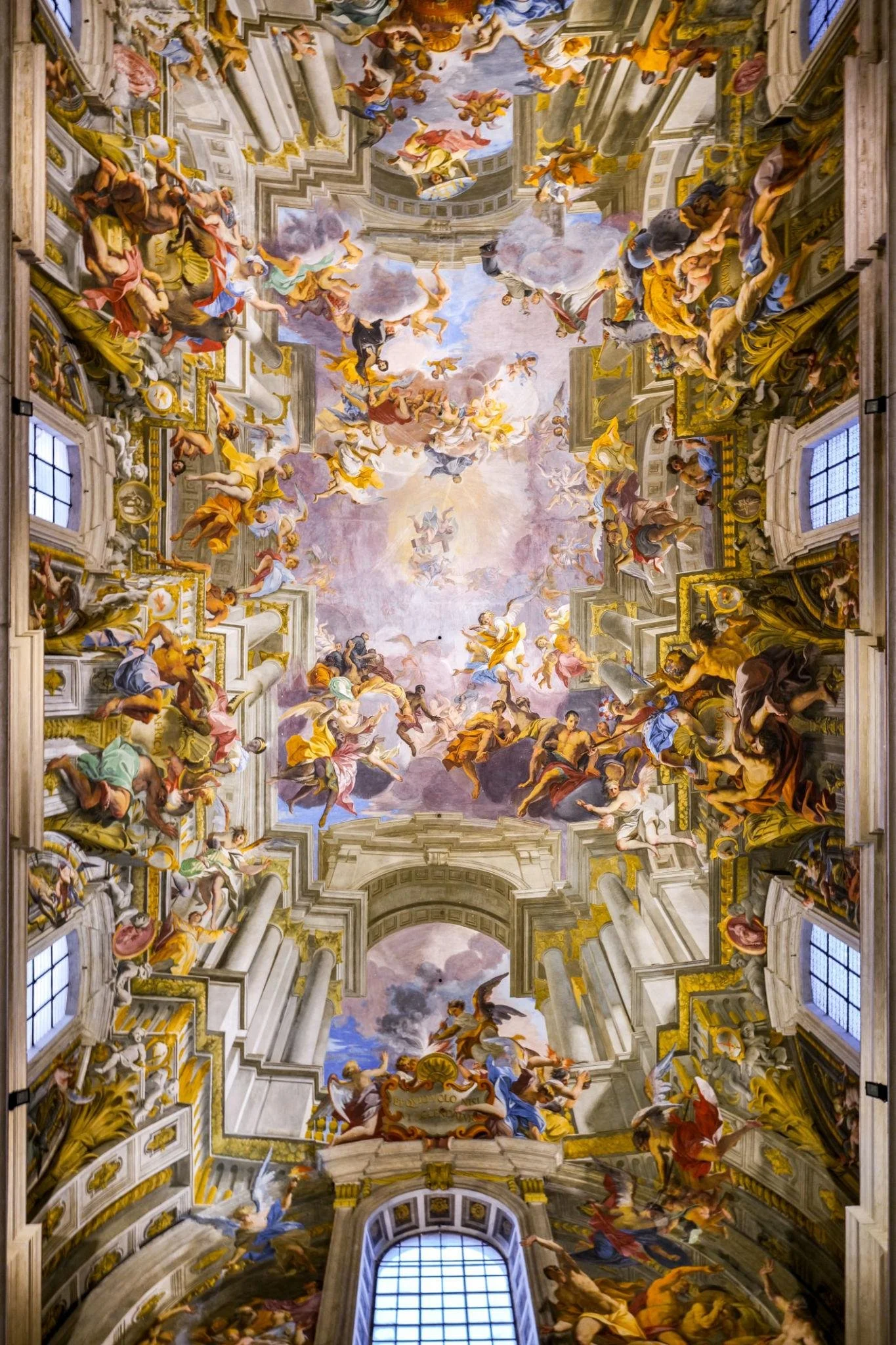
Correggio, Sant'Ignazio di Loyola
They are often described as feats of illusion, ceilings that open to the sky, and architecture extended beyond its limits. But what matters, and what you can only register in person, is that they are built around a fixed viewing point. In some cases, there is literally a mark on the floor. Stand there, and the space coheres. Move away, and it collapses into distortion.
Again, the painting tells you where to be. It constructs not just an image, but a position for your body.
And then there is Claude Monet.
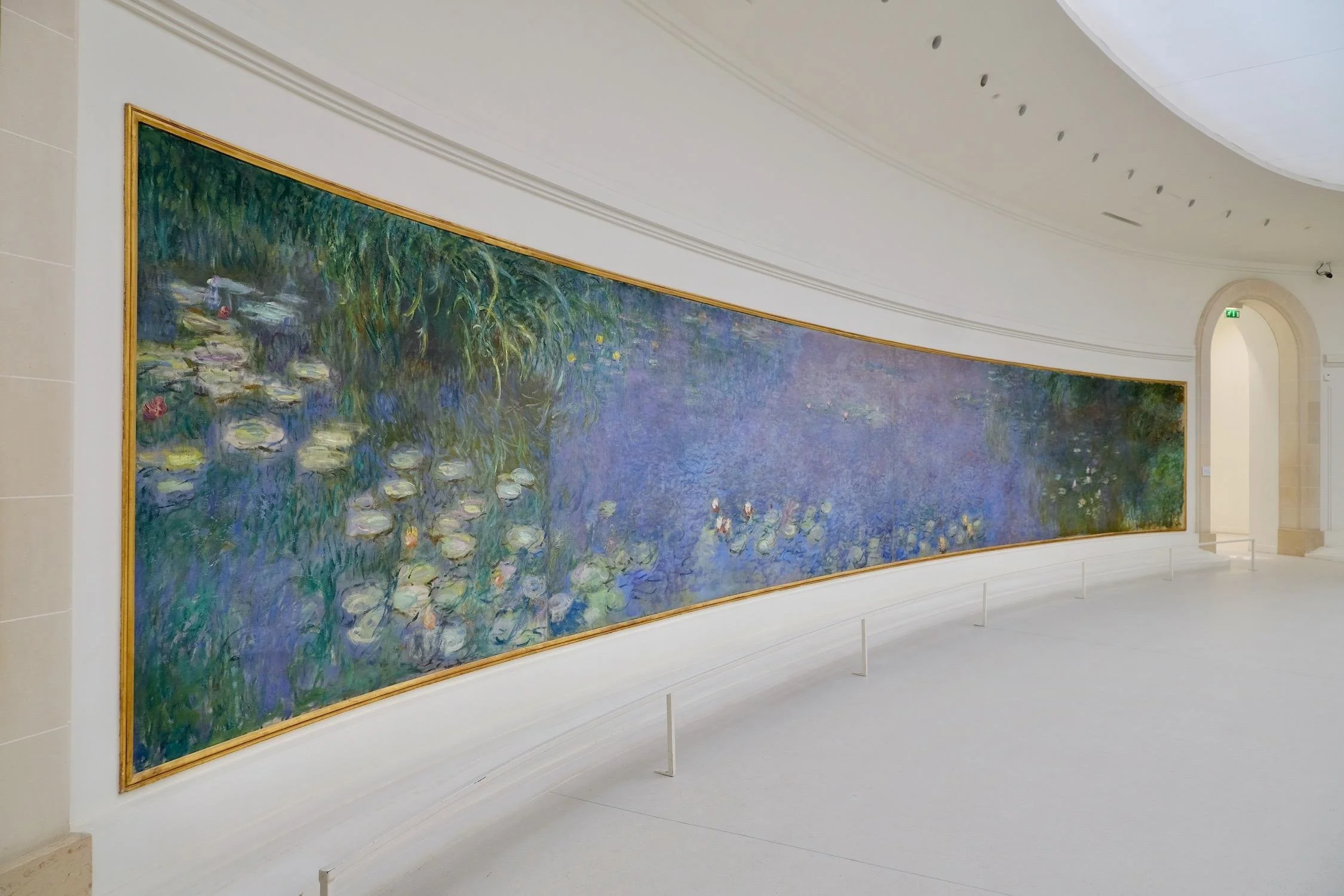
I had seen the late Water Lilies many times in books. They were beautiful, atmospheric, familiar. It wasn’t until I stood in the rooms at the Orangerie that I understood that I had never really seen them.
There is no correct place to stand.
You move, and the painting moves with you. Reflections appear and disappear. What reads as surface becomes depth, then returns to surface again. Edges dissolve. Space opens and closes without warning. The painting does not settle into a single image that can be fixed and held.
The understanding comes slowly, and it comes through the body. You walk. You look. You adjust. And somewhere in that process, the idea of a stable viewpoint falls away. The painting is not asking you to find the right position. It is showing you that there isn’t one.
That realization cannot be reproduced. It has to be arrived at.
Looking back across these works, what changes is not simply style or period, but the role assigned to the viewer.
In some paintings, you stand in one place and the image resolves.
In others, you stand in one place and you become the subject.
In others, you move and meaning reveals itself.
And in Monet, you move and the need for a fixed position disappears altogether.
It is a small shift, but it changes everything.