
AN ONCOLOGIST AND AN ARTIST WALK INTO A BAR . . .
After my opening at the Soprafina Gallery in Boston several years ago, friends invited me to dinner with an oncologist* and his wife. Over the meal, he told me about his research. He had access to mountains of data collected from patients over many years, and he and his team were struggling to mine it for patterns that might predict cancer. This was before artificial intelligence could handle such a task. He had resorted to color-coding the data. I told him he was heading for trouble.
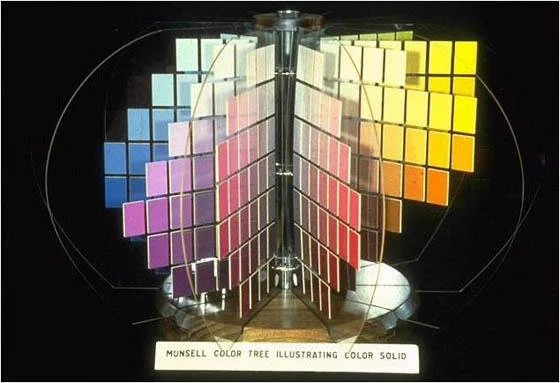
Too many variables. Too many hues. And a good number of men are color blind. If he insisted on color, I suggested the Munsell system, which accounts for hue, value, and intensity, making it far more precise.
Then another thought occurred to me. I told him he might assign musical notes to different factors, and that when certain elements combined to signal the onset of cancer, the notes would form a dissonant chord. He could listen to his data instead of only looking at it, scanning for the places where the sound jarred. He seemed surprised, but I knew it made sense. Our ears are tuned to notice what doesn’t belong. A sour note will leap out of a phrase in a way that a misplaced color in a tangle of codes might not.
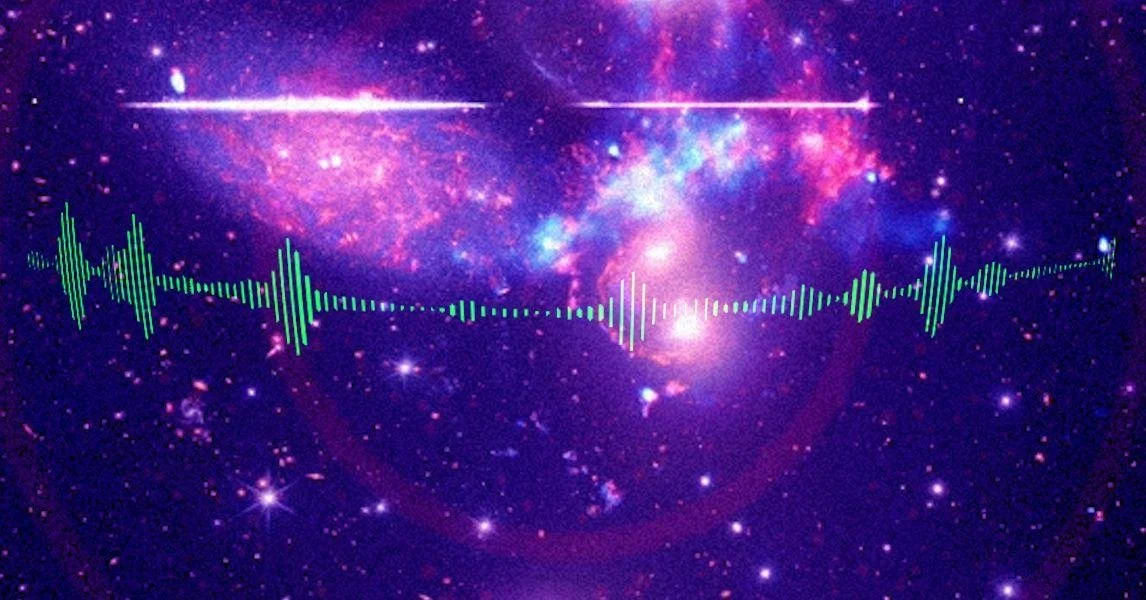
Later, I learned that scientists do something similar with the universe. Telescopes gather information about radiation and light far beyond human vision, and researchers translate it into sound. Different types of objects are assigned specific tones. When they listen, patterns emerge: the steady pulse of a neutron star, the turbulence of a galaxy cluster, the strange quiet around a black hole. The universe becomes legible in another register.
That dinner conversation confirmed something I had long felt but not articulated: meaning lives in patterns, and patterns cross the boundaries of the senses. Geometry becomes music. Music becomes light. All of it is vibration. Whether in a cathedral window or a medical dataset, harmony and dissonance reveal structures that might otherwise remain hidden.
The idea stayed with me. The thought that dissonance might reveal cancer, or that a telescope could translate invisible radiation into sound, felt familiar. It echoed what I was already doing in my studio. My paintings are built from frequencies—layers of marks and decisions that accumulate until they hum in a certain way. I think of them less as images than as fields of vibration. The harmony or tension between elements gives rise to the experience. In a sense, I am listening to the painting as much as I am looking at it, waiting for the chord that tells me it is alive.
In the years since that dinner, researchers have begun experimenting with the sonification of cancer data in ways that resemble what I suggested. Scientists have begun translating breast-imaging data into sound, allowing listeners to hear differences between tumor and healthy tissue. Others have developed auditory tools for surgeons, where shifts in pitch or timbre help locate tumor margins more accurately during breast-conserving surgery. Gene-expression data has been translated into music, with melodies and harmonies highlighting similarities between tumor types. In these cases, harmony and dissonance are not metaphors. They are analytic tools.
For me, it is affirming to see science moving in this direction. What began as an intuitive suggestion across a dinner table has become part of a broader method: listening for structure in what cannot be easily seen. Whether through sonified cancer scans, the translated frequencies of distant galaxies, or layers of paint on a canvas, the principle is consistent. The world is made of patterns. We are learning to hear them.
*David H. Sherr, Ph.D.
Emeritus Professor
Department of Environmental Health
Boston University School of Public Health