
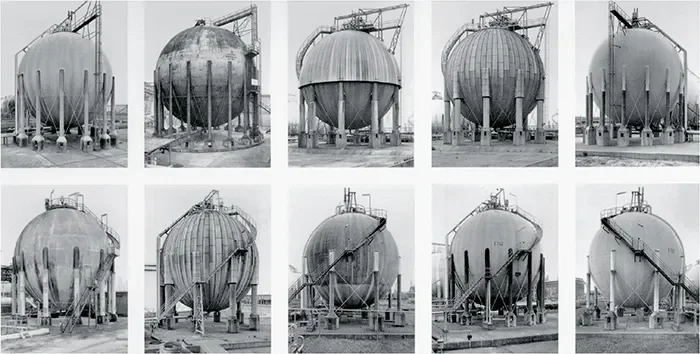
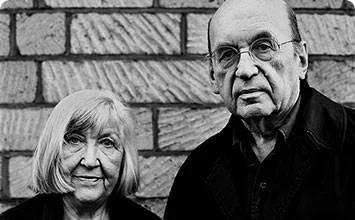
Bernd Becher and Hilla Becher
With Bernd and Hilla Becher, collaboration is not expressive. It is procedural. The work announces itself through repetition, restraint, and refusal. Two people, one method, sustained over a lifetime.
Their photographs of industrial structures are often described as neutral, even deadpan. Water towers, blast furnaces, gas tanks. Shot straight on. Overcast light. No drama. But neutrality here is a discipline, not an absence. What the Bechers built together was a way of seeing that required agreement at every level. Subject, angle, distance, timing, sequencing. Nothing could drift.
Again, the collaboration becomes clearest when you look at the work in its intended form. Not a single image, but a grid. One water tower is descriptive. Twenty water towers become analytic. The eye begins to register difference within sameness. Variations in proportion, engineering logic, regional habit. The photographs stop being pictures and start functioning as evidence.
This is where authorship dissolves. There is no meaningful way to separate Bernd’s eye from Hilla’s. Decisions are cumulative and shared. The work does not perform personality. It performs agreement.
What makes the partnership radical is its resistance to hierarchy. There is no primary author and no supporting role. The photographs are not expressive gestures that could be traced back to temperament. They are the result of a system that only works if two people adhere to it completely.
Their collaboration also extended into teaching. The Düsseldorf School did not emerge from charisma or style. It emerged from method. By insisting on rigor, patience, and serial thinking, the Bechers created a framework others could inhabit without imitation. You could recognize the inheritance without mistaking it for duplication.
Historically, this kind of collaboration is easy to underestimate. It lacks drama. There is no visible friction, no narrative of sacrifice. But the cost is real. To sustain this level of restraint over decades requires trust and a shared belief that the work will reveal itself slowly, if at all.
Placed alongside the other partnerships in this series, the Bechers offer a limiting case. Collaboration not as fusion or expansion, but as disappearance. Two egos receding so that the structure can be seen.
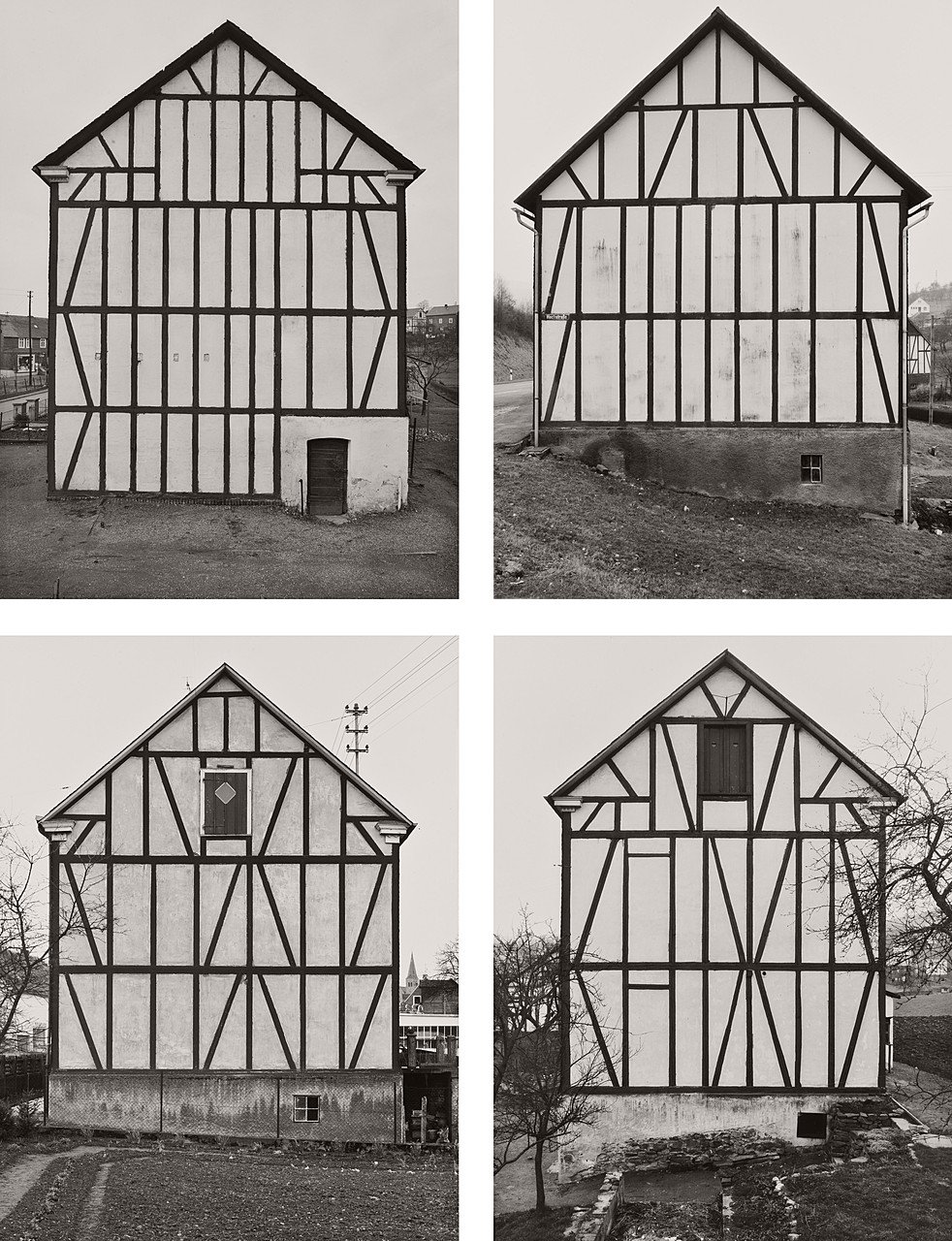

Bernd Becher and Hilla Becher
What they demonstrate is that collaboration can be a form of ethics. A commitment to accuracy. To patience. To letting the world show itself without embellishment.
Some partnerships make room for ambition. Some complicate ideas. This one removes everything that does not need to be there.
For other posts on artistic collaborators, check out:
Sonia Delaunay and Robert Delaunay