
COLLABORATORS: Gilbert and George

Gilbert & George, The Singing Sculpture, Sonnabend Gallery, New York, 1991 © 2017 Gilbert & George
Gilbert and George present perhaps the most literal form of collaboration in this series. They did not align two practices or share a method. They declared themselves a single artist, split across two bodies, and then lived that declaration without exception.
From the beginning, they insisted on authorship as unity. There is no Gilbert work and no George work. There is only Gilbert and George. This was not a conceptual pose adopted late in their careers. It was the premise from which everything followed. Art, life, image, and labor collapsed into one continuous practice.
Their early performances as “living sculptures” made the terms explicit. Standing, singing, moving slowly through space, dressed identically, they removed expression in the usual sense and replaced it with presence. The work was not about gesture or improvisation. It was about agreement. To inhabit the work required constant calibration. How long to stand. How to move. When to stop. Collaboration here was not metaphorical. It was bodily.

Gibert and George, from Thirteen Earthly Pictures
Later, in their large-scale grid works, the same logic persists. The images are confrontational, often abrasive. Sex, religion, bodily fluids, nationalism. But the content is held inside a strict structure. Repetition. Symmetry. Seriality. The grid does what agreement always does in collaboration. It contains volatility without neutralizing it.
What’s notable is that their partnership does not erase difference by smoothing it out. It does something more difficult. It subjects difference to a shared rule set. They dress alike. They speak together. They appear together. This uniformity is not about sameness of thought. It is about refusing the hierarchy that would otherwise emerge.
There is no backstage Gilbert and foreground George. No primary sensibility and supporting one. Whatever tensions exist are absorbed into the structure of the work. The public never sees negotiation, only its result.
Historically, this is an uncomfortable model. We are trained to look for the individual voice, the singular intelligence. Gilbert and George deny us that satisfaction. The work insists that meaning can be produced without revealing who thought what first.
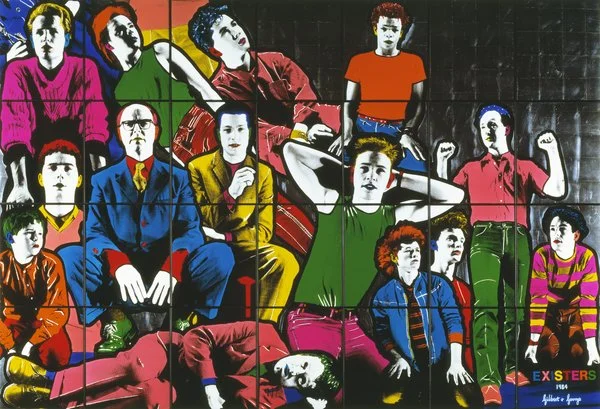
Gibert and George, Existers, Copyright: © Gilbert & George
Placed next to the Bechers, the contrast is instructive. Both partnerships erase individual authorship, but they do so differently. The Bechers disappear into method. Gilbert and George disappear into image. One effaces the self. The other performs it relentlessly.
What they share is a refusal of partial commitment. Collaboration here is not additive. It is total. You do not step into it for a project. You live inside it.
Gilbert and George show that collaboration can be an identity rather than a strategy. That authorship can be shared so completely that the question of credit becomes irrelevant. Once you accept their premise, the work holds. Once you resist it, nothing makes sense.
That tension is the point.
For other posts on artistic collaborators, check out:
Sonia Delaunay and Robert Delaunay