
Back in 1419, when Gentile da Fabriano left Brescia with his young Venetian assistant, Jacopo Bellini, in tow, he wasn’t really headed to Florence. He was headed to the pope. Martin V, newly elected and not yet able to return to Rome, was living at Santa Maria Novella, and Gentile had promised to join him once he finished the chapel he was painting for Pandolfo Malatesta in Brescia. He made his way south by way of Fabriano, and by 1420 he had rented a house and workshop in Florence near Santa Trinita. The pope soon moved on to Rome. Gentile stayed, because Palla Strozzi made him an offer.

Gentile da Fabriano, Adoration of the Magi, 1423, Uffizi Gallery, Florence
Strozzi wanted an altarpiece for his family chapel in Santa Trinita, and Gentile spent nearly three years on it. The Adoration of the Magi is a crowd scene in gold: kings, horses, camels, hunting dogs, and falcons, in brocades so thick with real gold that you half expect them to be listed in Strozzi’s inventory. Jacopo was in the workshop while it was being made. We can’t point to a horse or a robe and say he painted it, but he watched a major commission come together from the inside.
Then he walked outside.
Florence hadn’t thrown out Gothic art. Lorenzo Ghiberti, one of its most celebrated artists, was finishing the bronze north doors of the Baptistery, and they still belong partly to the world Jacopo knew, with quatrefoil frames and gilded figures. But inside those frames the figures move more freely, and they stand on ground that recedes. Ghiberti stood almost exactly on the line between Gentile’s world and the one Florence was inventing.

Lorenzo Ghiberti, Adoration of the Magi, panel from the north doors of the Baptistery, Florence
Brunelleschi was working out how to put measurable space on a flat surface, and in 1420 he began raising the dome over the cathedral. In Florence you could watch geometry go up. Donatello was giving the human body weight. In the shallow marble relief beneath his Saint George, he made an arcade and a landscape recede into a space only a few centimeters deep.
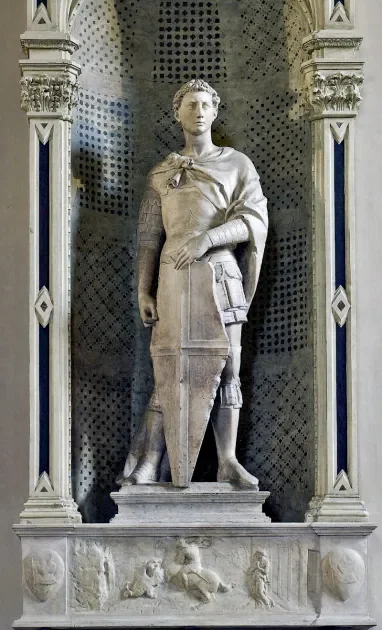
Donatello, Saint George and the Dragon, c. 1415–17
Masolino was borrowing Gentile’s softness while trying out a more believable world. And there was Masaccio. In 1422 he was twenty and hadn’t yet painted the frescoes that would make him famous. But in the San Giovenale Triptych, his earliest known work, the Virgin has real weight, the angels occupy real space, and the floor runs back toward a single point. Jacopo couldn’t know that Masaccio would be dead at twenty-six. He could only see that something was happening.
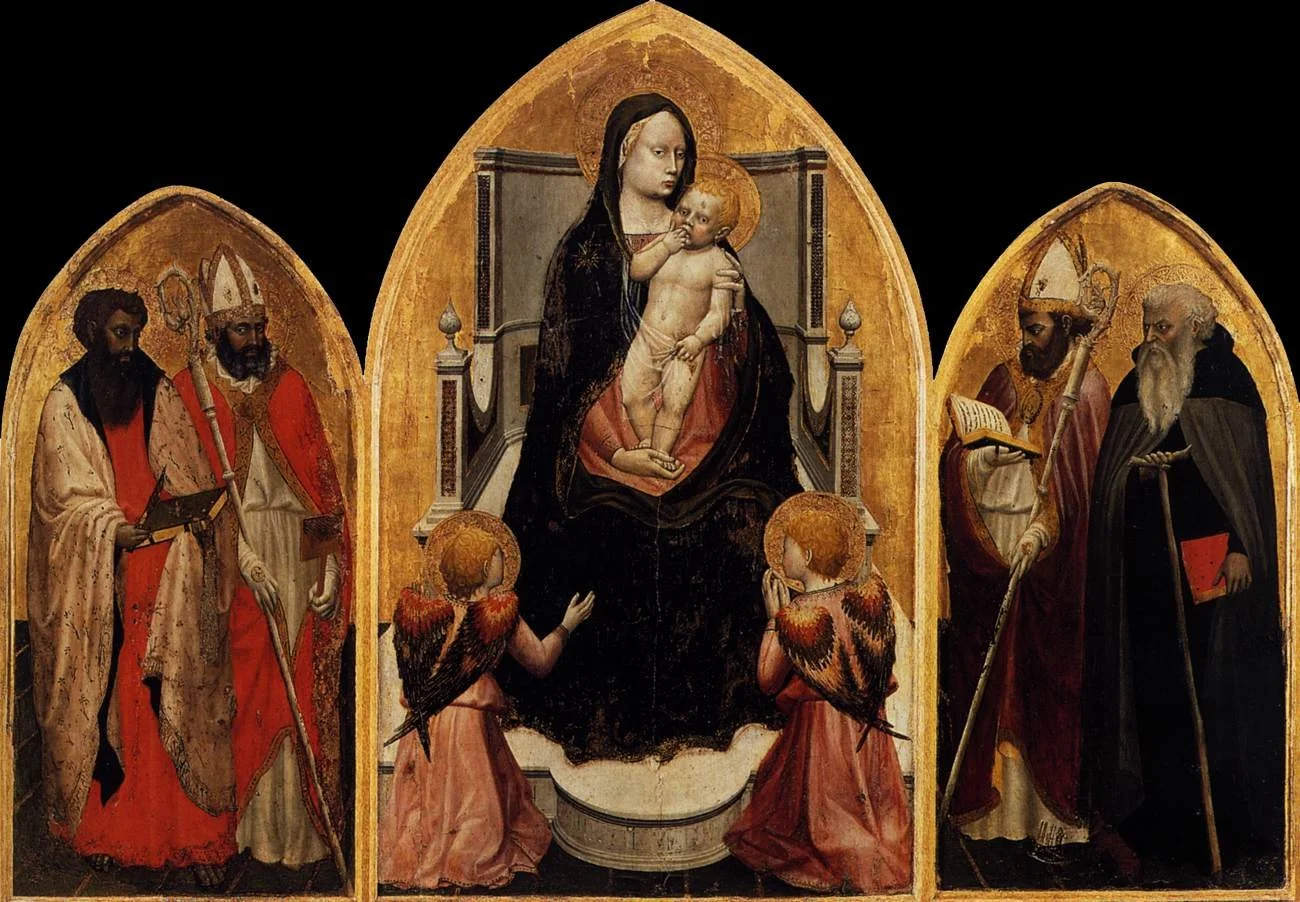
Masaccio, San Giovenale Triptych, 1422
Florentine painters wanted to know where a figure stood, how far back a building went, where the light came from, and what the body under the clothes weighed. How splendid a surface could be was no longer the only question.
Gentile was looking too. The Adoration still glitters, but the world inside it has started to deepen. Roads wind back into the hills, and figures overlap and turn. In the small predella scenes underneath, he gives up gold for real skies, including a Nativity lit at night, one of the first convincing night scenes in Italian painting. He never became a Florentine theorist of perspective, but you can see Florence in the picture. It worked the other way as well: Masolino studied Gentile closely, and other Florentine painters borrowed from him.
For the moment, Jacopo remained Gentile’s pupil. His earliest surviving Madonnas are so close to his master’s style that some of them were once attributed to Gentile himself. Florence didn’t change the way Jacopo painted overnight. It gave him problems to solve, especially perspective and where to put figures in space, and he spent the rest of his career working on them.

DEEP DIVE
Keith Christiansen, Gentile da Fabriano (Cornell University Press, 1982). The best account in English of Gentile’s Florentine years: the house near Santa Trinita, the Strozzi commission, and how his painting changed once he got to Florence.
Laura Laureati and Lorenza Mochi Onori, eds., Gentile da Fabriano and the Other Renaissance (Electa, 2006). Andrea De Marchi’s essays in this exhibition catalogue follow Gentile from Brescia to Florence and are especially good on what he absorbed there, and on what the Florentines took from him.
Otto Pächt, Venetian Painting in the 15th Century: Jacopo, Gentile and Giovanni Bellini and Andrea Mantegna (Harvey Miller, 2003). Pächt is the one to read on Jacopo working out perspective and slowly letting go of Gothic habits of space, a story that starts here and runs through his drawing books.
Daniel Wallace Maze, Young Bellini (Yale University Press, 2021). For Jacopo’s place in Gentile’s Florentine household and his earliest work.
THE FAMILY BUSINESS is my developing treatment for a television drama about the Bellini family, their workshop, and the world of Renaissance Venice.