FRANK STELLA: WHAT THE STRIPE SOLVED
"I would like the paintings to be their own justification, so that anything asked of them would be irrelevant." - Frank Stella
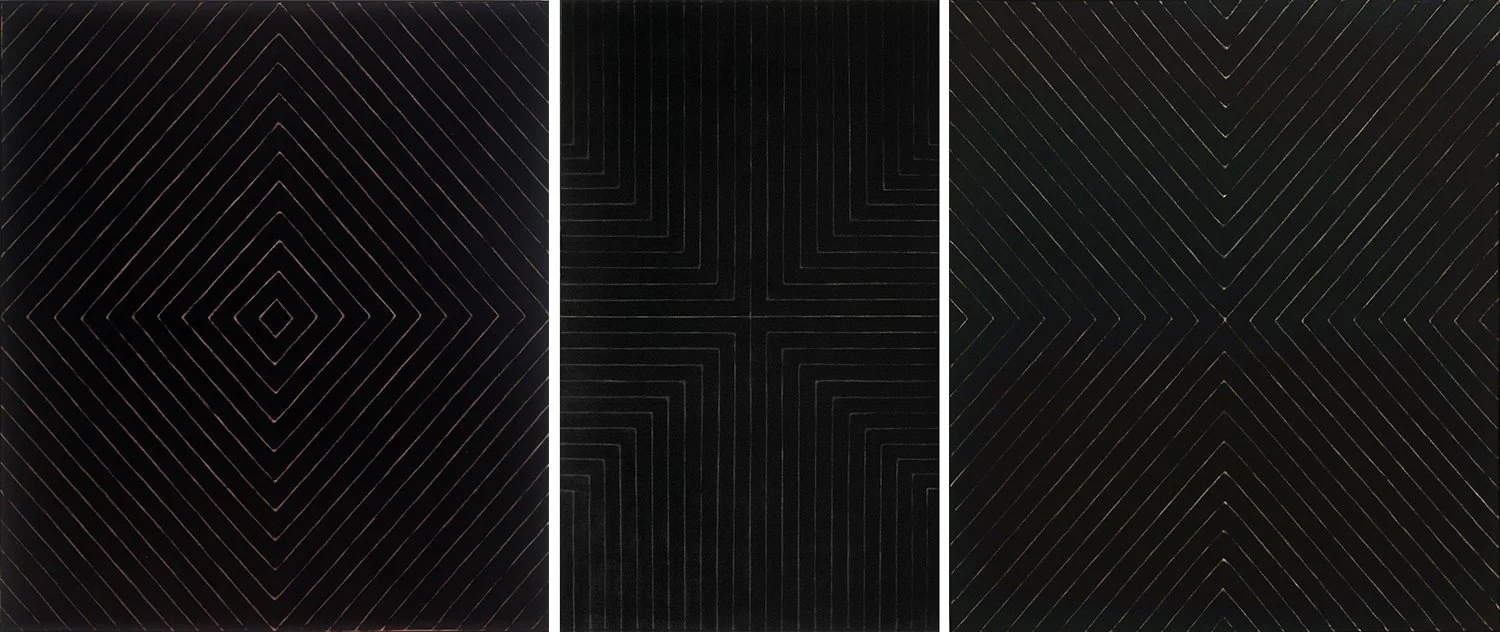
Selected Black Paintings (from left to right): Frank Stella, Jill, 1959, enamel on canvas, 229.6 x 200 cm (Buffalo AKG Art Museum); Frank Stella, Die Fahne Hoch!, 1959, enamel on canvas, 308.9 × 184.9 cm (Whitney Museum of American Art, New York); Frank Stella, Zambezi, 1959, enamel on canvas, 230.51 x 200.03 cm (SFMOMA)
FRANK STELLA: WHAT THE STRIPE SOLVED
Frank Stella did not arrive at the stripe because he liked stripes.
He arrived at it because he was trying to solve a problem in painting.
By the late 1950s, Abstract Expressionism had made the painter’s gesture one of the principal subjects of painting. The movement of the hand, the pressure of the brush, the evidence of hesitation, speed, revision, and emotion were all there to be read. The painting carried the record of the artist making it.
Stella was not interested in leaving that kind of record.
He had moved to New York after graduating from Princeton in 1958 and was working part-time as a house painter. He had also seen Jasper Johns’s flags and targets. What interested him was not simply their flatness, but the way Johns stayed with a predetermined motif. The image already existed. The artist did not have to invent a composition each time he approached the canvas. Stella later said that what struck him was “the idea of stripes—the rhythm and interval—the idea of repetition.”
The stripe gave him a way to proceed.
GETTING RID OF COMPOSITION
Stella described the kind of painting he wanted to move away from as “relational painting.” In relational painting, one shape is placed in response to another. A mark in the upper corner might require something lower down to balance it. The painter continues adjusting the parts until the composition feels resolved.
This is so deeply embedded in the way painters are taught to work that it can seem almost synonymous with painting itself.
Stella wanted to know what would happen if he stopped moving the parts around.
Symmetry helped. Repetition helped even more. Instead of deciding where each stripe should go, he established a pattern and followed it. The brush width determined the width of the painted band. A narrow interval of raw canvas separated one band from the next. The stripes turned at right angles or converged toward a center, but they did so according to a structure that had already been established. Stella said that he and the other painters working in this direction were not trying to “jockey everything around.”
The stripe limited his choices, but it did not make the painting automatic. It moved the decisions elsewhere.
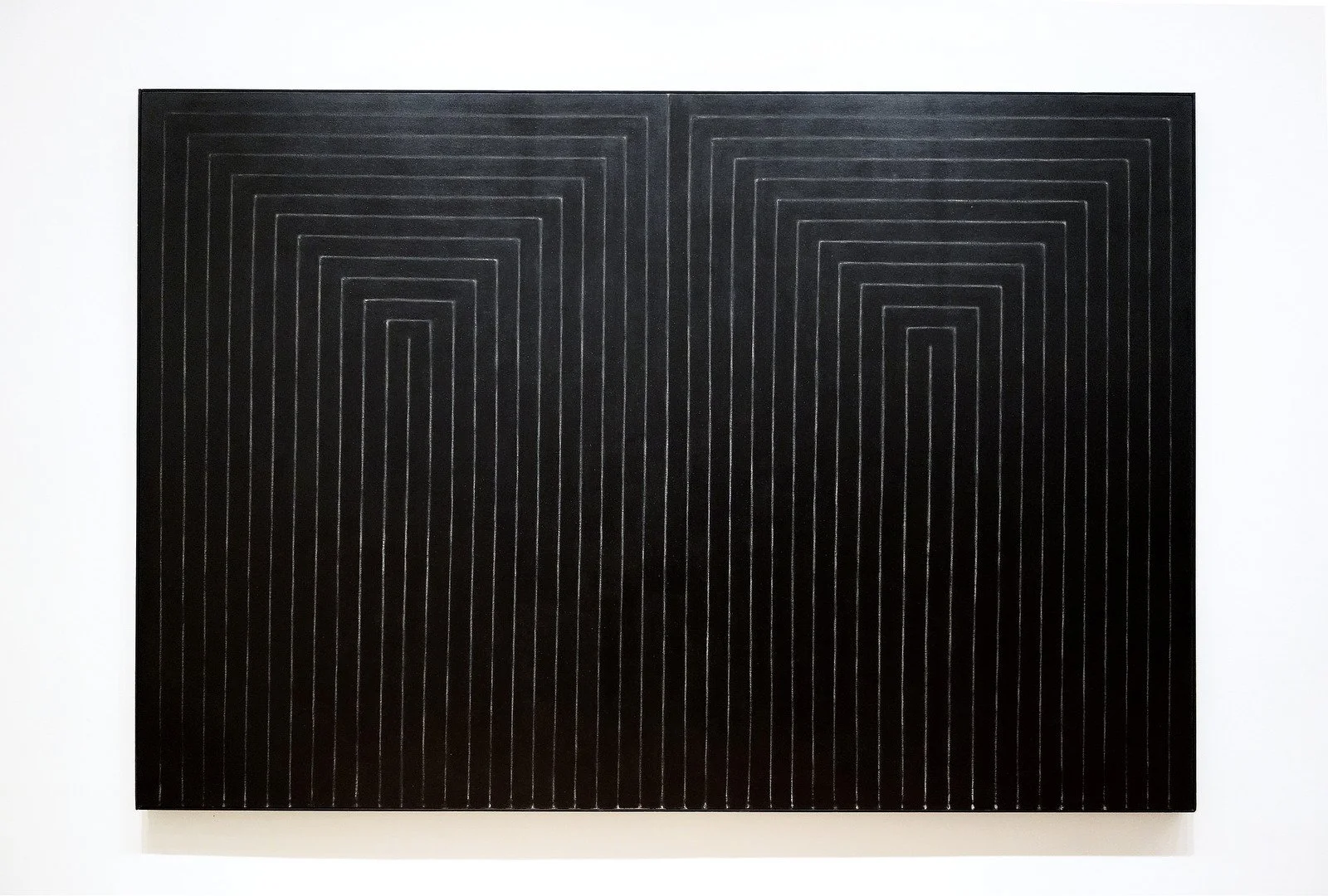
Frank Stella, The Marriage of Reason and Squalor, II, 1959, enamel on canvas, 230.5 x 337.2 cm (The Museum of Modern Art, New York) © 2026 Frank Stella / Artists Rights Society (ARS), New York
In The Marriage of Reason and Squalor, II, two nearly identical configurations of black stripes fill an enormous horizontal canvas. The bands fold inward, one inside the next. The narrow lines between them are not painted white. They are the canvas itself, left exposed. Stella painted the black enamel freehand with a housepainter’s brush, and the slight irregularities remain visible. He described the regulated pattern as a way to gradually and consistently force illusionistic space out of the painting.
The painting is flat, but it is not inert. The repeated bands lead the eye inward, then stop it. They appear to create depth and then withdraw it. The eye keeps trying to enter a space that the painting refuses to provide.
This is one of the contradictions of Stella’s Black Paintings. He wanted the entire idea to be visible at once, without the viewer having to search for imagery or psychological content. Yet the paintings do not remain still in the eye. Their measured repetitions generate pressure. The raw canvas lines flicker against the black. The pattern can feel architectural, optical, even bodily, despite the artist’s insistence that there was nothing there beyond what could be seen.
His famous phrase, “What you see is what you see,” is usually taken as an instruction not to interpret the painting. But seeing is never quite that obedient.
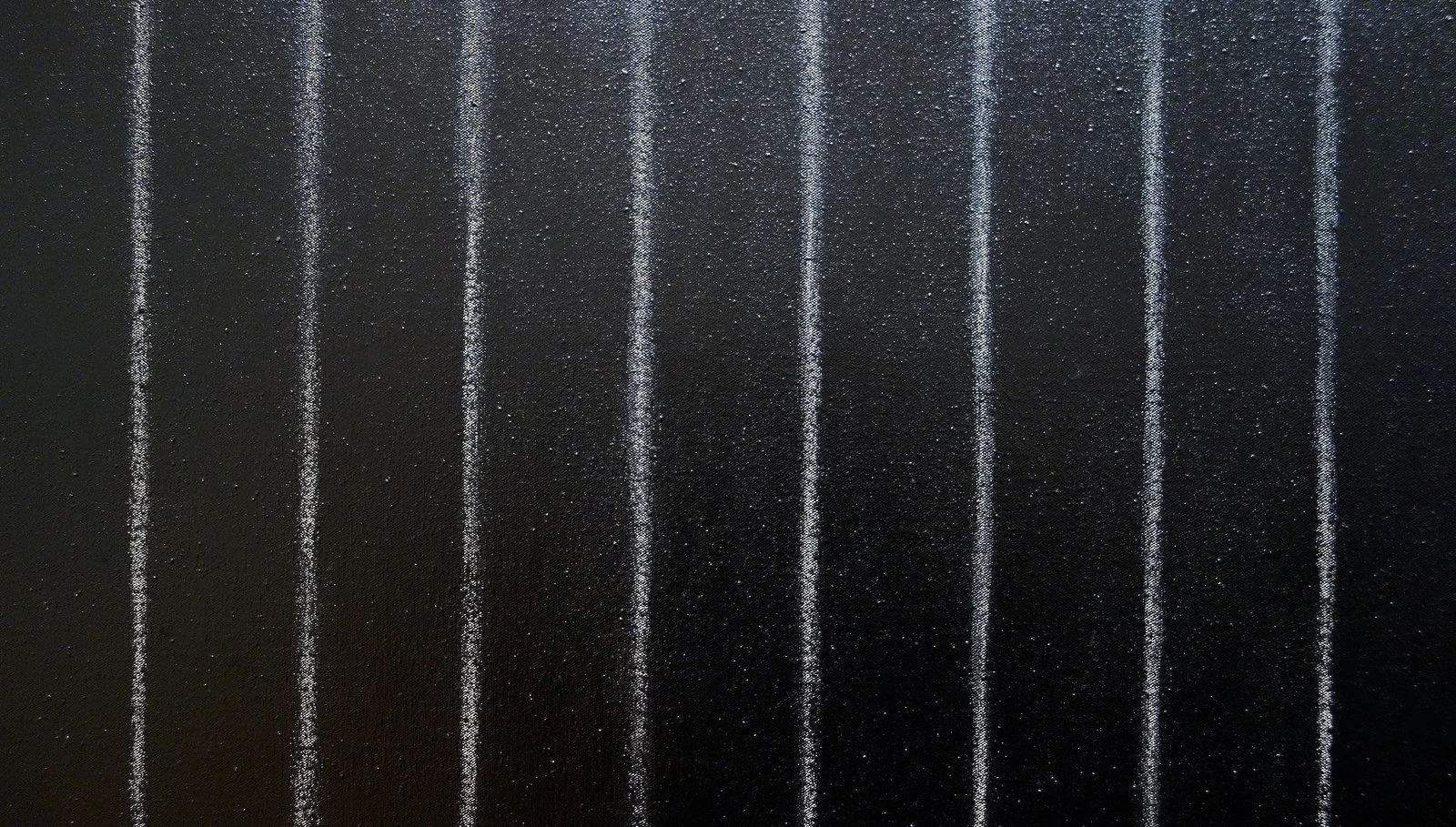
Frank Stella, The Marriage of Reason and Squalor, II (detail), 1959, enamel on canvas, 230.5 x 337.2 cm (The Museum of Modern Art, New York)
The titles complicate things further. Die Fahne hoch! takes its name from the opening words of a Nazi marching anthem. Other Black Paintings were given titles associated with Nazism and the Holocaust. Stella maintained that the paintings were nonreferential, but titles such as Die Fahne hoch! and Arbeit Macht Frei cannot be made neutral simply by declaring that the painting itself contains no image. The cruciform structure and flaglike proportions of Die Fahne hoch! inevitably bring history into the room.
The painting may not depict anything, but it is not without associations. This may be less a failure of Stella’s argument than evidence of how difficult it is to make a painting refer only to itself.
THE EDGE OF THE PAINTING
In the Black Paintings, the canvas dimensions helped determine the pattern of the stripe. The bands followed the rectangle, repeated it, divided it, and turned back from its edges.
But the rectangle itself remained unquestioned.
A conventional rectangular canvas carries a long history with it. It can still be understood as a window, even when there is no landscape or figure inside it. Stella’s next move was to allow the progress of the stripes to determine the actual contour of the support.
This led to the Aluminum Paintings of 1960 and, subsequently, the Copper Paintings. The canvas was notched, cut away, opened at the center, or constructed as an L, a cross, a stepped form, or another shape generated by the bands. The Metropolitan Museum describes these shaped canvases as paintings whose outer forms resulted from the serial progression of the stripes.
The change is more radical than it first appears.
In a rectangular painting, the pattern ends at the edge. In the shaped canvases, the pattern helps create the edge. The painting no longer occupies the shape provided in advance. The internal structure and the outside contour belong to the same decision.
Newstead Abbey, painted in aluminum paint in 1960, is still recognizably vertical, but its sides have been cut into a sequence of notches. The aluminum bands travel through the shape, turning and returning until it becomes difficult to say whether the stripes describe the canvas or the canvas describes the stripes.
The shaped canvas is sometimes treated as an eccentric departure from the austerity of the Black Paintings. I see it as the consequence of them. Once Stella allowed the edge to determine what happened inside the painting, it was only a matter of time before he asked why the edge itself should remain untouched.
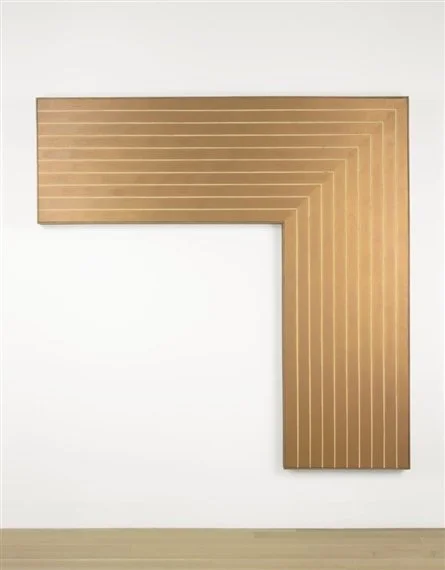
Frank Stella,Creede II, Copper paint on shaped canvas, 1961
The Copper Paintings push the question further. In Creede I and Creede II, large portions of the expected square are missing. Each painting is essentially an angular band turning around empty wall. The absent area is no longer a passage of raw canvas within the painting. It is an actual opening beyond the painting. The Whitney’s Michael Auping described Stella’s question as: how much could be removed before the work ceased to read as a painting?
What began as an attempt to stop composing had changed the painting's physical definition.
THE METALLIC PAINTINGS
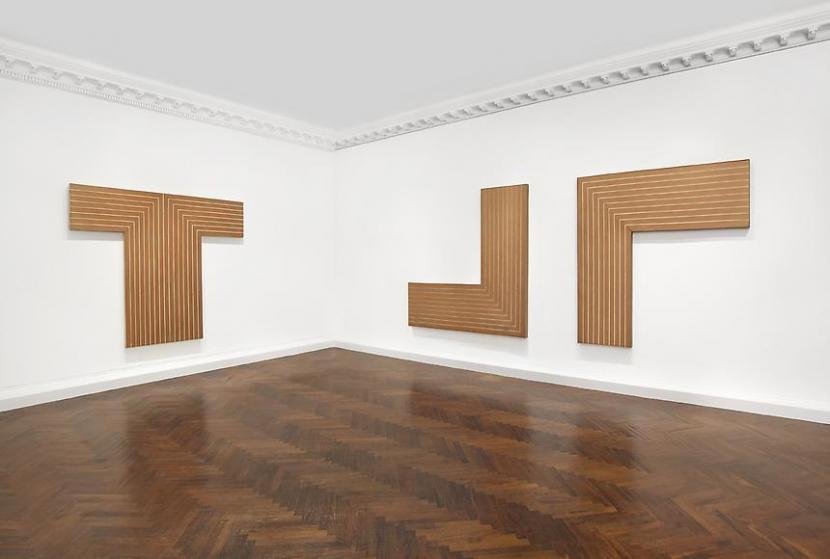
Stella installation, L&M Arts, NYC, 2012
The switch from black enamel to aluminum and copper paint also changed how the surface behaved.
Black paint can suggest depth even when the painter is trying to eliminate it. Black absorbs light. It can appear velvety, empty, or immeasurable. The metallic paints resist that kind of entry. They catch the changing light in the room and return it to the viewer. Their color belongs as much to the material as to pigment.
Stella later described the Aluminum and Copper Paintings as having been made with something like “liquid metal.” He liked the material’s physical insistence. The paint was heavy and thick and difficult to handle. It did not disappear into an image.
The metallic surface also altered the relationship between the painted stripe and the unpainted canvas. In the Black Paintings, the pale canvas lines can seem to sit atop the black. In the Aluminum Paintings, the raw intervals separate reflective bands whose appearance changes as one moves. The painting remains flat, but the light refuses to stay fixed.
Stella’s work is often described as a reduction: less gesture, less illusion, fewer colors, fewer compositional decisions. But reduction does not quite explain what happened. Every element he removed exposed another question.
If the gesture is removed, how is the paint applied?
If composition is removed, what determines the pattern?
If the pattern follows the edge, what determines the edge?
If the painting is an object, how much of that object can be removed before it becomes something else?
The stripe did not end the inquiry. It carried him into it.
FOR THOSE WHO LIKE TO WATCH PAINT DRY
Stella’s materials were closely connected to his experience as a house painter. He bought commercial paint, sometimes choosing unwanted colors from bargain bins, and worked with the broad brushes he already knew how to use. He built deep stretchers from one-by-three-inch lumber, giving the paintings greater projection from the wall than a conventional canvas.
For the Black Paintings, he worked on unprimed canvas. The narrow light-colored lines are not painted. They are strips of canvas left bare between the black bands. He laid out the pattern using a pencil and a ruler, but he did not use masking tape to produce the edges. The enamel was applied by hand, freehand, with a housepainter’s brush.
This is important when looking at the paintings in person. Their geometry is exact, but their execution is not mechanical. The width of the stripes varies slightly. The black paint does not meet the raw canvas with the hard, sealed edge that tape would produce. Brushwork remains visible inside the bands.
Stella did not want the brushstroke to function as handwriting. He did not want it to describe the movement or emotional state of the painter. He wanted to transfer paint from the can to the canvas without making the brush's path the subject. As he explained in the 1964 interview with Bruce Glaser, he was trying to keep the paint as good as it was in the can.
The difference is subtle. The hand has not disappeared. It has been given a more limited job.
The brush fills the prescribed band. The small variations are not flourishes and are not corrected. They are simply what happens when a person uses a broad brush to cover a large canvas.
The metallic paintings required custom supports because their shapes tracked the bands' progress. In some sections, notches were cut from the perimeter. In others, the center was cut away. In works such as Creede I and Creede II, Stella removed most of the expected rectangle, leaving an L-shaped band that turns around an area of exposed wall. The geometry could be worked out as a drawing or diagram, but the stretcher had to be built to make that geometry physical.
The aluminum and copper paints were commercial metallic coatings rather than traditional artists’ colors. Stella later emphasized their weight and thickness. Unlike a transparent stain, the metallic paint sits assertively on the canvas and responds to the light outside it.
There is a temptation to imagine that once Stella had devised the system, the making of the paintings became merely procedural. He rejected that idea. A diagram was not a painting. The plan could be settled, but he still had to make the object in order to discover what it looked like.
As a painter, I understand this. A system may reduce the number of decisions, but it does not eliminate uncertainty. It concentrates it. The question becomes less about what to do next and more about whether the thing you have decided to do will produce a painting worth looking at.
Stella made the stripe carry that uncertainty.
It gave him a method, but it did not give him the answer.
YOU MAY ALSO LIKE: