GERHARD RICHTER: THE REALITY OF PAINTING
“I don’t believe in the reality of painting, so I use different styles like clothes: it’s a way to disguise myself.” - Gerhard Richter
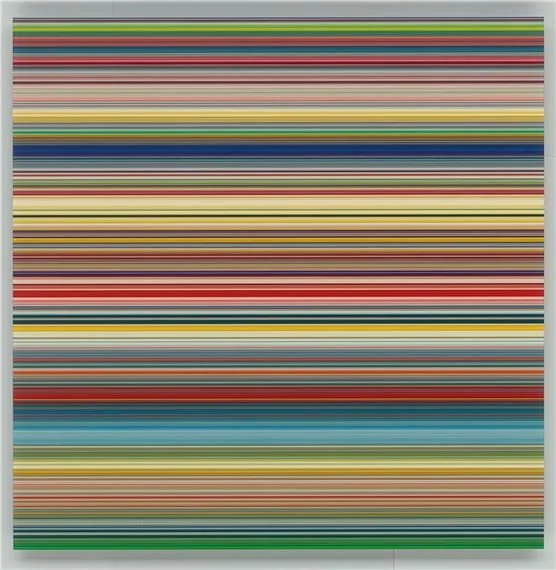
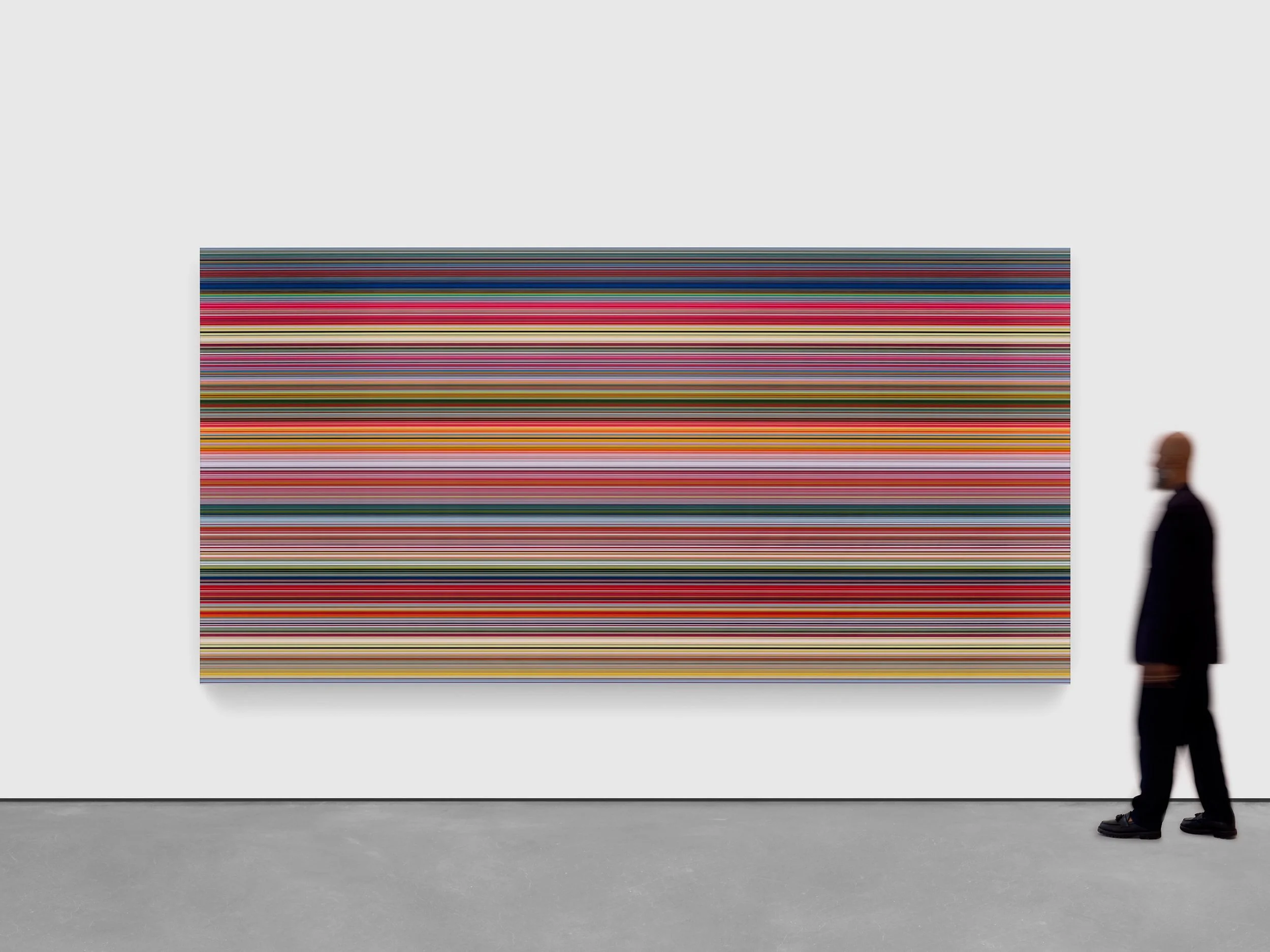
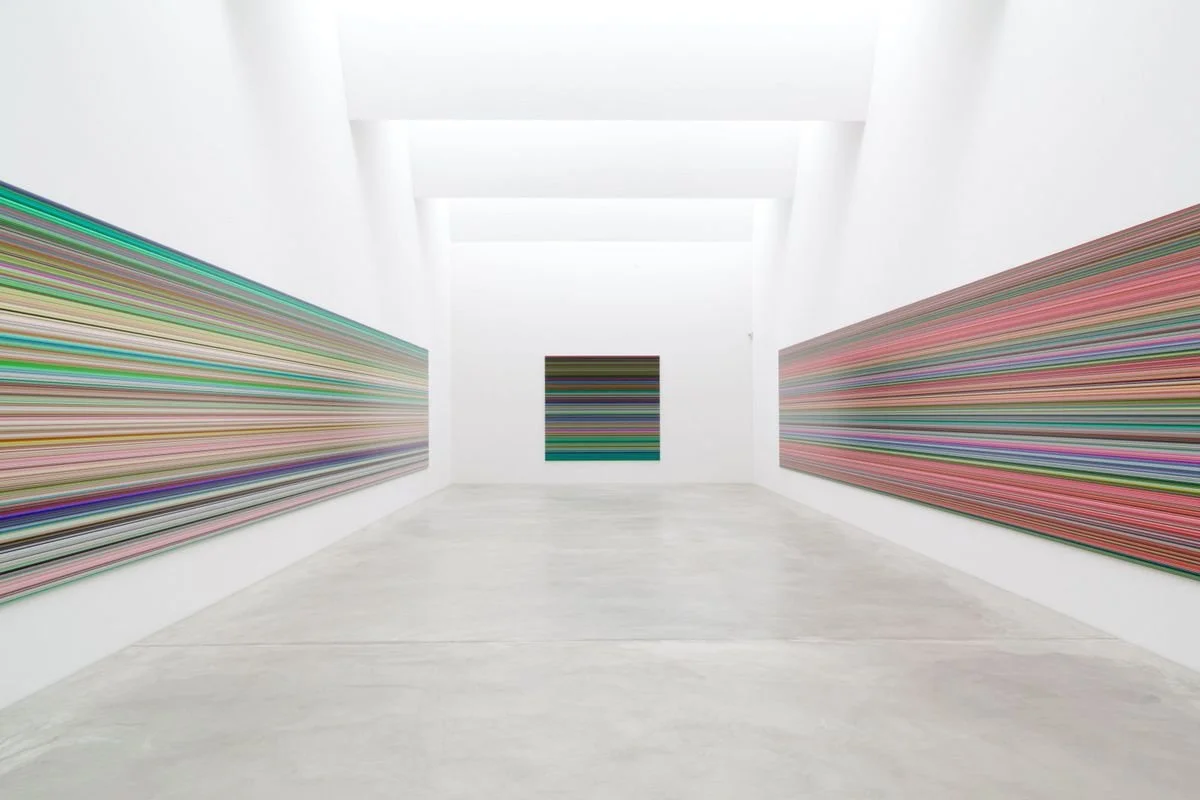
Gerhard Richter, Strip-R9FA2-570
In the late 1970s I often visited Berlin with my then partner, Michael Marton, a German documentary filmmaker. On one of those trips we went into East Berlin with his film friend Norbert, who was delivering a roll of wallpaper to a friend.
That detail stays with me now: wallpaper. A domestic thing. A room thing. A pattern meant to make a wall more livable, carried across one of the most heavily policed borders in the world.
Staying in West Berlin was already strange. It was a Western enclave inside the German Democratic Republic, a dot of democracy in a sea of communism, or socialism, depending on how careful one wants to be with the language. There was a literal wall around it. When I was there, I felt vulnerable. The city was precarious by definition, but its life argued against that fact. West Berlin was vibrant, exposed, defiant. It did not feel safe, exactly, but it felt alive.
East Berlin struck me first by its smell. I thought of it then as diesel, though it may have been the sour exhaust of those small East German cars. Whatever the chemistry, the smell was heavy and oily and everywhere. There were stores, but almost nothing in them. Most of the postwar buildings seemed to be bleak versions of the International Style, one box after another, stripped of elegance and stripped of hope.
We had lunch in a restaurant and were given a feast. I was told later that this was because we paid in D-marks, hard currency, more valued than the local money. Even hospitality seemed to pass through a political system.
We left through Checkpoint Charlie, the crossing monitored by the Americans. Before we got to the western side, the East German guards searched the car for refugees. They looked under the vehicle with mirrors. When we presented our passports, they asked the Germans to turn sideways and show their ears. Evidently, the ear was considered as particular as a fingerprint. If your ear did not match the ear visible in the passport photograph, that might mean you were traveling on false papers.
At Checkpoint Charlie, the guards looked under the car with mirrors, then asked the Germans to turn sideways so they could compare their ears to the photographs in their passports. It was absurd, but no one was laughing.
When we were back in West Berlin, I told Michael, “I need a Coke.”
I don’t drink Coke.
This is my very small, very partial insight into the world Richter came from. I don’t want to exaggerate it. I passed through East Berlin for a day. Richter was formed by Germany’s twentieth century: Nazi childhood, war, East German artistic training, state culture, flight to the West, and the long afterlife of images that cannot be trusted.
It is also true that I would not say any of this now with the same innocence. Coming from an American, the phrase “surveillance and oppression” has acquired a different sound. My own country feels less immune to authoritarian spectacle than I once believed. But that day in East Berlin, the difference was physical. The stores were almost empty. The buildings were gray and mean. At Checkpoint Charlie, the guards looked under the car with mirrors, then asked the Germans to turn sideways so they could compare their ears to the photographs in their passports. It was absurd, but no one was laughing.
Richter was born in Dresden in 1932. He grew up first under Nazism, then was trained as an artist in East Germany, where art was expected to serve the state. He studied mural painting in Dresden and worked for a time within the structures available to him. Then, in 1959, he saw Documenta II in Kassel. The encounter with Western modernism, with Pollock and the Abstract Expressionists, altered his sense of what painting could be. In 1961, shortly before the Berlin Wall went up, he and his wife left East Germany for the West.
That biographical outline is already dramatic, but Richter’s family history is even more entangled with the moral catastrophes of the century. His aunt Marianne, who appears in one of his early paintings holding the infant Richter, was diagnosed with schizophrenia, forcibly sterilized, and later killed under the Nazi euthanasia program. Decades later, it emerged that Richter’s first father-in-law had been an SS doctor involved in the system of forced sterilization. It is almost too much as narrative, which may be one reason Richter’s work so often refuses narrative.
He does not give us confession. He does not give us redemption. He does not give us the image as proof.
Instead, again and again, he gives us an image that has been interfered with.
The photo paintings blur the photograph, as if to say that the photograph is not truth, and painting it does not make it truer. The abstract paintings use the squeegee to drag paint across the canvas, making a surface that is physical and beautiful, but also partly outside his control. The hand is there, and not there. Intention is there, and then it is disrupted.
Richter has said that he needs chance, but not blind chance. He wants chance that has been planned, chance that interrupts him, chance that is better than he is. That sentence helps me understand the Strip works.
The Strip works begin with a painting. This matters.
They do not begin with a stripe. They do not begin with a canvas on which the artist has decided the width, pressure, spacing, interval, edge, and color of each band. They begin with one of Richter’s own abstract paintings from 1990, Abstraktes Bild, catalog number 724-4. That painting was made with his squeegee method, dragging and scraping layers of pigment across the canvas. It is dense, textured, chromatic, full of the physical residue of paint moving over paint.
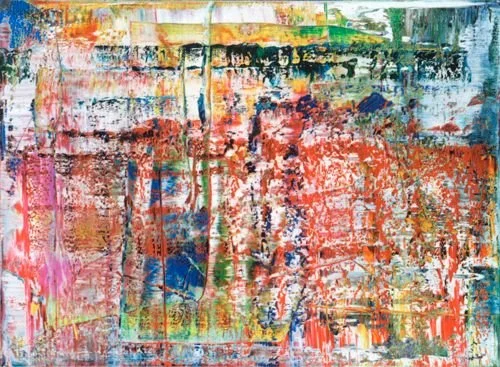
Gerhardt Richter, Abstract Bild, "724-4" (1990)
Then Richter turned that painting into an image of a painting.
He photographed or scanned it. The image was then subjected to a digital process. It was split vertically, mirrored, split again, mirrored again, and recombined. Two became four, four became eight, eight became sixteen, and so on, until the complex surface of the original painting had been reduced to thousands of thin bands of color. Those bands were then stretched horizontally.
What had been paint became data. What had been gesture became a line. What had been a surface became a sequence.
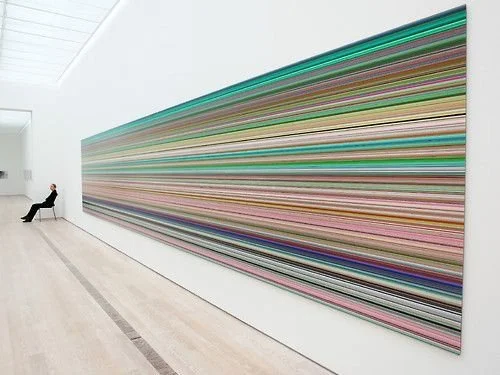
The final works are not oil on canvas. They are digital prints on paper, mounted between aluminum and Perspex, often using the highly polished process known as Diasec. Perspex is acrylic glass, what we would usually call Plexiglas. The print is sealed behind this hard, glossy, reflective surface. The result is luminous and impersonal. There is no canvas weave, no drag of the brush, no absorbent ground, no place where paint has sunk in or caught on a ridge. The image has a body, but it is not a painterly body.
This is why I find the Strip works so interesting in relation to stripes.
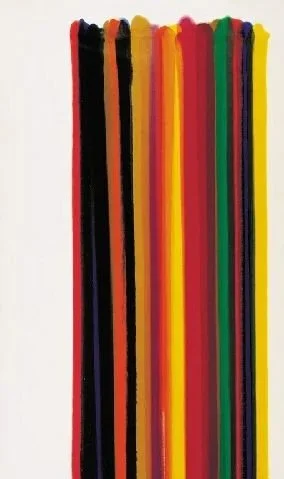
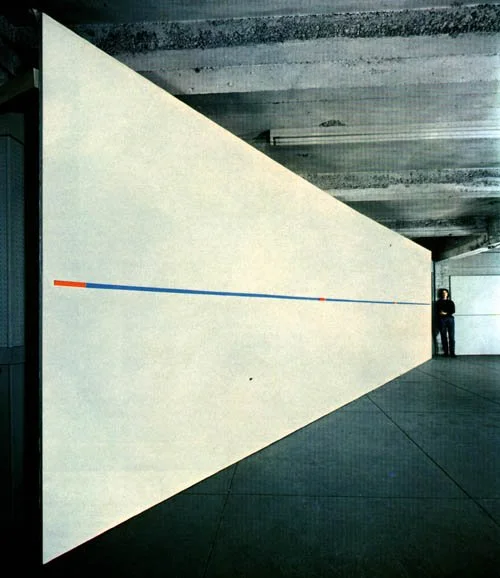
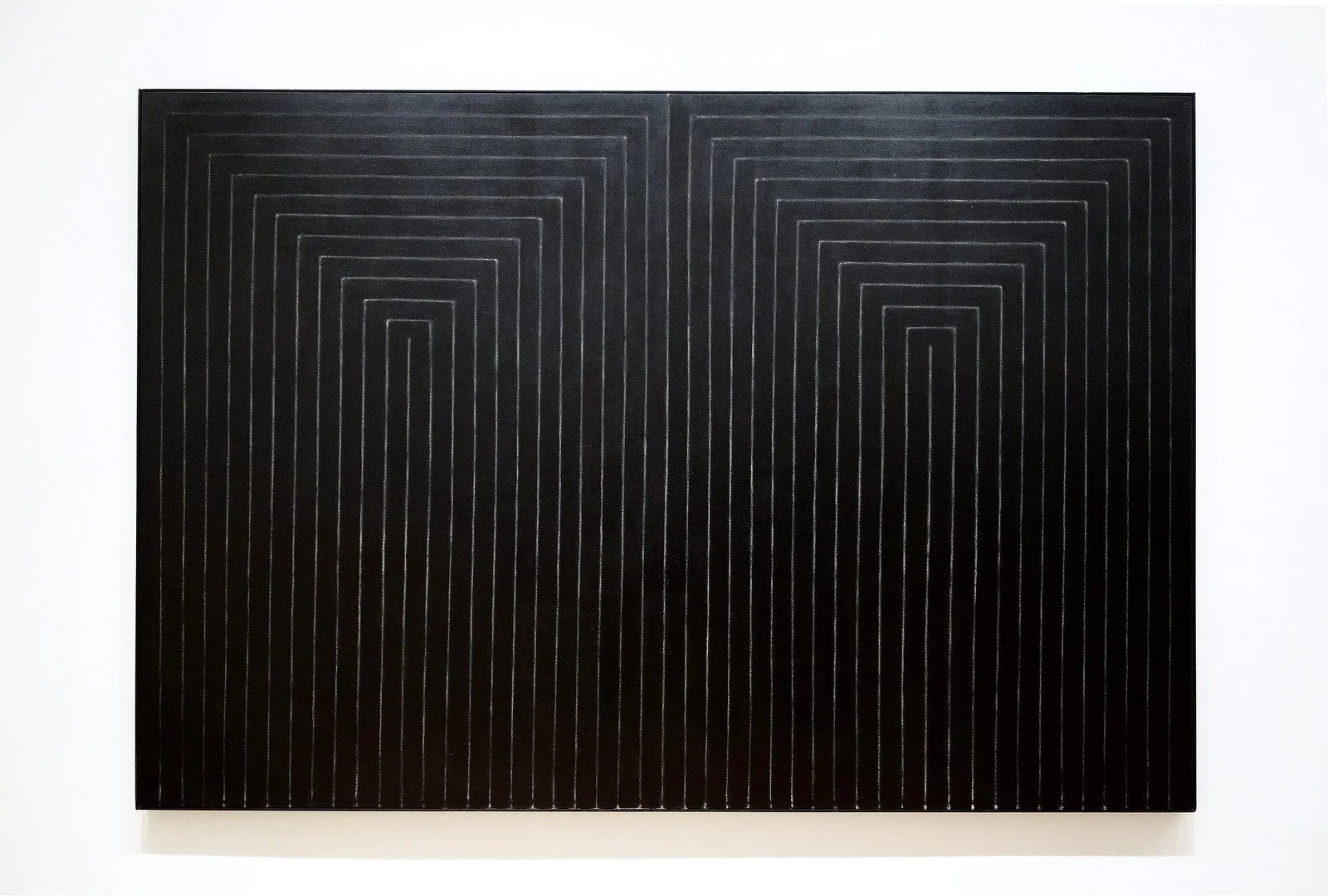
Barnett Newman’s zips are acts of placement. Agnes Martin’s lines are acts of attention. Bridget Riley’s stripes are optical instruments, made through calculation and adjustment, but still held in relation to the eye and the hand. Kenneth Noland’s bands are questions of color, proportion, interval, and the behavior of stained paint on raw canvas.
Richter’s stripes come from somewhere else.
They are not built. They are extracted.
They are what remains after a painting has been photographed, divided, mirrored, repeated, flattened, and stretched beyond recognition. The original painting has not been developed into stripes. It has been dismantled into them.
This is where the English title becomes interesting. Richter calls them Strips, not Stripes. A strip is a narrow band, but “to strip” is also a verb. To strip something is to remove from it. To take away. To reduce. To expose. The Strip works are not only images made of bands of color. They are paintings stripped of painting.
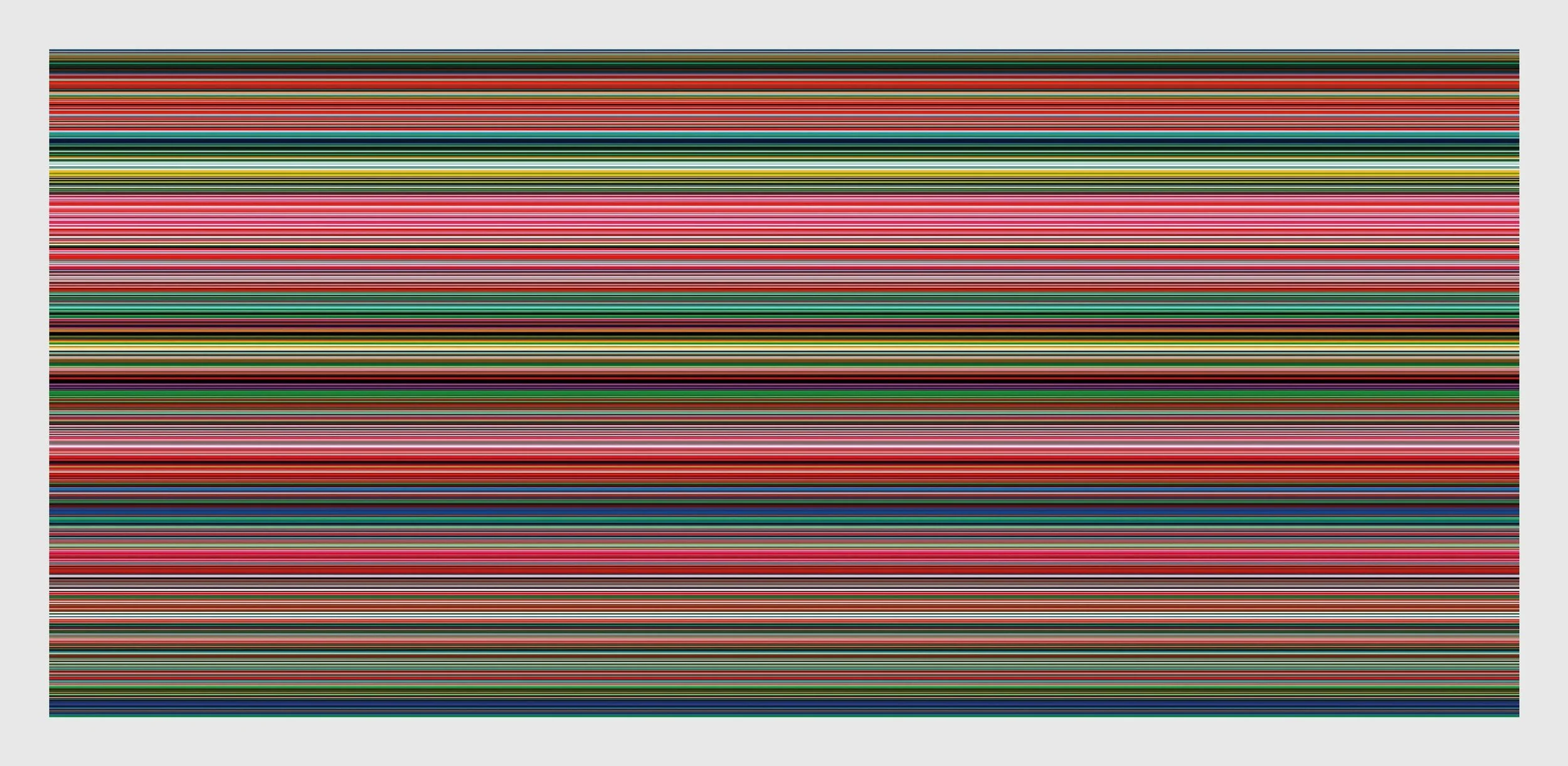
Gerhardt Richter, Strip, 2011
And yet they are beautiful.
That is the uncomfortable part. They are not merely diagrams or exercises. At a large scale, they can produce a physical sensation close to optical vibration. Color flickers. Bands compress and expand. The eye moves along them, unable to settle. In that sense, they may meet Bridget Riley on the retina, although they arrive there by the opposite route. Riley builds optical instability through disciplined visual construction. Richter arrives at it by submitting a painting to a system.
I keep coming back to the question of what these works do not do.
They do not ask us to admire touch. They do not let us stand in front of the painted surface and imagine the artist’s body moving in relation to our own. They do not offer the stripe as a decision made directly on the canvas. They do not make painting more intimate. They make it more remote.
But they also do something that could only come from painting. The source is still there, even if we cannot see it. Somewhere behind every band is the 1990 abstract painting, with its dragged pigment and its accumulated decisions. The body has not vanished. It has been translated into a code so extreme that it no longer looks like a body.
That seems very Richter to me.
His work keeps asking what happens when seeing is organized by systems larger than the eye: the photograph, the archive, the state, the market, the computer. He does not trust images, but he cannot leave them alone. He does not trust painting, but he keeps returning to it, or to what remains after painting has been put under pressure.
Perhaps that is why the Strip works belong in a series about stripes, but only if they are named correctly. They are not stripe paintings in the same sense as Newman, Martin, Riley, Noland, or Davis. They are a limit case. They are what happens when a painting is converted into information, and the stripe appears as the residue of that conversion.
When I think back to East Berlin, I remember the guards looking under the car with mirrors. I remember the demand that the Germans turn their heads and show their ears. I remember the sensation of identity itself becoming a surface to be inspected.
Richter’s Strip works are not about East Berlin in any direct way. I would not want to make that claim. But they come from an artist who knew what it meant to live among systems that examined, classified, and distrusted appearances. In the Strips, even painting does not get to remain itself. It is examined, divided, mirrored, reduced, and sealed behind a shining surface.
What comes out on the other side is gorgeous.
It also no longer smells of paint.
YOU MAY ALSO LIKE: